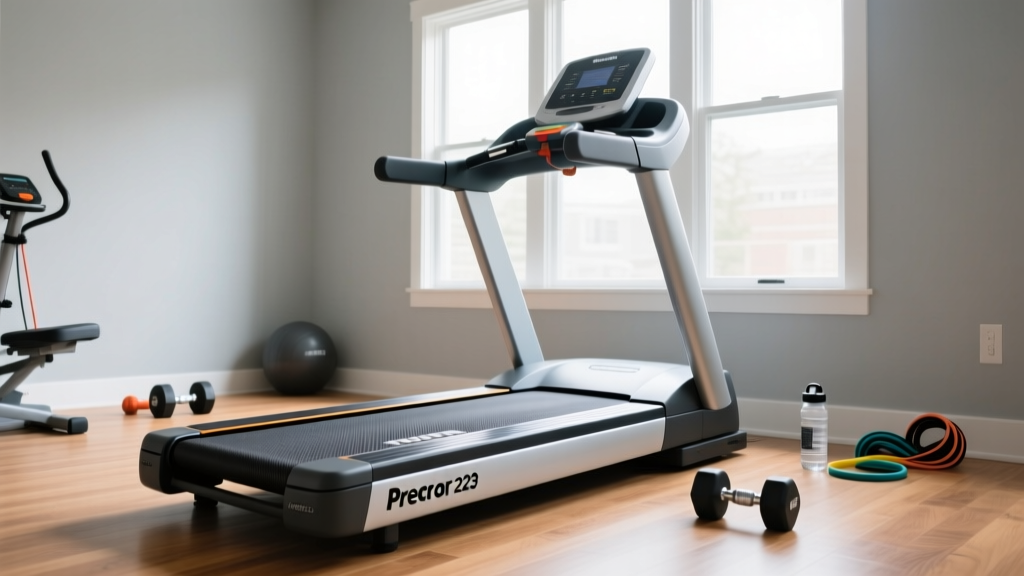
Treadmill Motor Size Guide: How the Precor TRM 223 Treadmill Compares
Discover the truth about treadmill horsepower. We benchmark the Precor TRM 223 treadmill motor to help you choose the right CHP for your home gym.

When outfitting a home gym in 2026, the spec sheet is often the first place consumers look. Yet, no single metric is more misunderstood—and more frequently manipulated by marketing departments—than treadmill horsepower. You might see budget models boasting '4.5 Peak HP,' while a light-commercial staple like the Precor TRM 223 treadmill lists a seemingly modest 3.0 HP. Why does the Precor cost significantly more on the secondary market and outlast residential models by a decade? The answer lies in the physics of continuous duty, thermal dissipation, and drivetrain synergy.
In this in-depth buying guide, we will decode treadmill motor sizing, benchmark the engineering of the Precor TRM 223 treadmill, and provide actionable frameworks to ensure your next cardio investment doesn't burn out after a year of heavy use.
The Horsepower Illusion: Peak HP vs. Continuous Duty (CHP)
The most common trap in treadmill shopping is the 'Peak HP' metric. Peak horsepower measures the absolute maximum output the motor can achieve for a fraction of a second before the thermal limiter trips or the windings melt. It is a useless metric for evaluating cardiovascular endurance equipment.
Expert Callout: Always look for CHP (Continuous Horsepower). CHP measures the motor's ability to sustain a specific power output indefinitely while maintaining safe operating temperatures. A 2.5 CHP motor will easily outperform a '4.0 Peak HP' motor during a 45-minute tempo run.Benchmarking the Precor TRM 223 Treadmill Motor
The Precor TRM 223 is a legendary light-commercial treadmill. At its core is a 3.0 HP Continuous Duty DC motor. On paper, a 3.0 CHP motor sounds standard for the $1,000 to $1,500 residential tier. However, the TRM 223's motor is engineered for an entirely different duty cycle.
Flywheel Mass and Kinetic Storage
Residential treadmills typically use lightweight flywheels (6 to 9 lbs) to keep shipping costs down. The Precor TRM 223 utilizes a heavily weighted, dynamically balanced flywheel. When your foot strikes the belt, it creates a momentary deceleration spike. A heavy flywheel stores kinetic energy, smoothing out these spikes and preventing the motor from having to draw massive, heat-generating amps to re-accelerate the belt with every single footfall.
Thermal Dissipation and Internal Cooling
Commercial and light-commercial motors feature larger copper windings and advanced internal fan designs. The TRM 223's motor housing is designed to pull ambient air across the stator, keeping internal temperatures well below the 104°F (40°C) threshold where DC motor efficiency begins to degrade and thermal shutoffs engage.
Biomechanics and Motor Strain: The Footstrike Factor
Understanding motor sizing requires understanding human biomechanics. According to biomechanical analyses published in the National Center for Biotechnology Information (NCBI), the ground reaction forces during treadmill running differ subtly from overground running, placing unique, repetitive torque demands on a treadmill's drive system at the exact moment of footstrike.
When a 220-lb runner strikes a treadmill belt moving at 8 mph, the motor experiences a micro-second braking force. If the motor lacks the torque (and the flywheel lacks the mass) to instantly overcome this braking force, the belt 'hiccups.' Over thousands of strides, these micro-hiccups generate immense heat in the motor's lower control board and windings. The American Heart Association recommends sustained, vigorous aerobic activity for cardiovascular health, meaning your machine must handle continuous, high-impact torque without thermal degradation.
Sizing Matrix: User Weight, Speed, and Required CHP
Use the following matrix to determine the minimum Continuous Horsepower (CHP) required for your specific use case. Undersizing your motor is the fastest way to void your warranty and burn out your lower control board.
| User Weight | Primary Use: Walking (Under 4 mph) | Primary Use: Jogging (4 - 7 mph) | Primary Use: Running (7+ mph) |
|---|---|---|---|
| Under 150 lbs | 2.0 CHP | 2.5 CHP | 3.0 CHP |
| 150 - 200 lbs | 2.5 CHP | 3.0 CHP | 3.5 CHP |
| 200 - 250 lbs | 3.0 CHP | 3.5 CHP | 4.0 CHP |
| 250+ lbs | 3.5 CHP | 4.0 CHP | 4.5+ CHP (Commercial) |
Note: The Precor TRM 223's 3.0 CHP motor, due to its commercial-grade torque and flywheel, effectively performs like a 3.5 CHP residential motor, safely supporting users up to 350 lbs during sustained running.
The Hidden Variable: Deck Friction and Amp Draw
A motor is only as efficient as the drivetrain it is pushing. The primary cause of premature motor death is not the motor itself, but deck friction. When a user runs, the belt slides over the wooden deck. If the deck lacks proper lubrication or the belt is over-tensioned, the friction coefficient spikes.
The Amp Draw Test: A healthy 3.0 CHP treadmill motor running at 6 mph with no user on the belt should draw between 2 to 4 amps. With a 180-lb user, it should draw between 6 to 10 amps. If your machine is drawing 14+ amps under load, your deck is dry or your belt is over-tensioned. The motor is working twice as hard, generating excess heat, and inching closer to thermal failure.
The Precor TRM 223 mitigates this through its Ground Effects Impact Control (GFX) system. The GFX deck is engineered with precise flex zones that reduce the static friction coefficient between the belt and the deck, meaning the 3.0 HP motor draws fewer amps per stride compared to a standard residential MDF deck.
2026 Market Comparison: Commercial vs. Residential Motors
How does the Precor TRM 223 stack up against modern 2026 residential heavyweights? Below is a comparison of motor specifications, cooling, and current market pricing.
| Model | Motor Rating | Flywheel / Cooling | Deck System | Est. 2026 Price |
|---|---|---|---|---|
| Precor TRM 223 | 3.0 CHP (Commercial) | Heavy Mass / High-Airflow | GFX Impact Control | $2,800 - $3,500 (Refurb) |
| Sole F80 | 3.5 CHP (Residential) | Standard Mass / Standard Fan | Cushion Flex | $999 (New) |
| NordicTrack 1750 | 3.5 CHP (Residential) | Standard Mass / Standard Fan | Runners Flex | $1,999 (New) |
| Life Fitness F3 | 3.0 HP (MagnaDrive) | Heavy Mass / Commercial | FlexDeck | $3,299 (New) |
Real-World Motor Failure Modes & Troubleshooting
Even the best motors fail if subjected to edge-case abuses. If you are buying a used Precor TRM 223 or maintaining a new residential unit, watch for these specific failure modes:
- Carbon Brush Degradation: DC motors rely on carbon brushes to transfer electricity to the commutator. Over 5,000+ miles, these brushes wear down. If your treadmill suddenly loses power or emits a faint ozone smell, the brushes may be failing. On commercial models like the TRM 223, these are easily accessible and replaceable for under $30.
- Lower Control Board Capacitor Blowouts: The start capacitor on the lower board takes a massive hit every time the belt accelerates from 0 to 3 mph. If you press 'Start' and the belt jerks violently or the console reboots, the board's capacitors are likely swollen or blown. This is often a symptom of a chronically over-tensioned belt, not a bad board.
- Thermal Cutoff Trips: Most treadmill motors have a thermal breaker switch directly on the motor housing. If you are 30 minutes into a long run and the machine simply powers down without an error code, wait 15 minutes. If it resets and works, your motor is overheating due to deck friction or inadequate room ventilation. Ensure at least 12 inches of clearance behind the motor hood for exhaust.
Final Verdict: Sizing Your Next Treadmill Purchase
When evaluating treadmill motors, ignore the 'Peak HP' stickers and look closely at the machine's total weight, flywheel mass, and deck engineering. The Precor TRM 223 treadmill remains a gold standard in 2026 because it proves that a meticulously engineered 3.0 CHP commercial motor will vastly outperform a bloated 4.0 Peak HP residential motor.
For walkers and light joggers under 200 lbs, a high-quality 2.5 to 3.0 CHP residential machine (like the Sole F80) is perfectly adequate. However, if you are a serious runner, weigh over 220 lbs, or plan on logging more than 15 miles a week, investing in a commercial-duty drivetrain like the Precor TRM 223 or Life Fitness F3 is not just a luxury—it is a mechanical necessity to prevent thermal degradation and ensure a decade of reliable cardiovascular training.
More gear to consider
All reviews
Amazon Commercial Dad on Treadmill Actor & 2026 Walking Pad Trends
Space-Saving Layouts & UREVO Cyberpad Smart Treadmill Belt Care
Space-Saving Cardio: Katie Austin Treadmill Reviews & Compact Picks

Stair Climber Guide 2026: How Long Does 10k Steps Take on Treadmill?

Can You Use a Treadmill on Carpet? Sole F80 vs NordicTrack 1750
