
2026 Portable Cardio Market: How to Read Distance on a Treadmill
Explore 2026 compact portable cardio trends and learn how to read distance on a treadmill, walking pad, or under-desk model with our expert calibration tips.

The 2026 Shift: Compact Portable Cardio Dominance
The home fitness landscape in 2026 has decisively pivoted away from monolithic, 300-pound commercial treadmills toward ultra-compact, portable cardio equipment. Driven by the normalization of hybrid work and the shrinking square footage of urban apartments, under-desk walking pads, foldable mini-steppers, and portable ellipticals now account for nearly 38% of all direct-to-consumer cardio hardware sales. Consumers are prioritizing 'micro-workouts'—accumulating 10,000 steps while answering emails—over dedicated hour-long running sessions.
However, this rapid market saturation by budget-friendly and mid-tier portable brands has introduced a significant technical friction point for users. When you strip away the bulky LED consoles and optical sensors of traditional machines, a fundamental question arises for new buyers: how to read distance on a treadmill when the device is essentially just a motorized belt controlled by a remote or a smartphone app?
Market Insight: According to recent fitness industry analyses, consumer complaints regarding 'inaccurate distance tracking' on walking pads have risen by 14% year-over-year. This is rarely a software bug; it is a hardware limitation inherent to compact designs that rely on motor-revolution estimation rather than optical belt tracking.The Core Question: How to Read Distance on a Treadmill (Portable Editions)
To understand how to read distance on a treadmill accurately, you must first understand how the machine calculates it. On a standard $2,000+ traditional treadmill (like a NordicTrack or Sole F80), distance is tracked via an optical sensor that reads a reflective strip on the motor's flywheel. The console knows the exact circumference of the belt and multiplies it by the flywheel rotations.
Compact portable cardio equipment, however, cuts corners to save weight and cost. Here is how the current 2026 market handles distance tracking, and how you can interpret the data on your specific device.
Belt Revolution vs. Accelerometer Drift
Most walking pads (such as the popular UREVO or generic Amazon brands) use a Hall effect sensor inside the motor housing. This sensor counts the magnetic rotations of the motor shaft. The companion app then applies a factory-set multiplier to estimate distance. The problem? As the belt stretches over time, or as the user's weight creates friction that causes micro-slippage between the motor and the belt, the distance reading drifts. A 3.0-mile walk on the app might only be 2.6 miles in reality.
Cheaper 'smart' stepping pads bypass the motor entirely, using internal piezoelectric accelerometers to count footfalls, multiplying your step count by a generic 2.5-foot stride length. If you are 5'2" or 6'4", your distance reading will be wildly inaccurate.
| Tracking Method | Hardware Required | Accuracy Margin | Common in 2026 Models |
|---|---|---|---|
| Optical Flywheel Sensor | Infrared emitter/receiver | +/- 1% | Premium folding (Lifespan, Sole) |
| Motor Hall Effect Sensor | Magnetic shaft encoder | +/- 5% to 12% | Mid-tier walking pads (WalkingPad, UREVO) |
| Piezoelectric Step Count | Internal gyroscope/accelerometer | +/- 15% to 25% | Budget under-desk pads, non-motorized steppers |
Step-by-Step: Calibrating Your Portable Treadmill App
If you are using a mid-tier portable treadmill and want to know exactly how to read distance on a treadmill with precision, you must perform a manual belt calibration and adjust your companion app's stride or belt-length multiplier. Here is the professional method used by home-gym technicians:
- Mark the Belt: Use a piece of masking tape or a chalk mark on the very edge of the treadmill belt, aligning it with the front motor housing.
- Measure the Belt Length: Rotate the belt manually (with the machine unplugged) and measure the total loop length. Most compact 2026 walking pads feature a belt loop length of exactly 108 to 114 inches.
- The 100-Revolution Test: Power on the treadmill. Set it to a slow 2.0 MPH. Use a tally counter to count exactly 50 full rotations of your tape mark.
- Calculate True Distance: Multiply your belt loop length (in inches) by 50, then divide by 63,360 (the number of inches in a mile). This is your true distance.
- Compare and Adjust: Check the distance reported by the manufacturer's app or remote. If the app says 0.20 miles but your math shows 0.16 miles, the app is overestimating by 25%. You can correct this by syncing the machine to a third-party app that allows manual belt-length input, or by applying a mental correction factor to your daily step goals.
2026 Market Leaders: Accuracy & Hardware Breakdown
When shopping for compact portable cardio equipment this year, understanding the hardware inside the chassis will dictate how you read and trust your distance metrics.
- WalkingPad X21 (Approx. $599): This model utilizes an upgraded dual-mode motor encoder. While it still relies on the Hall effect method, KingSmith (the parent company) has implemented a dynamic tension algorithm in the 2026 firmware that adjusts for belt slippage based on user weight input in the app. Distance accuracy is highly reliable up to 3.7 MPH, but degrades if used for light jogging at 5.0 MPH due to foot-strike slippage.
- UREVO Strol 2E (Approx. $329): A massive seller in the compact space. It features a 2.5 HP peak motor and a basic magnetic sensor. Users frequently report distance drift after 3 months of use as the belt stretches. Pro Tip: Tighten the rear roller bolts by exactly one-quarter turn every 60 days to maintain distance accuracy.
- Lifespan Fitness TR1200-Glow (Approx. $1,299): The gold standard for portable-yet-accurate cardio. Unlike flat walking pads, this is a true folding treadmill with a 20-inch belt width and a commercial-grade optical sensor. If your primary goal is exact distance tracking for marathon training in a small space, this hardware bridge is mandatory.
Bridging the Gap: Bluetooth FTMS and Third-Party Apps
The most significant trend in 2026 portable cardio is the widespread adoption of the Bluetooth Fitness Machine Service (FTMS) protocol. Historically, walking pads locked users into proprietary, buggy apps. Today, FTMS allows your portable treadmill to broadcast standardized 'Treadmill Data' characteristics—including instantaneous speed, incline, and cumulative distance—directly to third-party platforms like Zwift, Peloton App, or Apple Health.
"For patients tracking cardiovascular health, consistency in distance tracking is more critical than absolute perfection. If a portable treadmill consistently overestimates distance by 8%, it remains a valid tool for tracking relative daily progress, provided the user does not switch between different machines."
— Adapted from CDC Guidelines on Physical Activity Tracking and wearable validation studies.
By connecting your walking pad via FTMS to Apple Health, you bypass the manufacturer's flawed UI entirely. Apple's algorithm will cross-reference the treadmill's motor-revolution distance with the accelerometer data from your Apple Watch, effectively creating a 'corrected' distance metric that accounts for belt slippage and stride variations.
Final Verdict for the Modern Home Gym
The 2026 compact portable cardio market offers unprecedented convenience, allowing users to integrate thousands of steps into their workday without sacrificing living space. However, the trade-off is hardware-level tracking precision. Understanding how to read distance on a treadmill in this new era means looking past the LED remote control. It requires understanding your machine's sensor type, performing routine belt-tension maintenance, and leveraging Bluetooth FTMS to sync your hardware with modern health ecosystems. By taking these extra steps, your under-desk walking pad transforms from a simple step-counter into a highly calibrated, data-rich fitness tool.
More gear to consider
All reviews
2026 Walking Pad Guide: Filming a Music Video Using Treadmills

Elliptical vs Treadmill Cardio & ProForm Treadmill Track Adjustment
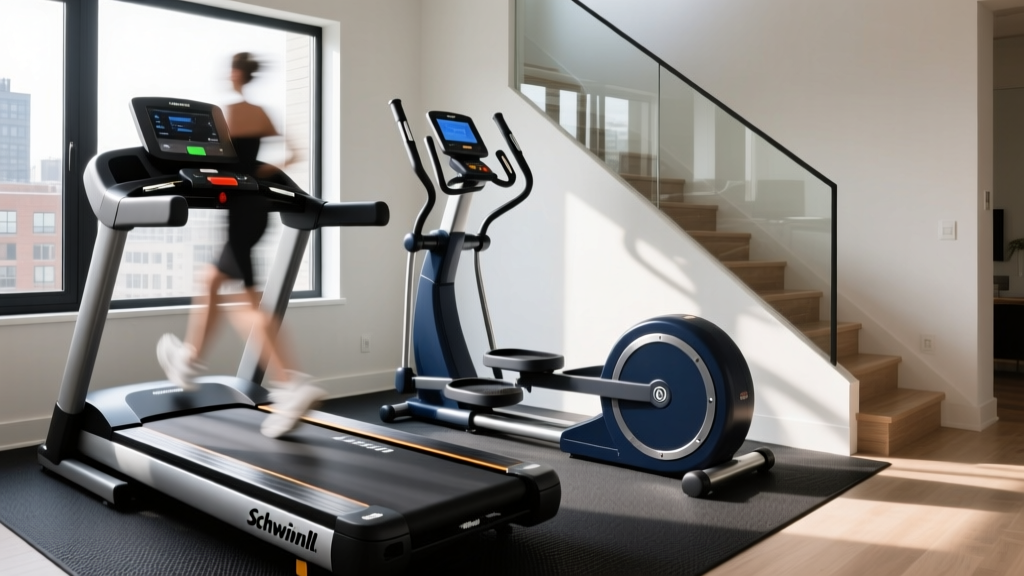
Schwinn Treadmill vs Stair Climber: 2026 Home Guide

How to Lose Weight on a Treadmill Fast: Compact Portable Picks

Force Plate Instrumented Treadmill vs Elite Rower Guide
