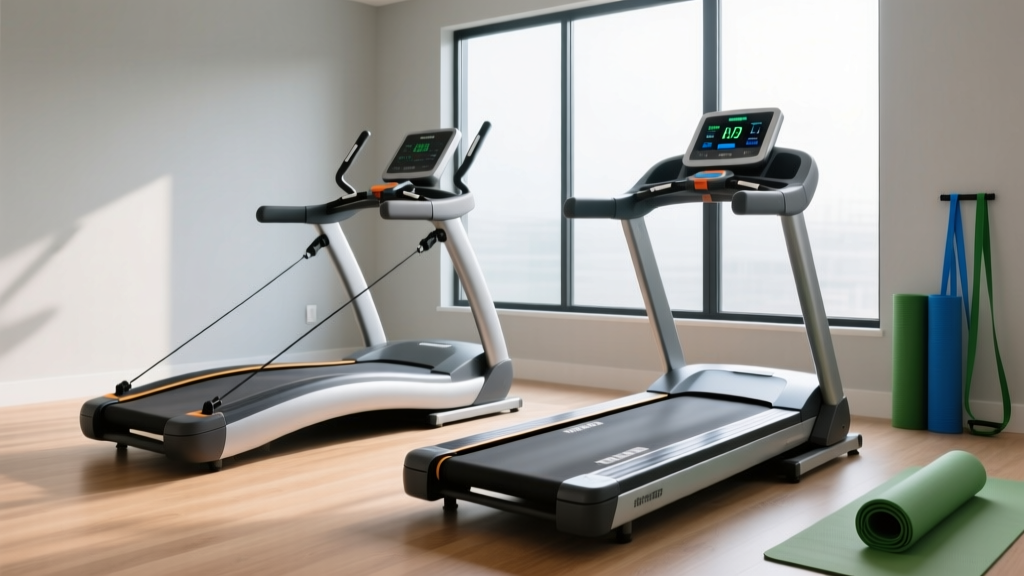
Setup Guide: Curved vs Motorized Treadmill Workouts
Master your home gym installation. Compare curved manual vs motorized treadmill setup, space needs, and calibration for optimal treadmill workouts.

The Foundation: Spatial Mapping and Clearance Protocols
When preparing your home gym for high-intensity treadmill workouts, the physical installation dictates both safety and performance. The decision between a curved manual treadmill (like the TrueForm Trainer or AssaultRunner Elite) and a traditional motorized model (like the Sole F80 or NordicTrack Commercial 1750) fundamentally alters your spatial requirements. Before unboxing, you must map your room's dimensions against the machine's operational footprint.
According to safety guidelines outlined by the Consumer Product Safety Commission (CPSC), motorized treadmills require a minimum of 24 to 36 inches of clearance behind the machine. This rear fall zone is non-negotiable; if a user slips on a motorized belt moving at 10 mph, the machine will continue to propel them backward until the safety key is pulled. Curved manual treadmills, however, are self-paced. Because the belt only moves when you push it, the rear clearance requirement drops to a mere 12 inches for basic ventilation and maintenance access.
Conversely, curved treadmills demand strict vertical clearance. The curved deck geometry elevates the running surface by 3.5 to 5 inches compared to a flat motorized deck. If you are placing a TrueForm Trainer in a basement with a standard 8-foot ceiling, a 6-foot-2 athlete will have less than 18 inches of headroom during the flight phase of a sprint, creating a severe head-strike hazard.
Unboxing and Assembly: The Heavy Lifting Reality
The physical assembly of these two machine archetypes requires entirely different approaches. Motorized treadmills are typically shipped in two main pieces: the pre-assembled deck/motor housing, and the folding upright console. Assembly primarily involves bolting the uprights to the deck and routing the delicate console data cables through the steel tubing. Pinching these wires during assembly is the number one cause of Day-1 console failures.
Curved manual treadmills arrive as a single, massively dense unit. The TrueForm Trainer weighs approximately 350 lbs, while the AssaultRunner Elite sits around 280 lbs. Because they do not fold and lack wheels for easy pivoting, moving a curved treadmill from the driveway to the gym room requires a two-person team and a specialized appliance dolly with stair-climbing tracks.
⚠️ Installation Warning: Never attempt to tilt a motorized treadmill onto its side to clean beneath it or adjust leveling feet without securing the hydraulic folding latch. In 2026, heavy-duty incline motors add significant top-heavy weight to the front roller, making unsecured tilted decks a major crush hazard.Motorized Treadmill Setup: Calibration and Incline Zeroing
Once a motorized treadmill is positioned, the setup is not complete until the belt tension and incline sensors are calibrated. Out of the box, manufacturers often over-tighten the running belt to prevent shipping slippage. Running a 12 mph sprint interval on an over-tensioned belt will cause the motor's amp draw to spike, eventually tripping your home's circuit breaker or burning out the drive motor's control board.
The Belt Lift Test
- Power off and unplug the machine.
- Locate the center of the running deck and slide your fingers under the edge of the belt.
- Lift the belt. It should rise exactly 2 to 3 inches off the wooden deck.
- If it is tighter, use a 3/16-inch Allen wrench (standard on most Sole and Horizon models) to turn both rear roller adjustment bolts counter-clockwise by exactly one-quarter turn.
- Walk the belt manually to ensure it remains centered on the track.
Next, perform an incline zero-calibration. Most modern motorized treadmills require you to hold the 'Incline Up' and 'Speed Down' buttons simultaneously upon booting to enter engineering mode. This forces the incline lift motor to find its absolute mechanical floor, ensuring that when your treadmill workouts call for a 0% grade, you aren't secretly running on a 0.5% micro-incline.
Curved Manual Treadmill Setup: Slat Alignment and Tension
Curved treadmills bypass electrical calibration in favor of mechanical precision. The running surface consists of vulcanized rubber slats attached to a continuous Kevlar-reinforced belt that glides over a UHMW (Ultra-High Molecular Weight) polyethylene track. If the belt drifts laterally during your treadmill workouts, the friction will generate a high-pitched squeak and destroy the slat guides.
Biomechanical studies highlighted by the American Council on Exercise (ACE) suggest that curved treadmills significantly reduce joint impact by encouraging a forefoot strike. However, this benefit is entirely negated if the sled track is improperly tensioned, forcing the user to fight lateral drag.
Adjusting the Magnetic Resistance
Models like the AssaultRunner Elite feature a magnetic resistance knob. During initial setup, you must calibrate this resistance to match your biomechanics. If the resistance is set too high, the curve's 'sweet spot' shifts backward, forcing you to over-stride to maintain momentum. Use a 10mm socket wrench to loosen the resistance housing, align the magnetic bracket to the factory laser-etched marker on the chassis, and retighten. This ensures the push-curve transition feels seamless during interval training.
Installation & Footprint Comparison Matrix
Use the following matrix to determine which machine aligns with your spatial and electrical infrastructure as of 2026 market standards.
| Feature | Motorized (e.g., Sole F80) | Curved Manual (e.g., TrueForm Trainer) |
|---|---|---|
| Average Unit Weight | 280 lbs | 350 lbs |
| Rear Safety Clearance | 24 - 36 Inches (Mandatory) | 12 Inches (Ventilation only) |
| Vertical Deck Elevation | 7 - 9 Inches | 11 - 14 Inches |
| Power Requirements | Dedicated 15-Amp / 20-Amp Circuit | None (Can be placed outdoors/garage) |
| Primary Setup Tool | 3/16' Allen Wrench, Phillips Head | 10mm Socket, 15mm Wrench |
| 2026 Average Retail Price | $1,199 - $2,499 | $2,999 - $4,500 |
Optimizing Flooring for Biomechanical Feedback
The surface beneath your treadmill drastically alters the acoustic output and joint feedback of your treadmill workouts. Never place either machine directly on hardwood or luxury vinyl plank (LVP) flooring; the point-load weight of the leveling feet will permanently dent the subfloor, and sweat will warp the wood seams.
For motorized treadmills, a 3/8-inch thick high-density rubber mat is sufficient. This thickness absorbs the harmonic vibration generated by the incline motor and the rhythmic impact of footfalls, preventing the noise from transferring into the floor joists.
For curved manual treadmills, you must upgrade to a 1/2-inch or 3/4-inch thick horse-stall mat. Because curved treadmills lack a heavy steel motor at the front to anchor them, the aggressive horizontal push-off forces generated during sprint intervals can cause the entire 350 lb frame to 'walk' across a slippery rubber mat. A thicker, heavier mat with a high coefficient of friction grips the floor and locks the sled in place.
Frequently Asked Setup Questions
Q: Can I install a curved manual treadmill in an unheated garage?
A: Yes, but with a caveat. The UHMW polyethylene guide tracks on curved treadmills become stiff and brittle in temperatures below 40°F (4°C). If you live in a climate with freezing winters, you must install a space heater to keep the garage above 45°F, otherwise, the slat belt will stutter and jerk during the first five minutes of your workout until friction warms the track.
Q: Do I need to lubricate a curved treadmill belt upon initial setup?
A: No. Unlike motorized treadmills that require a silicone-based liquid lubricant applied between the belt and the wooden deck, curved treadmills use dry UHMW tracks. Applying liquid silicone to a curved track will attract dust and hair, creating a gritty paste that ruins the slat guides. Only use a dry PTFE (Teflon) spray on the side guide rails if the manufacturer explicitly recommends it in the 2026 owner's manual.
Q: Why does my motorized treadmill trip the breaker during sprint intervals?
A: This is almost always a setup error related to circuit sharing. A motorized treadmill under heavy load (e.g., a 200 lb runner at 10 mph) can draw up to 15 amps. If your treadmill is plugged into a circuit shared with a space heater, a window AC unit, or even a high-draw refrigerator compressor, the cumulative amp draw will trip a standard 15-amp residential breaker. Hire an electrician to install a dedicated 20-amp line for your fitness equipment.
More gear to consider
All reviews
What Does Pace Mean on a Treadmill? Plus Cardio Noise Comparisons

Elliptical vs Treadmill: Budget & Treadmill Stress Test Procedure

Treadmill Sprint Intervals: Buying Guide & Setup Walkthrough
PaceMaster ProSelect Treadmill: 2026 Feature Buying Guide

Hitting 6 mph on a Treadmill: Top Folding Picks for Small Spaces
