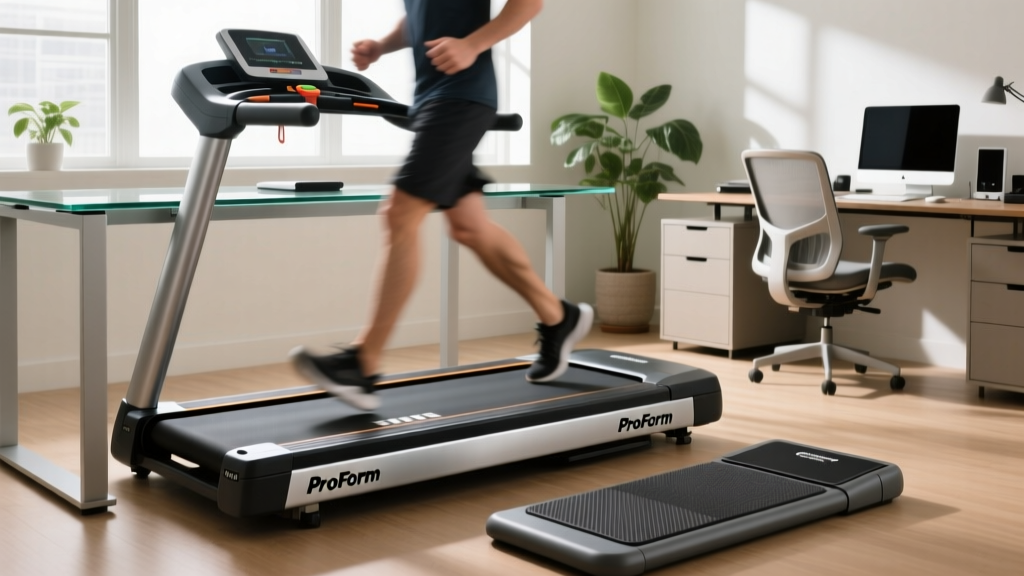
NXSCI Treadmill Guide: Curved vs Motorized Step-by-Step
Compare the NXSCI treadmill in curved manual vs motorized models. A beginner-friendly, step-by-step guide to choosing the right home cardio machine for 2026.

Introduction: Navigating the NXSCI Treadmill Lineup in 2026
When outfitting a home gym, the debate between curved manual treadmills and traditional motorized models is one of the most common dilemmas for beginners. Historically, curved treadmills were luxury items reserved for elite athletic facilities, often costing upwards of $5,000. However, the market has shifted dramatically. Brands like NXSCI have disrupted the space by offering highly accessible, budget-friendly alternatives. In 2026, an NXSCI treadmill can be found in two primary camps: their non-motorized curved slat models (typically priced between $450 and $599) and their folding motorized units (ranging from $250 to $350).
But which one is actually right for your fitness journey? According to the CDC guidelines, adults need at least 150 minutes of moderate-intensity aerobic activity per week, making the reliability and comfort of your machine paramount. This beginner-friendly, step-by-step guide will break down the biomechanics, spatial requirements, and real-world costs of the NXSCI curved manual treadmill versus its motorized counterparts, ensuring you make an informed, sweat-proof investment.
Step 1: Understand the Core Mechanics and Power Source
Before stepping onto the belt, you must understand how each machine generates movement. This fundamental difference dictates everything from your running form to your electricity bill.
The NXSCI Curved Manual Treadmill
The curved manual treadmill is entirely user-powered. It features a concave running surface made of individual rubber or composite slats that glide on ball bearings. There is no motor. Instead, the machine uses magnetic resistance and the natural physics of your stride. When you push down and back on the front curve of the belt, your kinetic energy drives the treadmill. To slow down, you simply shift your weight toward the back of the curve, reducing the belt's momentum.
The NXSCI Motorized Treadmill
Traditional motorized models, like the NXSCI folding series, rely on a continuous horsepower (CHP) motor—usually between 1.5 and 2.5 CHP for home models. The motor turns a front roller, which pulls a continuous PVC or multi-ply belt over a lubricated wooden or MDF deck. You dictate the speed via a digital console, and the machine forces you to keep up with the belt's predetermined pace.
Beginner Insight: If you experience frequent power outages or want to place your treadmill in a garage or patio without easy access to grounded outlets, the user-powered NXSCI curved model offers ultimate placement freedom.Step 2: Compare Biomechanics and Muscle Activation
The shape and power source of your treadmill drastically alter how your muscles fire. Research highlighted by the American Council on Exercise (ACE) indicates that curved treadmills significantly increase posterior chain engagement compared to flat, motorized belts.
| Feature | NXSCI Curved Manual | NXSCI Motorized (Flat) |
|---|---|---|
| Primary Muscle Focus | Glutes, hamstrings, calves (Posterior chain) | Quadriceps, hip flexors (Anterior chain) |
| Foot Strike Pattern | Encourages midfoot/forefoot strike | Often encourages heel striking |
| Caloric Expenditure | Up to 30% higher at the same perceived pace | Standard baseline caloric burn |
| Joint Impact | Lower impact (slats absorb shock, no jarring heel strikes) | Moderate impact (depends heavily on deck cushioning) |
| Pacing Control | Self-regulated (you are the motor) | Machine-regulated (console sets the pace) |
Because you must physically pull the curved belt backward with every stride, the NXSCI curved treadmill recruits more muscle fibers in your hamstrings and glutes. This makes it an exceptional tool for runners looking to improve their sprint mechanics and reduce the risk of quad-dominant overuse injuries.
Step 3: Evaluate Space, Noise, and Setup Constraints
Beginners often overlook the acoustic and spatial footprint of their cardio equipment until it is assembled in their living room. Let us look at the hard data regarding the physical footprint and noise profiles of both NXSCI options.
Dimensions and Weight
- Curved Manual: Typically measures around 65 inches long by 32 inches wide. It is a fixed, non-folding frame weighing roughly 120 to 145 lbs. You must dedicate a permanent 15-square-foot area for this machine.
- Motorized Folding: Usually measures 60 inches long by 28 inches wide when in use, but folds down to a vertical footprint of roughly 25 by 28 inches. Weighing between 90 and 110 lbs, it often includes transport wheels for easy relocation.
The Noise Factor
If you live in an apartment or have sleeping family members, noise is a critical metric. The motorized NXSCI treadmill generates a baseline hum from the motor (around 55-60 decibels), which spikes to 70-75 decibels when your feet strike the belt at a running pace. Conversely, the curved manual treadmill has zero motor noise. The only sound is the dull thud of footfalls on rubber slats and the whir of ball bearings, usually peaking at a quiet 45-50 decibels. For early morning or late-night apartment runners, the curved model is vastly superior.
Step 4: Master Your Form (A Step-by-Step Transition Guide)
Transitioning from a motorized treadmill to a curved manual treadmill can feel jarring for the first 10 minutes. Many beginners panic because the belt does not start moving until they apply force. Follow this step-by-step protocol to master the NXSCI curved treadmill safely.
- The Mount: Step onto the side rails first. Do not step directly onto the center of the curved belt while stationary, as the extreme slope can throw off your balance.
- The Handrail Hold: Grasp the front handrails firmly. This is the only time you should hold the rails during your workout transition.
- Initiating Movement: Place your lead foot on the front downward slope of the belt. Push down and backward, similar to how you would push a heavy sled or a lawnmower.
- Finding the Sweet Spot: Once the belt is moving, step off the handrails. To maintain a steady jogging pace, stay near the apex (the highest, flattest middle point) of the curve.
- Accelerating: To sprint or run faster, lean your torso slightly forward and move your feet further down the front curve. The steeper the angle you push against, the faster the belt will spin.
- Decelerating Safely: Do not jump onto the side rails at high speeds. Instead, stand tall, shift your weight backward toward the rear upward slope, and let your feet gently drag to apply friction until the belt stops.
Expert Warning: Never hold the handrails while running on a curved treadmill. According to Mayo Clinic fitness experts, maintaining proper posture and natural arm swing is vital for core engagement and spinal alignment. Holding the rails shifts your center of gravity, negating the 30% extra calorie burn and potentially causing lower back strain.
Step 5: Analyze Long-Term Maintenance and Cost of Ownership
The initial purchase price is only half the equation. Cardio machines require upkeep, and the maintenance profiles for curved versus motorized treadmills are entirely different.
Motorized Maintenance Realities
A motorized NXSCI treadmill requires strict adherence to a lubrication schedule. You must apply 100% silicone treadmill lubricant under the belt every 3 months (or every 130 miles). Failure to do so increases friction, which forces the motor to draw more amperage, eventually burning out the motor control board—a replacement part that can cost $150 to $250. Additionally, the belt will stretch over time, requiring you to manually adjust the rear roller tension bolts every 6 to 12 months to prevent belt slipping.
Curved Manual Maintenance Realities
Because there is no motor, there is no belt friction requiring silicone lubrication. The maintenance on the NXSCI curved treadmill is largely mechanical. Every 6 months, you should inspect the slat tension. If the belt feels loose or "sluggish," you will use the included hex keys to tighten the rear tensioning bolts. Furthermore, you should periodically check the side guide wheels and ball bearings for dust buildup, wiping them down with a dry microfiber cloth to ensure a frictionless glide.
Cost Summary Matrix:• Curved Upfront Cost: $450 - $599 | 5-Year Maintenance Cost: ~$0 - $20 (bearing grease)
• Motorized Upfront Cost: $250 - $350 | 5-Year Maintenance Cost: ~$60 (lubricant) + potential $150 (control board replacement if neglected)
Final Verdict: Which NXSCI Treadmill Should You Choose?
Choosing between the curved manual and motorized NXSCI treadmill ultimately depends on your specific fitness goals, living situation, and budget.
Choose the NXSCI Curved Manual Treadmill if: You are a runner focused on improving your biomechanics, you want to maximize calorie burn in shorter 20-minute HIIT sessions, you live in an apartment where motor noise is an issue, and you prefer a zero-lubrication maintenance routine. It is an investment in athletic performance and joint longevity.
Choose the NXSCI Motorized Folding Treadmill if: You are a beginner focused on steady-state walking or light jogging, you have limited floor space and need to fold the machine away after use, you prefer the machine to dictate your pace via pre-programmed console workouts, or you are strictly bound by a sub-$350 budget.
By understanding the mechanical and biomechanical differences outlined in this guide, you can confidently select the NXSCI treadmill that aligns with your 2026 fitness resolutions, ensuring your home cardio setup remains a staple of your health routine for years to come.
More gear to consider
All reviews
2026 Cardio Trends: Air Bike vs Assault Bike & Weslo Cadence G 40

NordicTrack T Series 6.5 S Treadmill Setup & Feature Comparison

LifeSmart TM6500 PowerTouch Review: Best Compact Cardio Options 2026
2026 Draxfit Treadmill Review: Best Folding Pick for Small Spaces

ProForm 860 Quiet Treadmill vs Curved Manual: 2026 Guide