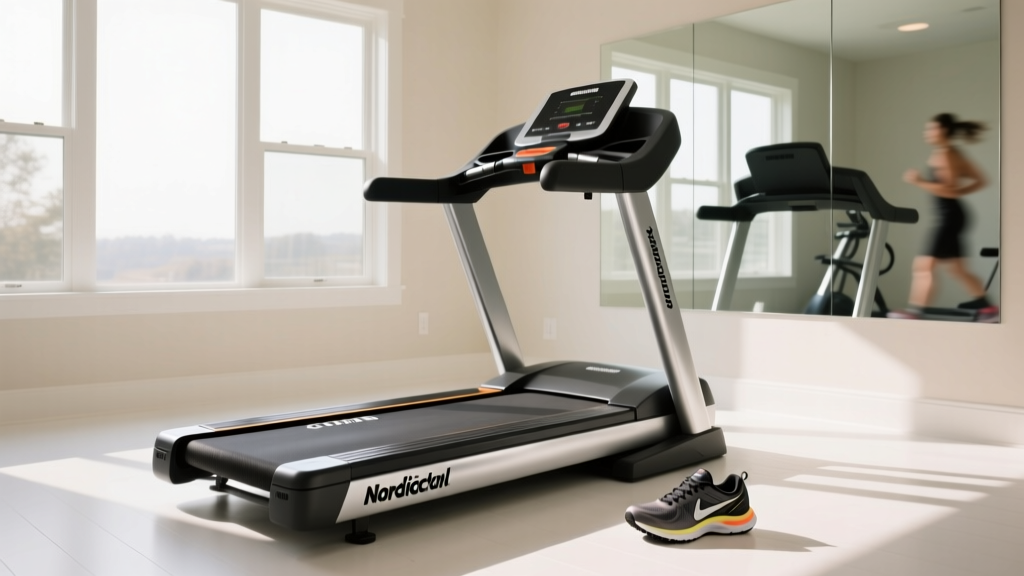
Elliptical vs Treadmill: NordicTrack C1800i Treadmill Value Analysis
We break down the elliptical vs treadmill debate by analyzing the used NordicTrack C1800i treadmill against modern 2026 ellipticals for true home gym ROI.

The Core Dilemma: Biomechanics vs. Budget
When outfitting a home gym, the elliptical vs treadmill debate usually centers on joint health and caloric expenditure. However, from a financial perspective, the conversation shifts dramatically toward total cost of ownership (TCO), depreciation, and long-term maintenance. In 2026, buyers are increasingly looking at the secondary market to acquire premium cardio equipment at a fraction of the retail cost. To understand the true value proposition of these two cardio giants, we are using a specific legacy benchmark: the NordicTrack C1800i treadmill. By analyzing the real-world costs of maintaining this discontinued but heavily circulated treadmill against purchasing a brand-new, mid-tier elliptical, we can uncover where your home gym budget is best allocated.
Case Study Baseline: The Used NordicTrack C1800i Treadmill
Originally released as a premium folding unit, the NordicTrack C1800i treadmill remains a staple on Facebook Marketplace, Craigslist, and eBay. Because NordicTrack has since transitioned to their T-Series and Commercial lines, the C1800i is strictly a secondhand asset in 2026. Yet, its hardware specifications still rival entry-level new models costing three times as much.
- Motor: 3.0 CHP Mach Z (Continuous Duty)
- Treadbelt: 20" x 60" (Commercial standard for runners over 6 feet tall)
- Incline: 0% to 15% motorized grade
- User Capacity: 350 lbs
- 2026 Used Market Price: $250 – $450 (depending on local demand and cosmetic condition)
While the upfront cost is undeniably attractive, the NordicTrack C1800i treadmill carries specific failure modes that budget-conscious buyers must anticipate. The most common mechanical failure in aging C1800i units is the stripping of the plastic gears inside the incline motor gearbox, a repair that requires a $65 replacement part and moderate DIY wrench skills. Additionally, the console ribbon cable is prone to oxidation in humid environments, leading to erratic speed jumps—a safety hazard that requires a $25 cable replacement and dielectric grease application. If you lack mechanical aptitude, the "budget" C1800i can quickly balloon into a $600+ liability once you factor in professional technician call-out fees.
The Modern Elliptical Alternative: 2026 Mid-Tier Contenders
To provide a fair value analysis, we must compare the used treadmill against a modern, reliable elliptical. The Sole E95 Elliptical (2025/2026 iteration) serves as our baseline for the "buy new" elliptical route. Retailing at $2,199, it represents a significant upfront premium over the C1800i.
- Flywheel: 32 lbs (Heavy-duty for smooth momentum)
- Stride Length: 20" adjustable
- Drive System: Front-drive with sealed cartridge bearings
- User Capacity: 400 lbs
- Warranty: Lifetime frame, 5-year parts/electronics, 2-year labor
Unlike the belt-driven, high-friction environment of a treadmill, the Sole E95 relies on magnetic resistance and sealed pivot bearings. This translates to a near-zero maintenance footprint. There is no belt to lubricate, no deck to wax, and no high-torque motor to overheat. The financial trade-off is clear: you are paying a $1,700+ premium upfront to completely eliminate the mechanical anxiety and hidden repair costs associated with aging treadmills.
Total Cost of Ownership (TCO) Matrix: 5-Year Horizon
To visualize the budget breakdown, we modeled a 5-year ownership scenario assuming 4 hours of weekly use per machine. The treadmill model assumes a used purchase requiring standard refurbishment, while the elliptical assumes a new retail purchase.
| Cost Category | Used NordicTrack C1800i Treadmill | New Sole E95 Elliptical |
|---|---|---|
| Upfront Acquisition | $350 (Average used) | $2,199 (MSRP) |
| Delivery & Assembly | $150 (Third-party movers) | $0 (Often included or DIY) |
| Preventative Maintenance | $90 (100% silicone lubricant, belt tensioning) | $15 (PTFE spray for pivot joints) |
| Expected Repairs (Years 1-5) | $180 (Incline motor, ribbon cable, roller bearings) | $0 (Covered under warranty) |
| Electricity Cost (5 Years) | $145 (Avg 1500W draw under load) | $12 (Avg 40W draw for console) |
| 5-Year Depreciation Loss | $150 (Resale value drops to ~$200) | $1,100 (Resale value ~$1,100) |
| Total 5-Year Net Cost | $765 | $3,326 |
As the matrix illustrates, the used treadmill wins purely on absolute dollar expenditure. However, the elliptical retains roughly 50% of its retail value after five years, acting as a stable physical asset, whereas the legacy treadmill is essentially a consumable good that will eventually reach the end of its mechanical life.
Hidden Costs: Footprint, Acoustics, and Floor Loading
Budgeting for cardio equipment extends beyond the price tag and repair bills; it includes the spatial and structural realities of your home. The NordicTrack C1800i treadmill weighs approximately 210 lbs. When a 200 lb user is running at 7.0 MPH, the dynamic impact force can exceed 600 lbs of localized downward pressure per stride. If you are placing this on a second-floor room with standard 16-inch joist spacing, you risk structural fatigue and severe acoustic transfer to the floor below.
Expert Insight: Treadmill impact noise is primarily low-frequency structure-borne vibration. No amount of cheap foam matting will stop this. If you live in a multi-story home or an HOA-regulated condo, the "hidden cost" of a treadmill might be the $400+ you will spend on high-density acoustic isolation pads (like the StayLock tiles) to avoid noise complaints or lease violations.
Conversely, an elliptical like the Sole E95 weighs 238 lbs, but the force distribution is entirely static. Because your feet never leave the pedals, there is zero impact shock. The acoustic footprint is limited to the low hum of the flywheel and the mechanical whir of the drive belt, making it vastly superior for shared-wall living situations, despite its larger static footprint (82" x 31" vs the treadmill's folded 73" x 30").
Caloric ROI and Joint Loading: What the Data Says
From a physiological standpoint, how do these machines compare? According to Mayo Clinic fitness experts, both machines offer excellent cardiovascular conditioning, but the biomechanical loading is drastically different. Running on a treadmill subjects the knees, hips, and lower back to impact forces equivalent to 2.5 times your body weight. The elliptical eliminates this ground-reaction force, making it the undisputed choice for users with osteoarthritis, prior meniscus repairs, or chronic plantar fasciitis.
However, if your goal is pure caloric expenditure and bone-density retention, the treadmill holds the edge. The Consumer Product Safety Commission (CPSC) and various sports medicine journals note that weight-bearing exercises (like treadmill walking or running) are critical for maintaining bone mineral density as we age. Furthermore, a 180-lb individual running at 6.0 MPH on a 5% incline will burn approximately 850 calories per hour, compared to roughly 650 calories on an elliptical at a perceived equivalent exertion level. You are essentially paying a "joint tax" for the higher caloric ROI of the treadmill.
The Final Verdict: How to Allocate Your Home Gym Budget
Choosing between an elliptical and a treadmill is not just about fitness goals; it is a financial risk assessment. Here is our decision framework for 2026:
Buy the Used NordicTrack C1800i Treadmill If:
- Your strict budget cap is under $600.
- You are comfortable using a multimeter, socket set, and silicone lubricant to perform your own maintenance.
- Your home gym is on a concrete slab (basement or garage) where impact noise and floor loading are non-issues.
- You are training for outdoor road races and require the biomechanical specificity of a 20" x 60" running surface.
Invest in a New Mid-Tier Elliptical If:
- You view your equipment as a 10-year asset and want the security of a comprehensive warranty.
- You have a history of joint pain, lower back issues, or are in post-injury rehabilitation.
- Your gym is located on an upper floor or in a shared living space where acoustic dampening is a priority.
- You want a "set it and forget it" machine that requires zero mechanical intervention over its lifespan.
Ultimately, the NordicTrack C1800i treadmill remains a masterclass in secondary-market value for the handy DIYer, offering commercial-grade running specs for the price of a smartwatch. But for those who prioritize joint longevity, zero maintenance, and modern reliability, the modern elliptical justifies its premium price tag through sheer convenience and long-term structural integrity.
Frequently Asked Questions
Is the NordicTrack C1800i treadmill still supported with parts in 2026?
While NordicTrack no longer manufactures the C1800i, third-party fitness parts suppliers (like Fitness Repair Parts or Appliance Factory Parts) still stock essential components such as drive belts, motor controllers, and roller bearings. However, proprietary console motherboards are largely discontinued, meaning a dead console often requires sourcing a donor machine or retrofitting a universal Bluetooth tablet mount.
Do ellipticals burn as many calories as treadmills?
At the exact same heart rate and perceived exertion, treadmills generally burn 10% to 15% more calories due to the energy required to stabilize the body against impact and propel your actual body weight forward. However, ellipticals allow users to engage the upper body (push/pull handles), which can narrow the caloric gap if used aggressively.
How often do I need to lubricate a used treadmill belt?
For a machine like the C1800i seeing 4 hours of weekly use, you should inspect the deck friction every 90 days. If the belt feels hot to the touch immediately after a run, or if the motor amperage spikes (noticeable by the console dimming), it requires an application of 100% pure silicone treadmill lubricant. Never use WD-40 or petroleum-based products, as they will dissolve the belt backing.
More gear to consider
All reviews
Air Bike vs Assault Bike: Better Than 30 min on the treadmill?
Walking Pad vs Treadmill: Best Treadmill Workouts to Burn Fat
Rowing Machine Setup: No NordicTrack T 6.5 S Treadmill Manual Needed

Sole Treadmill Maintenance Woes? 2026 Home Stair Climber Guide
Stationary Bike Types vs 13 3 30 Treadmill: Space Guide
