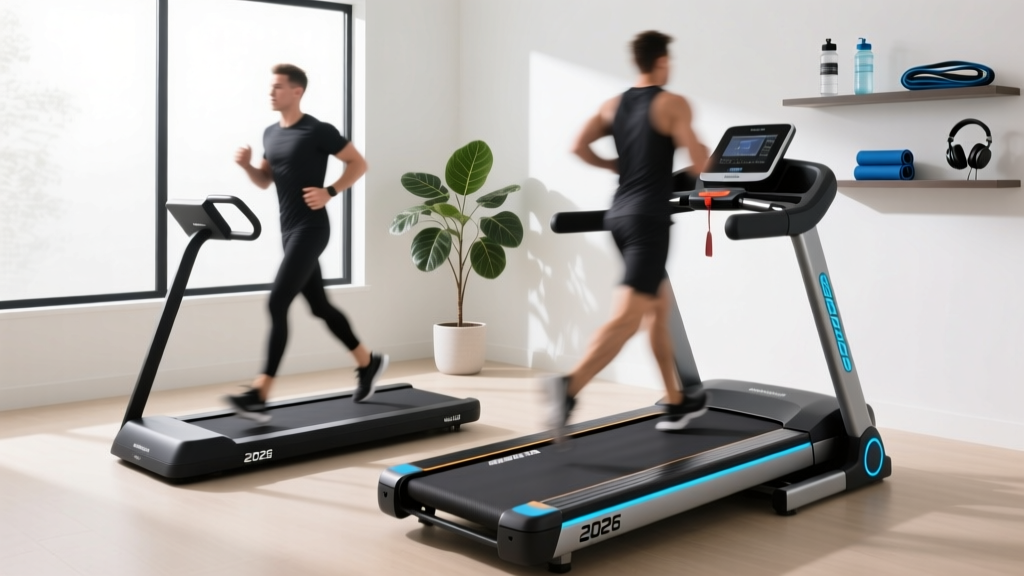
How to Start a Treadmill: Walking Pad vs Full-Size Comparison 2026
Learn how to start a treadmill routine by comparing 2026 walking pads vs full-size treadmills. Expert specs, pricing, and habit-building frameworks.

When users search for how to start a treadmill, they are usually grappling with two distinct hurdles. The first is literal: navigating the safety keys, console interfaces, and side-rail protocols of modern cardio machines. The second is psychological: overcoming the immense friction required to begin a consistent fitness habit. In 2026, the fitness industry has bifurcated into two primary solutions for indoor walking and running: the ultra-compact walking pad and the traditional full-size treadmill.
Choosing between them dictates not just your workout biomechanics, but your daily adherence. Below, we break down the exact specifications, spatial requirements, and behavioral frameworks to help you decide which machine actually makes 'starting' effortless.
The Psychological vs. Literal Meaning of 'Starting'
A traditional treadmill demands a dedicated footprint of roughly 30 square feet and a heavy-duty electrical circuit. It is a destination. You must walk to it, clear the space, and plug it in. A walking pad, conversely, slides under a sofa or stands against a wall, reducing the physical friction of starting a workout to near zero. According to Harvard Health Publishing, reducing environmental barriers is one of the most effective ways to build a sustainable daily walking habit, which is where under-desk treadmills excel.
Head-to-Head Matrix: 2026 Walking Pad vs. Traditional Treadmill
To understand the mechanical differences, we must look at the raw data. Below is a comparison of the current market leaders in both categories.
| Feature | KingSmith WalkingPad X21 (Premium Pad) | Sole F63 (Traditional Treadmill) |
|---|---|---|
| Price (2026) | $549 - $599 | $1,199 - $1,299 |
| Motor | 2.5 HP (Peak) | 3.0 CHP (Continuous) |
| Belt Dimensions | 15.7' x 43.3' | 20' x 60' |
| Top Speed | 7.5 mph (Handle Up) / 3.7 mph (Flat) | 12.0 mph |
| Incline | 0% (Fixed Flat) | 0% - 15% Motorized |
| Weight Capacity | 265 lbs | 325 lbs |
| Footprint | 6.5 sq ft (Active) | 28 sq ft (Active) |
Product Deep Dives: The Contenders
KingSmith WalkingPad X21: The Under-Desk Champion
The X21 represents the pinnacle of the walking pad category. Its 180-degree folding mechanism allows it to collapse to just 11 inches thick. The 52mm noise-reduction motor is specifically tuned for low-RPM walking, keeping decibel levels below 45dB—quiet enough for a shared home office. However, the 15.7-inch belt width requires a degree of spatial awareness; drifting too far left or right will result in your foot catching the plastic side rails. It is strictly a walking and light-jogging machine.
Sole F63: The Traditional Workhorse
The Sole F63 remains the gold standard for entry-level traditional treadmills. Its 3.0 Continuous Horsepower (CHP) motor is designed to dissipate heat during 60-minute running sessions, a feat the WalkingPad cannot replicate without overheating. The 60-inch belt length accommodates a full running stride, and the motorized 15% incline allows for high-intensity interval training (HIIT) and glute-targeted power walks. The trade-off is mass: the F63 weighs 280 lbs and is not meant to be moved once assembled.
Step-by-Step: How to Start a Treadmill (Console & Safety)
Regardless of the machine, understanding the literal process of how to start a treadmill safely is critical to preventing the 'startle effect' that causes many beginner falls.
Standard Treadmill Ignition Protocol
- Straddle the Belt: Never stand on the belt when powering on the machine. Step onto the left and right plastic side rails.
- Engage the Safety Lanyard: Clip the magnetic safety key to your shirt. If you drift backward, the magnet pulls away, instantly cutting power to the motor.
- Initiate Movement: Press 'Quick Start'. The belt will begin at 0.5 mph to 1.0 mph.
- Step On: Once the belt is moving at a walking pace, step onto the center of the belt and adjust your speed.
Walking Pad Exception: Most modern walking pads like the X21 bypass the safety lanyard in favor of a Bluetooth remote or smartphone app. To start, simply press the power button on the front LED matrix, step on, and use the remote to increment the speed by 0.5 mph intervals.
Electrical & Spatial Realities (The Hidden Friction)
One of the most overlooked aspects of buying cardio equipment is home infrastructure. Traditional treadmills like the Sole F63 draw significant amperage, especially under the heavy load of a running user.
'Plugging a heavy-duty treadmill into a shared 15-amp household circuit with other appliances is a primary cause of tripped breakers and degraded motor control boards.' — FitGearPulse Electrical Safety Guidelines, 2026
If you live in an older home or an apartment with shared circuits, a walking pad is vastly superior. Walking pads draw less than 5 amps at peak usage and can safely share a circuit with a laptop and a desk lamp. Furthermore, the American Heart Association recommends at least 150 minutes of moderate-intensity aerobic activity per week. A walking pad allows you to accumulate 30 of those minutes passively while answering emails, effectively removing the 'I don't have time' excuse.
Biomechanics: Stride Length and Joint Impact
If your goal is strictly cardiovascular health and step-count accumulation, a walking pad is sufficient. However, if you are training for a 5K or require incline therapy for knee rehabilitation, the walking pad falls short. The Mayo Clinic notes that altering your natural gait to fit a short treadmill belt can lead to hip flexor tightness and altered biomechanics over time. The 43-inch belt on a walking pad forces users with a stride length over 2.5 feet to subconsciously shorten their steps, which is counterproductive for serious runners.
The 30-Day Inertia-Breaking Protocol
Knowing how to start a treadmill is only day one. Here is a 30-day framework designed to transition you from a machine-owner to a consistent user, leveraging the low-friction nature of modern cardio gear.
- Days 1-7 (The Anchor Phase): Do not focus on speed or calories. Focus purely on proximity. If using a walking pad, pull it out of the closet every morning and leave it in your walking path. Step on it for just 5 minutes while drinking your morning coffee.
- Days 8-14 (The Pairing Phase): Pair the machine with a high-dopamine activity. Only allow yourself to listen to your favorite daily podcast or watch a specific Netflix show while the belt is moving. Target: 20 minutes at 2.5 mph.
- Days 15-21 (The Progression Phase): Introduce the '10% Rule'. Increase your total weekly time on the machine by no more than 10% to prevent plantar fasciitis and shin splints. Introduce 1-minute intervals at 3.5 mph.
- Days 22-30 (The Integration Phase): Your body has adapted to the belt friction. Begin incorporating upper-body movements (if using a walking pad with a handlebar) or transition to full 45-minute steady-state sessions.
Final Verdict: Which Should You Buy?
If your primary barrier to fitness is time and space, and your goal is to hit 8,000 to 10,000 steps a day without leaving your home office, the KingSmith WalkingPad X21 is the undisputed winner. It removes the friction of starting a workout entirely.
However, if you are a dedicated runner, require incline training, weigh over 265 lbs, or have a dedicated home gym space with proper 20-amp electrical circuits, the Sole F63 provides the biomechanical freedom and motor durability required for long-term, high-intensity cardiovascular training.
More gear to consider
All reviews
Treadmill Motor Size Guide: Setup & Lost Treadmill Key Fixes
Beginner Treadmill Guide: T12 Treadmill Features Compared

Elliptical vs Treadmill: ProForm Treadmill Service & Home Cardio

Treadmill Motor Guide: HP & Treadmill Vertical Calculator
Best Treadmill Fold Mechanisms for Small Spaces (2026)
