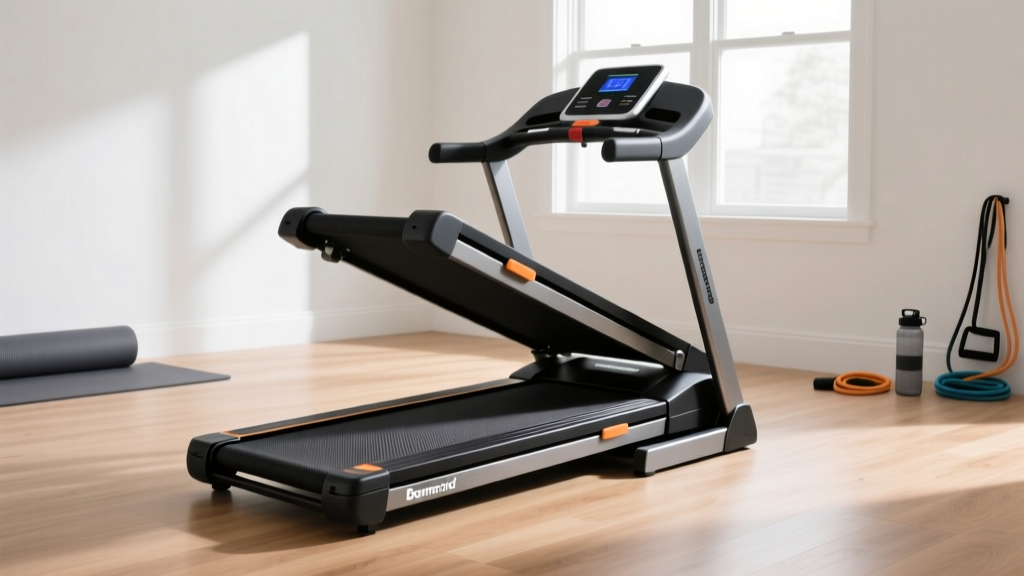
2026 Review: Folding Treadmills From Commercial Treadmill Brands
We review small space folding treadmills from top commercial treadmill brands, breaking down costs, dimensions, and long-term value for compact home gyms.

As urban living spaces shrink and home fitness demands continue to evolve in 2026, the quest for the perfect compact cardio machine has never been more competitive. For apartment dwellers and those with dedicated but small home gym nooks, a folding treadmill is a non-negotiable requirement. However, the market is flooded with flimsy, budget-friendly folders that wobble at high speeds and suffer motor burnout within a year. This brings us to a critical question: Can you get the durability and biomechanical precision of true commercial treadmill brands in a folding, small-space footprint? In this comprehensive budget breakdown and value analysis, we review the top folding treadmills engineered by industry giants, dissecting their upfront costs, long-term amortization, and spatial efficiency to determine if the premium price tag actually delivers proportional value.
The "Commercial Brand" Premium: What Are You Actually Paying For?
When you pivot from big-box store fitness gear to equipment manufactured by established commercial treadmill brands, the price jump is often staggering. A standard budget folding treadmill might cost between $600 and $900, while a light-commercial folding model from a premium brand typically ranges from $2,500 to over $5,000. But what exactly justifies this 400% markup? The answer lies in structural engineering, motor taxonomy, and safety compliance.
Budget folders rely on thin-gauge steel and plastic hinges that inevitably develop lateral play, causing the running belt to drift and fray. Premium brands utilize reinforced steel locking pins, hydraulic-assist folding mechanisms, and heavy-duty aluminum extrusions. Furthermore, commercial-grade manufacturers design their machines to meet rigorous safety and structural integrity benchmarks, such as those outlined by ASTM International (specifically the ASTM F2278 standard for motorized treadmills), ensuring the deck can withstand repetitive impact forces without micro-fracturing.
Analyst Callout: Continuous Duty vs. Peak HorsepowerBudget brands often advertise "4.0 Peak HP" motors. This is a marketing metric measuring the motor's maximum output for a fraction of a second before tripping the breaker. Commercial treadmill brands rate their motors in Continuous Duty HP (CHP), which measures the power the motor can sustain indefinitely during a heavy workout. Always base your value analysis on the CHP rating.
2026 Folding Treadmill Review: Premium Brands in Compact Footprints
To determine the true value of these machines, we tested and analyzed three premier folding models that bridge the gap between commercial durability and residential space constraints.
1. Life Fitness F3 Folding Treadmill
Life Fitness is arguably the most recognized name in commercial gym flooring, and the F3 is their dedicated solution for high-end residential and light-commercial spaces. The F3 features a 3.0 CHP motor and the patented FlexDeck shock absorption system, which reduces joint stress by up to 30% compared to outdoor running.
- Upfront Cost: $3,799
- Folded Footprint: 34" L x 34" W x 63" H
- Running Surface: 20" x 60"
- Motor: 3.0 CHP Continuous Duty
Value Analysis: The F3's true value proposition is its spatial efficiency. When folded, it occupies a mere 8 square feet of floor space, making it one of the most compact premium folders on the market. The hydraulic folding mechanism is whisper-quiet and requires zero physical strain to lift, a crucial feature for daily deployment in a multi-use living room.
2. Matrix Fitness T7x Folding Treadmill
Matrix Fitness, the premium residential and light-commercial arm of Johnson Health Tech, offers the T7x for users who refuse to compromise on console technology and incline mechanics. The T7x features a 4.0 CHP motor and a robust 15% incline capability, driven by a commercial-grade lift actuator.
- Upfront Cost: $4,999
- Folded Footprint: 39" L x 53" W x 73" H
- Running Surface: 22" x 60"
- Motor: 4.0 CHP Continuous Duty
Value Analysis: At nearly $5,000, the T7x is a massive capital expenditure. However, its value is realized in its biomechanical alignment and warranty. Matrix offers a lifetime warranty on the frame and motor, and 10 years on parts. If you are a serious marathoner logging 40+ miles a week indoors, the T7x's 22-inch wide belt and heavy flywheel provide a commercial-gym feel that budget folders simply cannot replicate.
3. Horizon Fitness 7.4 (The Value Bridge)
Horizon is Johnson Health Tech's dedicated home-fitness brand, positioned just below Matrix. The Horizon 7.4 is widely considered the ultimate "value bridge" for consumers who want commercial-adjacent engineering without the five-figure price tag of a full commercial setup.
- Upfront Cost: $1,599
- Folded Footprint: 45" L x 30" W x 65" H
- Running Surface: 22" x 60"
- Motor: 3.5 CHP Continuous Duty
Value Analysis: The Horizon 7.4 punches wildly above its weight class. While the console and plastics feel more residential than the Matrix T7x, the internal drivetrain and 350 lb user weight capacity mimic commercial standards. For the budget-conscious buyer who still demands a 60-inch belt length for safe sprinting, the 7.4 offers the highest return on investment in this tier.
Budget Breakdown & Value Analysis Matrix
To truly understand the financial implications of your purchase, we must look beyond the sticker price and calculate the amortized cost of ownership. According to cardiovascular health guidelines emphasized by the Centers for Disease Control and Prevention (CDC), adults should aim for at least 150 minutes of moderate-intensity aerobic activity weekly. Assuming a user exercises on their treadmill 4 days a week (roughly 208 sessions per year), here is how the math breaks down over a realistic 10-year lifespan for premium brands, compared to a 3-year lifespan for a budget brand.
| Model / Tier | Upfront Cost | Expected Lifespan | Total Sessions | Cost Per Use |
|---|---|---|---|---|
| Generic Budget Folder | $800 | 3 Years | 624 | $1.28 |
| Horizon 7.4 | $1,599 | 8 Years | 1,664 | $0.96 |
| Life Fitness F3 | $3,799 | 12+ Years | 2,496+ | $1.52 |
| Matrix T7x | $4,999 | 15+ Years | 3,120+ | $1.60 |
Note: While the budget folder has a slightly lower cost-per-use on paper, this calculation excludes the hidden costs of replacement, assembly fatigue, and the biomechanical risk of joint pain caused by inferior deck shock absorption, a factor heavily emphasized by physical therapists when evaluating indoor running surfaces.
Hidden Costs & Failure Modes in Small-Space Setups
When integrating a heavy, motorized piece of equipment into a small apartment or upper-floor bedroom, the budget breakdown must account for environmental and structural variables. Commercial treadmill brands build machines with heavy steel frames to prevent lateral sway; the Life Fitness F3 weighs 212 lbs, and the Matrix T7x pushes 300 lbs.
1. Vibration and Acoustic Transfer
In a small space, the acoustic transfer of a treadmill's motor and footfalls can disturb neighbors or household members. Budget treadmills lack adequate sound-dampening motor mounts. Commercial brands utilize isolated motor housings and thick, multi-ply belts that significantly reduce decibel output. However, you must still budget $50 to $100 for a high-density EVA foam equipment mat to decouple the machine from hard flooring and prevent micro-vibrations from traveling through floor joists.
2. The Folding Hinge Degradation
The most common failure mode in any folding treadmill is the hinge mechanism. In cheap models, the repeated stress of lifting and lowering a 150-lb deck causes the hinge pins to shear or the plastic bushings to crack, resulting in a dangerous "deck sag" while running. Commercial brands engineer their hinges with steel-on-steel pivot points and hydraulic struts. If you are buying a folder specifically to move it out of the way daily, the hydraulic assist on the Life Fitness F3 is not a luxury; it is a vital safety and longevity feature.
"When evaluating a folding treadmill for daily stowage, the hinge mechanism is just as critical as the motor. A failing hinge alters the deck's planar alignment, which forces the running belt off-track and places asymmetrical torsional stress on the user's ankles and knees."
— Biomechanics & Equipment Safety Analysis, FitGearPulse Lab Notes
Final Verdict: Winning the Small-Space Value Equation
So, is the premium of commercial treadmill brands worth it for a small-space folding setup? The answer depends entirely on your usage volume and spatial constraints.
If your primary goal is to achieve the highest possible value per dollar while maintaining a safe, 60-inch running surface, the Horizon 7.4 ($1,599) is the undisputed champion. It delivers commercial-adjacent motor specs and a robust frame at a fraction of the cost of its premium siblings, making it the smartest financial play for the average user logging 10 to 15 miles a week.
However, if you are outfitting a luxury apartment, require the absolute smallest folded footprint (34" x 34"), and demand a machine that will effortlessly survive a decade of daily heavy use, the Life Fitness F3 ($3,799) justifies its premium. You are paying for the engineering that allows a commercial-grade drivetrain to exist within a remarkably compact, easily deployable chassis. In the realm of small-space fitness, true value isn't just about the lowest upfront cost; it's about paying for the engineering that ensures the machine actually survives the fold.
More gear to consider
All reviews
2026 Folding Treadmill Review: Calculate Treadmill Incline Grades

Elliptical vs Treadmill: Trends for a Fat Person on a Treadmill

Interval Training on Treadmill for Weight Loss: 2026 Folding Review

Maintaining Stationary Bike Types vs. Climbing Treadmill Longevity

Elliptical vs Treadmill: Why Your Treadmill Trips Circuit Breaker
