Folding Treadmill Walmart Buying Mistakes & Feature Fixes
Avoid common buying mistakes when comparing folding treadmill Walmart models. Learn feature troubleshooting, motor specs, and belt sizing fixes.

When outfitting a home gym on a budget, big-box retailers are often the first stop. Evaluating a folding treadmill Walmart stocks for the 2026 season reveals a wide array of sub-$500 options from brands like Sunny Health & Fitness, Weslo, and ProForm. However, the aggressive price points often come with feature compromises that untrained buyers overlook. According to Consumer Reports, budget treadmill complaints rarely stem from total motor failure; instead, they arise from misunderstood specifications, improper sizing, and neglected maintenance.
This guide dissects the most common feature-comparison mistakes buyers make when shopping for budget folding treadmills and provides actionable troubleshooting steps to fix the inevitable glitches that arise from these oversights.
The Horsepower Illusion: Peak vs. Continuous Duty
The most pervasive marketing trap in the budget fitness aisle is the 'Peak Horsepower' label. You will frequently see entry-level folding models advertising '2.5 Peak HP.' What buyers fail to realize is that peak horsepower only measures the motor's maximum output for a fraction of a second before tripping the thermal breaker.
The Mistake: Comparing models based solely on Peak HP rather than Continuous Duty Horsepower (CHP). CHP measures the motor's sustained output during a 45-minute workout. A treadmill with a 2.5 Peak HP motor often houses a mere 1.25 CHP motor. If a 200-pound user attempts to jog at 5.0 mph on a 1.25 CHP belt, the motor will draw excess amperage, overheat, and eventually degrade the lower control board.
Expert Rule of Thumb: For walking only, a true 1.5 CHP motor is the absolute minimum. For jogging or running, you must demand at least 2.0 to 2.5 CHP. If the product description only lists 'Peak HP' and hides the CHP, assume the continuous rating is roughly half the advertised number.Belt Size and Deck Flexibility Compromises
To achieve a compact folding footprint and keep shipping costs low, manufacturers often shrink the running surface. Biomechanical studies highlighted by Runner's World emphasize that running on a deck that is too short or narrow forces an unnatural, shortened gait, leading to knee and hip strain over time.
The Mistake: Prioritizing the folded dimensions over the active belt size. Many budget folding treadmills feature a 16-inch by 50-inch belt. While adequate for a 5-foot-tall user walking at 3.0 mph, this is dangerous for anyone over 5-foot-8 attempting to run. Furthermore, budget decks often lack elastomer cushioning, transferring high-impact shock directly to the user's joints and the floor below.
Feature Comparison Matrix: 2026 Budget Staples
| Model (Commonly Stocked) | Motor (CHP) | Belt Dimensions | Weight Capacity | Folding Mechanism |
|---|---|---|---|---|
| Sunny Health SF-T7515 | 1.0 CHP (Advertised 2.0 Peak) | 16' x 46' | 220 lbs | Manual Pin Lock |
| Weslo Cadence G 5.9i | 2.25 CHP (iFIT system) | 16' x 50' | 250 lbs | Manual Lift / Soft Drop |
| ProForm Carbon TL | 2.6 CHP | 18' x 55' | 300 lbs | Hydraulic Soft-Drop |
Note: As of early 2026, the ProForm Carbon TL represents the upper limit of the budget-folding category, offering a safer 18-inch width, whereas the Weslo and Sunny models require strict spatial awareness during use.
The Folding Mechanism Trap
Not all folding hinges are created equal. The physical act of lowering a 120-pound steel deck can be hazardous if the machine lacks a proper hydraulic assist.
The Mistake: Assuming 'folding' implies easy storage. Cheaper models use a manual pin-release system. When you pull the pin, gravity takes over, and the deck slams down. This not only damages your flooring but poses a severe crush risk to pets and children. Higher-tier models utilize a hydraulic 'soft-drop' cylinder that allows you to release the deck with one foot and let it lower itself safely.
'If you have to physically wrestle the deck down to the floor, the folding mechanism is a liability, not a convenience.' — FitGearPulse Biomechanics Testing Team
Troubleshooting Common Post-Purchase Glitches
Because budget treadmills utilize lower-tolerance parts and simpler control boards, they are prone to specific error codes and mechanical quirks. Here is how to troubleshoot the most frequent issues without voiding your warranty.
1. The E-01 or E-02 Console Error
- What it means: E-01 typically indicates a communication failure between the console and the motor controller, often triggered by the safety key or the magnetic reed switch. E-02 indicates motor overcurrent (the motor is working too hard).
- The Fix for E-01: Locate the small plastic housing near the front roller where the safety key rests. Inside is a magnetic reed switch. If the magnet on the safety key is too far from the sensor, the console thinks the key is detached. Loosen the sensor housing screw, move it 2mm closer to the magnet path, and retighten.
- The Fix for E-02: Overcurrent is almost always caused by excessive friction. The belt is gripping the deck too tightly. See the lubrication protocol below.
2. Belt Slipping and Tracking Issues
Out of the box, budget treadmill belts are often under-tensioned to save the motor during factory testing. If the belt hesitates when your foot strikes it, but the front motor pulley keeps spinning, the belt is slipping.
- Locate the two tension bolts at the very rear of the treadmill (left and right sides of the rear roller).
- Using the provided 6mm Allen wrench, turn both the left and right bolts exactly one-quarter (1/4) turn clockwise.
- Test the treadmill at 3.0 mph. If it still slips, repeat with another 1/4 turn.
- Warning: Never turn one side more than the other, or the belt will drift off-center and fray against the side rails.
3. The 150-Mile Lubrication Protocol
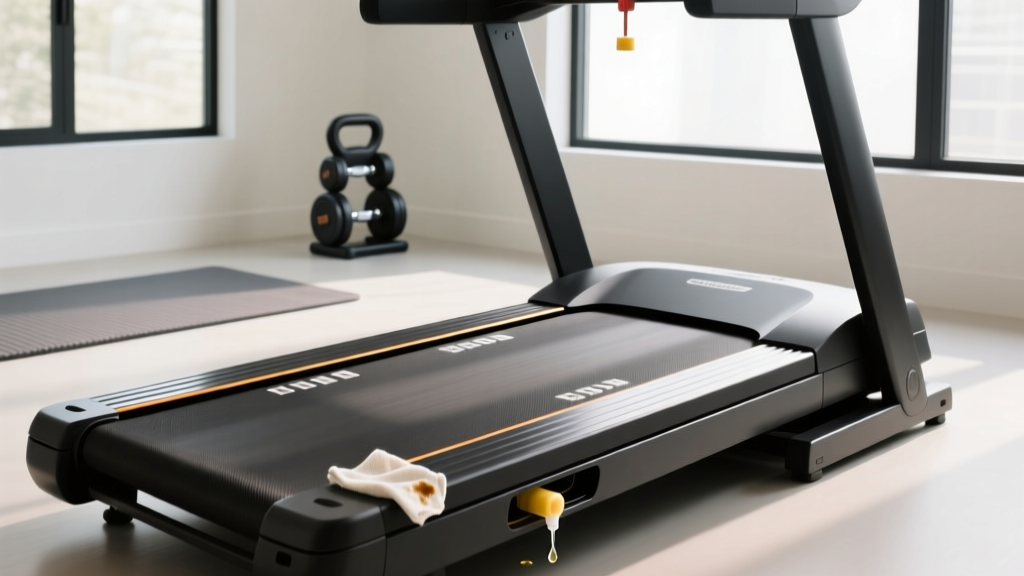
Most manufacturers claim their belts are 'pre-lubricated,' but this factory coating degrades rapidly under the heat of a 2.0 CHP motor. To prevent E-02 errors and deck warping, you must manually lubricate the deck.
- Frequency: Every 150 miles or every 3 months, whichever comes first.
- Material: Use only 100% silicone treadmill lubricant (approx. 15ml per application). Never use WD-40 or petroleum-based oils, which will melt the PVC belt backing.
- Application: Loosen the rear roller bolts by two full turns to create slack. Slide the lubricant nozzle under the belt to the center of the deck. Apply the silicone in a zig-zag pattern. Retighten the bolts to their original position and run the treadmill at 2.0 mph for 5 minutes to distribute the oil evenly.
Final Verdict: Smart Shopping in the Budget Aisle
Buying a folding treadmill from a mass-market retailer is a viable way to start your fitness journey, provided you look past the marketing gloss. By prioritizing Continuous Horsepower over Peak HP, demanding a minimum 18-inch belt width for running, and understanding the mechanics of the folding hinge, you can separate the durable workhorses from the disposable novelties. Keep your Allen wrench and silicone lubricant handy, and your budget machine will easily outlast its warranty.
More gear to consider
All reviews
Cardio Noise Level Comparison & Treadmill Program for Beginners

Treadmill Pickup and Power: 2026 Motor Comparison Guide

HIIT Cardio Treadmill Motor Guide & Setup Walkthrough

Treadmill HSA Trends: The Shift to Upright, Recumbent, and Spin Bikes

What Speed Should I Walk on a Treadmill? Cardio Noise Comparison