
Does Treadmill Build Muscle? Space-Saving Bikes vs. Treadmills
Asking if a treadmill builds muscle? Compare spatial footprints of treadmills vs. upright, recumbent, and spin bikes to optimize your home gym layout.

When drafting a floor plan for a compact home gym, every square inch commands a premium. This spatial constraint forces a critical evaluation of equipment ROI (Return on Investment). A frequent question we encounter from layout-conscious buyers is: does treadmill build muscle enough to justify its massive footprint? The short answer is no. While incline treadmill walking engages the gastrocnemius and soleus for muscular endurance, it does not trigger the mechanical tension required for true hypertrophy. If your primary goal is muscle growth, a squat rack or adjustable dumbbell set is a far superior spatial investment.
However, if your goal is high-yield cardiovascular conditioning without sacrificing half your living room, evaluating stationary bike types—upright, recumbent, and spin—reveals a much smarter approach to space optimization. In this guide, we break down the spatial realities of cardio machines and how to design an efficient, high-performance layout.
The Treadmill Spatial Tax: Footprint vs. Function
To understand why space-conscious athletes pivot to cycling, we must quantify the "spatial tax" of a treadmill. A standard motorized treadmill, such as the NordicTrack T Series 6.5S, measures roughly 70 inches long by 26 inches wide. However, the physical footprint is only half the equation.
⚠️ The Ejection Clearance Rule: For safety, treadmills require a minimum of 24 inches of clear space directly behind the belt to allow for ejection in the event of a fall. This pushes the functional footprint of a standard treadmill to over 22 square feet.Furthermore, treadmills generate significant dynamic harmonic vibration. If placed on a second-floor apartment or above a finished basement, the repetitive impact of a 180 lb runner can cause structural resonance and noise complaints. This brings us to the superior spatial alternatives: stationary bikes.
Decoding Stationary Bike Types for Compact Layouts
Stationary bikes eliminate the rear ejection zone requirement, drastically reducing their functional footprint. However, not all bikes are created equal when it comes to room geometry and biomechanics.
1. Spin Bikes (Indoor Cycling): The Ultimate Space-Saver
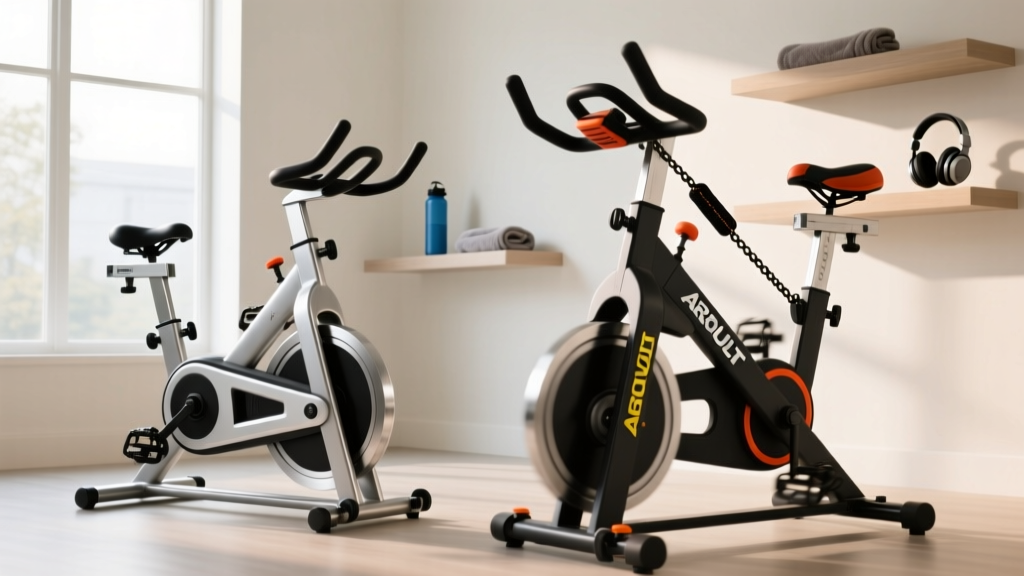
Spin bikes, modeled after road and track bicycles, offer the smallest footprint and the highest resistance ceiling. Models like the Schwinn IC4 (approx. $999) or the Bowflex C6 feature a footprint of just 48.7" L x 21.2" W.
- Layout Advantage: Their narrow profile allows them to be tucked into 45-degree corners or placed flush against a wall in narrow hallways.
- Biomechanical Note: Pay attention to the Q-factor (the distance between the pedals). The Schwinn IC4 boasts a 165mm Q-factor, mimicking outdoor road bikes and reducing knee valgus stress, which is crucial when you are forced to ride in tight, poorly ventilated corners where form might otherwise degrade.
- Muscle Engagement: By utilizing heavy magnetic resistance (up to 100 levels on premium models), spin bikes actually do build muscular endurance and size in the quadriceps and glutes, answering the hypertrophy question far better than a treadmill.
2. Upright Bikes: The Traditional Middle-Ground
Upright bikes feature a wider, more cushioned seat and a step-through frame. The Sole B94 ($1,299) is a prime example, measuring 43" L x 25" W.
While slightly wider than a spin bike, the step-through design is a massive advantage for spatial layout. You do not need to swing a leg over a high top tube, meaning an upright bike can be placed in a tight alcove or directly between two pieces of furniture with only 12 inches of lateral clearance for mounting and dismounting. According to the American Heart Association (AHA), varying your cardiovascular modalities is key to long-term heart health, and the upright bike provides a low-impact, easily accessible option for multi-user households.
3. Recumbent Bikes: The Ergonomic Space Trap
Many buyers mistakenly assume recumbent bikes are "small" because they sit low to the ground. This is a critical layout error. Because of the extended seat rail required to accommodate the reclined pedaling motion, recumbents like the Schwinn 270 ($899) measure a sprawling 64" L x 28" W.
"Recumbent bikes are exceptional for lumbar support and joint preservation, but their elongated chassis makes them notoriously difficult to integrate into multi-purpose rooms or small apartments." — Home Gym Layout Principles, 2026
Physical therapists often recommend recumbent bikes for rehabilitation and lumbar support, as noted in guidelines by the American Physical Therapy Association (APTA). However, from a pure space-optimization standpoint, they consume nearly as much linear floor space as a compact elliptical, negating the spatial benefits of cycling.
Floor Plan Matrix: Dimensions, Clearance, and Cost
Use the following comparison matrix to plan your 2026 home gym layout. Data reflects standard residential models currently on the market.
| Machine Type | Avg. Footprint | Required Clearance | Floor Load Type | 2026 Price Range |
|---|---|---|---|---|
| Motorized Treadmill | 70" x 28" | 24" Rear Ejection | Dynamic / High Impact | $800 - $2,500 |
| Spin Bike (Indoor) | 48" x 21" | 12" Lateral Mount | Static / Low Vibration | $900 - $2,495 |
| Upright Bike | 43" x 25" | 12" Step-Through | Static / Low Vibration | $700 - $1,500 |
| Recumbent Bike | 64" x 28" | 18" Lateral Mount | Static / Distributed | $600 - $1,200 |
Advanced Layout Strategies for Multi-Purpose Rooms
Integrating cardio equipment into a living space or bedroom requires more than just measuring the floor. You must account for environmental and structural variables.
1. The Sweat and Ventilation Zone
Treadmills project sweat backward and outward due to the running stride. Bikes, conversely, create a concentrated "drip zone" directly beneath the bottom bracket and handlebars. When laying out your room, place a high-density PVC equipment mat (at least 3/8" thick) under your bike. Position the bike near a window or a wall-mounted oscillating fan to manage humidity, which can otherwise warp nearby laminate flooring or drywall over time.
2. Power Routing and Cable Management
Modern spin bikes with HD touchscreens (like the Peloton Bike+ or NordicTrack S22i) require constant power and robust Wi-Fi. When designing your layout, ensure your chosen corner is within 6 feet of a grounded outlet to avoid using extension cords, which are a tripping hazard in tight spaces. Use adhesive cable channels along the baseboards to maintain a clean, minimalist aesthetic.
3. Structural Resonance and Neighbors
If you live in a multi-story dwelling, the Centers for Disease Control and Prevention (CDC) recommends at least 150 minutes of moderate aerobic activity weekly. Doing this on a treadmill in an upstairs apartment will inevitably cause low-frequency noise transfer through the floor joists. Spin bikes and magnetic upright bikes operate with near-silent belt drives and magnetic resistance, eliminating impact noise and keeping you in the good graces of your neighbors.
Frequently Asked Questions
Can I put a stationary bike on carpet?
Yes, but you must use a rigid equipment mat. Carpet fibers can trap sweat, leading to mold growth beneath the bike's stabilizers. Furthermore, thick carpet can cause the bike's leveling feet to sink, altering the bike's geometry and potentially causing premature wear on the bottom bracket bearings.
Which bike type burns the most calories in a small space?
Spin bikes (indoor cycling bikes) yield the highest caloric expenditure per square foot. Because they allow for out-of-the-saddle climbing and high-resistance intervals, you can achieve a higher VO2 max output in a 45-minute session compared to the seated, steady-state nature of most recumbent or upright bikes.
Do treadmills fold up to save space?
While many treadmills feature folding decks, the folded footprint is often still 30" x 30", and the machine becomes incredibly top-heavy and dangerous to move alone. A spin bike, on the other hand, usually features transport wheels and weighs under 120 lbs, allowing you to easily roll it into a closet when not in use.
More gear to consider
All reviews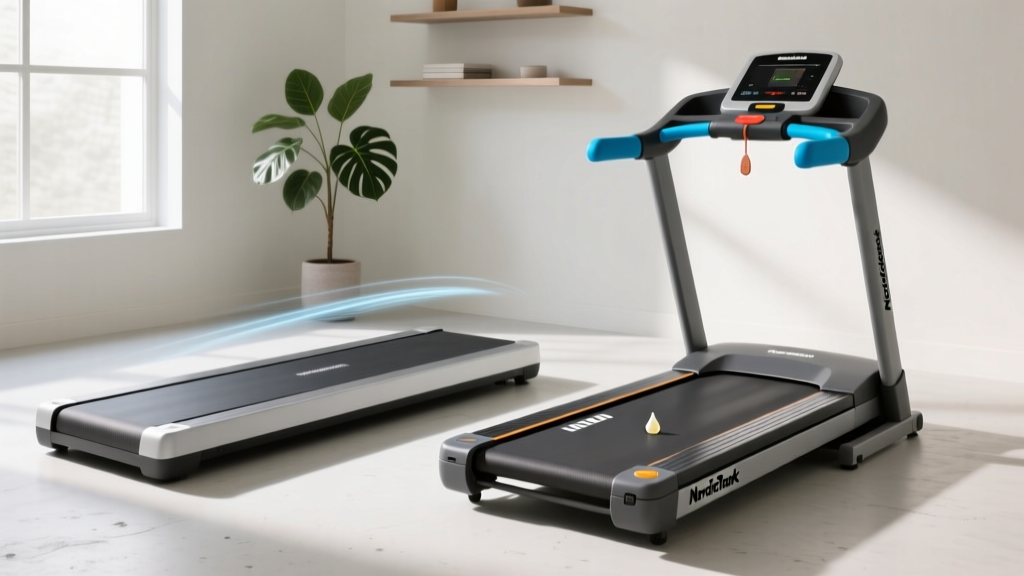
Walking Pad Review: Belt Care & NordicTrack Treadmill Belt Lubricant
Why Does Getting Off a Treadmill Feel Weird? Air vs Assault Bike Layouts

Are Treadmills Worth It? Feature Comparison & Setup Guide

Best Compact Treadmills 2026: Is a Treadmill Subscription Worth It?

Air vs Assault Bike: What Burns More Calories, Treadmill or Elliptical?
