
Do Treadmills Use a Lot of Electricity? Small Space Folding Review
Do treadmills use a lot of electricity? We review top folding treadmills for small spaces, analyzing motor efficiency, power draw, and maintenance tips.

The Real Power Draw: Do Treadmills Use a Lot of Electricity?
When outfitting a compact apartment or a dedicated home gym nook, space and efficiency are your primary constraints. This leads many buyers to ask a critical question before purchasing: do treadmills use a lot of electricity? The short answer is that it depends entirely on the motor's Continuous Duty Horsepower (CHP), your body weight, and—most importantly—how well you maintain the machine. A poorly maintained folding treadmill can draw up to 30% more amperage than a freshly serviced one, directly inflating your monthly energy bill and degrading the lower control board (MCB).
According to the U.S. Energy Information Administration (EIA), the national average retail price of electricity in early 2026 hovers around $0.17 per kilowatt-hour (kWh). To understand your actual costs, we must look past the marketing jargon of 'Peak Horsepower' and focus on real-world wattage consumption during a standard 60-minute workout.
⚡ The Amp-Draw Rule of Thumb: A standard 2.5 CHP folding treadmill running at 6.0 MPH with a 150 lb user will draw roughly 900 to 1,100 watts. At $0.17/kWh, running this machine for one hour every day costs approximately $4.50 to $5.50 per month. However, if the belt is dry and friction increases, that draw can spike to 1,500 watts, pushing your monthly cost higher while generating excess heat that destroys the motor windings.Power Consumption by Motor Size
| Motor Size (CHP) | Average Wattage (Jogging) | Max Amp Draw (Incline/Sprint) | Est. Monthly Cost (1hr/day) |
|---|---|---|---|
| 2.0 - 2.25 CHP | 600W - 800W | 10 - 12 Amps | $3.00 - $4.00 |
| 2.5 - 2.75 CHP | 900W - 1,100W | 12 - 15 Amps | $4.50 - $5.50 |
| 3.0+ CHP | 1,200W - 1,400W | 15 - 18 Amps | $6.00 - $7.50 |
*Calculations based on 30 days of use at $0.17/kWh. Source data adapted from U.S. Department of Energy appliance estimation guidelines.
Top Folding Treadmills for Small Spaces (2026 Energy-Efficiency Review)
Not all folding mechanisms are created equal, and compact footprints often mean smaller motor housings that trap heat. Here is how the top folding treadmills for small spaces perform regarding electrical efficiency, spatial footprint, and long-term maintenance requirements.
1. Horizon Fitness T202 (Best Overall for Compact Efficiency)
The Horizon T202 features a 2.75 CHP motor and a remarkably compact folded footprint of 34" L x 29" W. What makes the T202 stand out from an electrical longevity perspective is its advanced cooling fan design and heavy-duty lower control board. Because small spaces often lack optimal cross-breeze ventilation, the T202's internal thermal regulation prevents the motor from overworking. The hydraulic soft-drop folding hinge requires zero electrical assistance, ensuring no parasitic draw on the system when deploying the deck.
- Motor: 2.75 CHP (Highly efficient for users under 220 lbs)
- Folded Dimensions: 34" x 29" x 61"
- Maintenance Note: Requires 100% silicone lubrication every 130 miles to maintain its low-amp draw profile.
2. Sole Fitness F63 (Best Heavy-Duty Folding Option)
If you need a larger running surface (60" x 20") but still require a folding mechanism, the Sole F63 is the industry standard. It utilizes a 3.0 CHP motor. While a 3.0 CHP motor technically uses more electricity than a 2.0 CHP model, the F63's oversized motor actually runs cooler and more efficiently under heavy loads because it isn't straining near its maximum capacity. The folding mechanism uses a dual-lock pin system that keeps the deck perfectly level, preventing the lateral friction that often causes uneven belt wear and subsequent electrical spikes.
- Motor: 3.0 CHP (Runs cooler under load, extending MCB life)
- Folded Dimensions: 35" L x 32" W x 65" H
- Maintenance Note: Features Sole's 'Cushion Flex' deck; check deck alignment bi-annually to prevent edge-friction amp spikes.
3. ProForm Carbon TL (Best Budget Space-Saver)
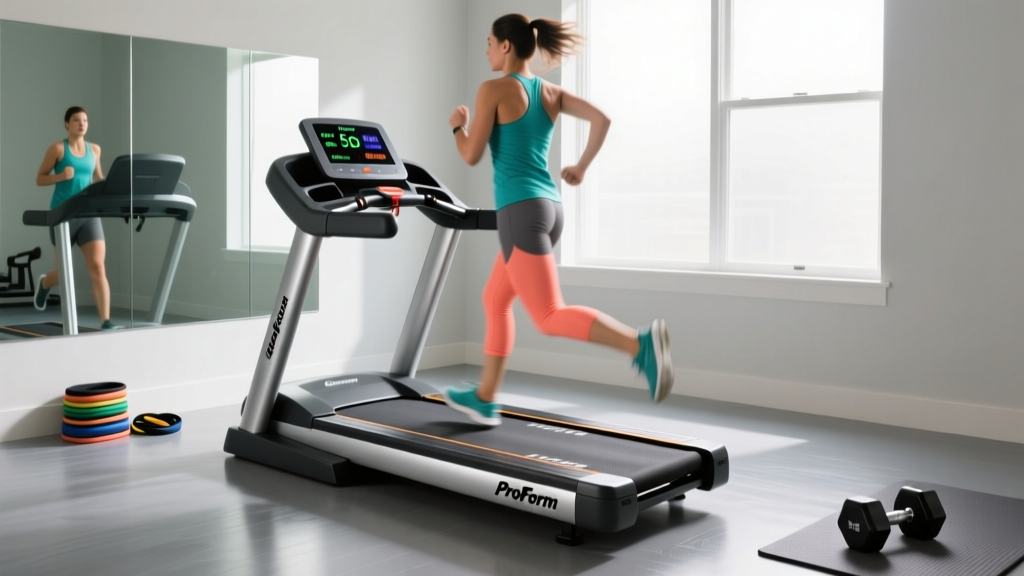
For tight budgets and tighter spaces, the ProForm Carbon TL offers a 2.6 CHP motor and a 55-inch track. It folds vertically using a SpaceSaver design. Because the motor is slightly smaller, it is highly sensitive to belt friction. Users must be vigilant about maintenance; a dry belt on the Carbon TL will immediately trigger the machine's internal thermal breaker during high-incline intervals.
Maintenance Care: Prolonging Motor Life and Reducing Power Consumption
The secret to keeping your treadmill's electricity usage low lies in minimizing mechanical friction. When the walking belt drags against the deck, the motor must pull more amperage to maintain your target speed. This excess heat degrades the motor's copper windings and eventually fries the Lower Control Board (MCB)—a replacement part that typically costs between $150 and $300.
Expert Insight: 'Many users blame the motor when their treadmill shuts down mid-run. In 80% of cases, the motor is fine; the lower control board has simply tripped its thermal overload switch due to excessive amp draw caused by a dry, unlubricated belt.' — Home Fitness Equipment Repair Technicians
The 'Coast-Down' Friction Test
Before assuming your machine is energy-efficient, perform this simple test to check for hidden electrical strain:
- Turn the treadmill on and set the speed to 4.0 MPH with zero incline.
- Step onto the side rails (safely) and pull the safety key to kill the power instantly.
- Time how long it takes for the belt to come to a complete stop.
- The Benchmark: A well-lubricated, low-friction belt should coast for 8 to 12 seconds. If it stops in under 5 seconds, your deck is dry, friction is high, and your treadmill is currently using significantly more electricity than necessary.
Step-by-Step Belt Lubrication Protocol
To restore electrical efficiency and protect your motor, follow this exact lubrication schedule:
- Purchase the correct lubricant: Use only 100% pure liquid silicone treadmill lube. Never use WD-40, petroleum-based oils, or silicone sprays containing propellants, as these will dissolve the belt's cotton backing and cause catastrophic motor strain.
- Loosen the belt: Use an Allen wrench to turn the rear roller adjustment bolts counter-clockwise (exactly 3 full turns on each side) to create slack.
- Apply the silicone: Squeeze exactly 15ml (half an ounce) of liquid silicone in a zigzag pattern directly onto the center of the deck, underneath the belt.
- Retighten and distribute: Tighten the bolts back to their original position. Turn the machine on at 2.0 MPH and walk on it for 3 minutes to evenly distribute the silicone across the deck.
Electrical Safety and Setup for Small Apartments
Small spaces often mean limited wall outlets, leading many users to plug their folding treadmills into cheap, overloaded power strips. This is a severe fire hazard and a primary cause of premature treadmill failure.
⚠️ Warning: The Back-EMF EffectWhen you decelerate rapidly or step off a moving treadmill, the motor acts as a generator, sending a reverse voltage spike (Back-EMF) back through the power cord. Standard office power strips cannot handle this reverse load and will degrade rapidly, leaving your treadmill's sensitive console electronics vulnerable to grid surges.
The Electrical Safety Foundation International (ESFI) explicitly warns against daisy-chaining high-draw motorized appliances on standard power strips. To ensure the longevity of your folding treadmill's electronics, adhere to this electrical checklist:
- Dedicated Circuit: Ideally, plug the treadmill into a dedicated 15-amp or 20-amp, 120-volt grounded outlet. Avoid sharing the circuit with space heaters, microwaves, or window AC units.
- Treadmill-Rated Surge Suppressor: If a dedicated wall outlet is impossible in your small space, use a single-outlet, treadmill-rated surge protector with a minimum rating of 1,500 Joules and an EMI/RFI noise filter.
- Check the Prongs: Inspect the treadmill's power plug monthly. If the metal prongs feel warm to the touch after a 30-minute run, the internal wiring of your wall receptacle may be loose, creating electrical resistance and wasting power as heat.
Frequently Asked Questions
Will a folding treadmill's hinge mechanism affect the motor's power draw?
Indirectly, yes. If the folding hinge becomes loose or warped over time, the running deck may sit at a microscopic angle. This causes the user's footfalls to push the belt laterally against the side rails. This lateral friction forces the motor to pull extra amperage to maintain speed. Always ensure the folding locking pin is fully engaged and the deck sits perfectly flat when unfolded.
Do walking pads use less electricity than traditional folding treadmills?
Yes. Under-desk walking pads typically feature 1.5 to 2.0 CHP motors and lack incline mechanisms, heavy consoles, and cooling fans. They generally draw between 300W and 500W during active use, making them the most energy-efficient cardio option for small spaces, though they are limited to walking speeds (usually maxing out at 4.0 to 6.0 MPH).
How often should I clean the motor compartment to prevent overheating?
Every 6 months, unplug the treadmill, remove the plastic motor hood cover (usually secured by 4 to 6 Phillips-head screws), and use a vacuum with a soft brush attachment to remove dust, pet hair, and carpet fibers from the motor vents and the lower control board heat sink. A clogged heat sink forces the MCB to work hotter, reducing its lifespan and marginally increasing electrical resistance.
More gear to consider
All reviews
Orangetheory Treadmill Workout Motor Errors: HP Sizing & Fixes

Rowing Machine Buying Guide: Technique & Treadmill Storage Tips

Horizon 7.0AT Treadmill Noise: Cardio Machine Comparison & Fixes
Elliptical vs Treadmill: Testing the ProForm XP 542s Treadmill Myth

Treadmill Motor Size Guide: Horsepower & Treadmill Spray Lube Care
