How to Fold ProForm Treadmill & Compact Cardio Value Guide
Learn how to fold ProForm treadmill models safely and analyze the true costs, footprint realities, and long-term value of compact portable cardio gear.

The True Cost of 'Portable' Cardio: A 2026 Budget Breakdown
The demand for space-saving fitness equipment has exploded, but the term 'compact' is often used as a marketing shield to justify underpowered motors and fragile frames. In the 2026 home fitness market, buyers are increasingly realizing that the cheapest portable cardio option rarely offers the best long-term value. When evaluating compact portable cardio equipment options, you must look beyond the initial price tag and analyze the total cost of ownership, which includes shipping surcharges for freight, floor reinforcement for concentrated weight loads, and the inevitable maintenance of folding mechanisms.
According to the Consumer Reports Treadmill Buying Guide, the most common point of failure in budget-friendly folding cardio machines is not the electronic console, but the mechanical hinge and hydraulic lift systems. This makes understanding the engineering behind your equipment just as critical as the upfront cost. To illustrate this, we will use one of the most popular folding designs on the market as our primary case study.
Case Study: How to Fold ProForm Treadmill Models Safely
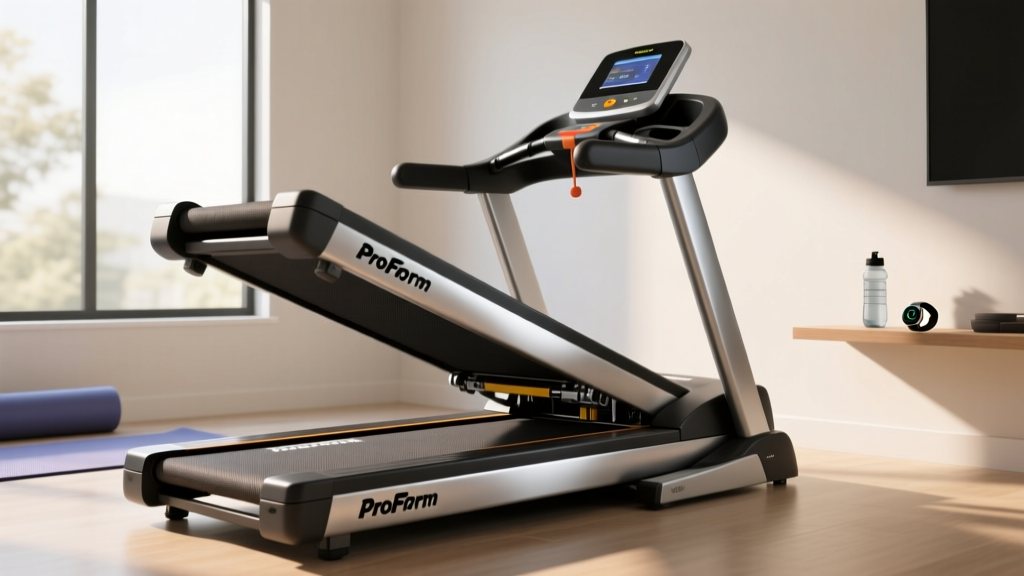
ProForm’s SpaceSaver design is the industry benchmark for upright folding treadmills. If you are wondering how to fold ProForm treadmill units like the popular Carbon TL or the Smart Pro series, the process relies on a gas-shock assisted pivot system. Improper folding is the leading cause of hydraulic seal blowouts and bent pivot pins.
Step-by-Step Folding Procedure
- Clear the Deck and Power Down: Remove any water bottles, towels, or devices. Unplug the machine or switch off the master power switch near the floor. A sudden power surge during the folding process can damage the incline motor if the deck shifts abruptly.
- Locate the Latch Knob: Stand to the left side of the treadmill deck. Look for the latch knob (usually a yellow or black pull-pin) located on the left upright frame, just above the deck hinge.
- Release and Lift: Pull the latch knob outward to disengage the locking pin. Using your legs (not your lower back), grip the underside of the deck and lift it upward. The gas shock cylinder will take over the heavy lifting around the 45-degree mark.
- Secure the Storage Latch: Continue lifting until the deck clicks securely into the storage latch at the top of the upright mast. You should hear a definitive metallic click. Tug the deck downward slightly to verify it is locked.
Never let go of the deck while it is in motion. If the internal gas shock has lost pressure (a common issue in machines older than 3 years), the 130-pound deck will free-fall, potentially crushing fingers or cracking the MDF running board. If the deck feels excessively heavy to lift, the hydraulic cylinder needs a $45-$80 replacement.
Space-Saving Claims vs. Reality: Footprint Analysis
Manufacturers love to advertise 'foldable' designs, but the actual square footage saved varies wildly depending on the machine's architecture. Below is a 2026 data matrix comparing the true spatial and financial footprint of top compact cardio categories.
| Equipment Type | Model Example | Unfolded Footprint | Folded / Stored Footprint | 2026 Avg Price | Value Rating |
|---|---|---|---|---|---|
| Under-Desk Walking Pad | Sunny Health SF-T7515 | 50" x 20" (6.9 sq ft) | 25" x 20" x 5" (3.4 sq ft) | $189 | Low (High failure rate) |
| Upright Folding Treadmill | ProForm Carbon TL | 70" x 27" (13.1 sq ft) | 33" x 27" x 61" (6.1 sq ft) | $549 | High (Best ROI) |
| Foldable Stationary Bike | XtremepowerUS X-Bike | 45" x 22" (6.8 sq ft) | 22" x 22" x 55" (3.3 sq ft) | $145 | Medium (Low resistance) |
| Compact Elliptical | Bowflex Max M6 | 49" x 30" (10.2 sq ft) | N/A (Does not fold) | $1,699 | Premium (Space efficient) |
As the data shows, while walking pads offer the smallest absolute footprint, their lack of incline, handrails, and continuous horsepower (CHP) limits their cardiovascular utility. The upright folding treadmill remains the undisputed champion of balancing a full-sized workout experience with a 50% reduction in floor space when stored.
Budget Tier Breakdown: Where Does the Money Actually Go?
When shopping for compact portable cardio equipment, your budget dictates the structural integrity of the machine. Here is exactly what your money buys at different price points in 2026.
The Sub-$300 Tier: The 'Disposable' Walking Pad
At this price, you are funding a 1.0 to 1.5 Peak HP motor and a 0.5-inch thick MDF deck. These machines are designed for users under 180 pounds walking at speeds below 3.0 mph. The hidden cost: The motor brushes typically burn out after 300 to 400 miles of use. Because the deck cannot be lubricated easily and the belt is thin, friction builds up, causing the motor to overheat and trip the internal thermal breaker.
The $400 - $700 Tier: The Entry-Level Folding Treadmill
This is the sweet spot for budget-conscious buyers who want longevity. Machines like the ProForm Carbon TL feature a 2.0 CHP (Continuous Horsepower) motor, which measures the power the motor can sustain indefinitely, not just at peak output. You also get a 1.25-inch thick deck with a phenolic coating, which reduces belt friction by up to 30% compared to raw MDF. The folding hinges in this tier use 15mm hardened steel pivot pins, capable of withstanding thousands of fold/unfold cycles without shearing.
The $1,000+ Tier: Premium Compact Cardio
Here, you are paying for advanced magnetic resistance systems, integrated touchscreens, and auto-incline motors. While the footprint might be similar to the mid-tier, the weight capacity jumps from 250 lbs to 350+ lbs due to heavier gauge steel framing. However, from a pure space-to-value ratio, the mid-tier offers a better financial return for the average user.
Long-Term Value: Maintenance Costs of Folding Mechanisms
A machine that folds is inherently more complex than a fixed-frame machine. Every hinge, latch, and gas shock represents a potential point of failure. According to fitness equipment repair data cited by ProForm Support, the most frequent service calls for folding treadmills involve squeaking pivot points and misaligned safety latches.
Expert Insight: 'The biggest mistake owners make with folding cardio gear is neglecting the hinge pins. A single drop of 3-in-One silicone lubricant on the pivot pin every six months prevents the micro-corrosion that causes the deck to bind and squeak. Furthermore, never store a folding treadmill in a non-climate-controlled garage; the humidity will rust the exposed hydraulic shock rod, destroying the seal and rendering the lift assist useless.'
Budgeting for Upkeep
- Silicone Belt Lubricant: $12 annually (Crucial for preventing motor strain on compact, low-clearance decks).
- Hydraulic Shock Replacement: $45 - $85 (Usually required every 4-6 years on upright folding models).
- Drive Belt Tensioning: Free (Requires removing the motor hood and adjusting the tensioner bolt; often necessary after moving a folded treadmill).
Frequently Asked Questions
Does folding a treadmill weaken the frame over time?
Not if done correctly. The structural integrity of a folding treadmill relies on the pivot pin and the locking latch. As long as you do not drop the deck and ensure the latch is fully engaged before walking on it, the frame will not weaken. However, repeatedly folding the machine while the incline is elevated can strip the incline motor gears.
Are walking pads a better budget alternative than folding treadmills?
Only if your goal is strictly low-intensity steady-state (LISS) walking while working at a standing desk. If you want to jog, run, or utilize incline training to increase your VO2 max—as recommended by ACE Fitness cardiovascular guidelines—a walking pad will fail to meet your biomechanical needs and will break down rapidly under the impact forces of running.
Final Verdict: Is Compact Cardio Worth the Investment?
When conducting a budget breakdown of compact portable cardio equipment, the cheapest option is rarely the most economical over a five-year period. Sub-$200 walking pads and ultra-budget folding bikes often end up in landfills due to non-replaceable parts and undersized motors.
To achieve true value, target the $450 to $650 range for folding treadmills like the ProForm Carbon series, or the $300 to $400 range for magnetic resistance folding bikes. These price points offer the critical intersection of continuous-duty motors, serviceable parts, and robust folding hinges. By understanding exactly how to fold, store, and maintain your equipment, you protect your financial investment and ensure your compact cardio gear survives the realities of daily home use.
More gear to consider
All reviews
Elliptical vs Treadmill: The Rise of Omnidirectional Treadmills

Curved vs Motorized Setup Guide and Accessories for Treadmills
Rowing Machine Setup Guide & NordicTrack C950i Treadmill Specs

Stair Climber Home Guide: Setup, Use & How to Unfold a Treadmill

Treadmill Belt Maintenance vs Fitness Tracker Elliptical Costs
