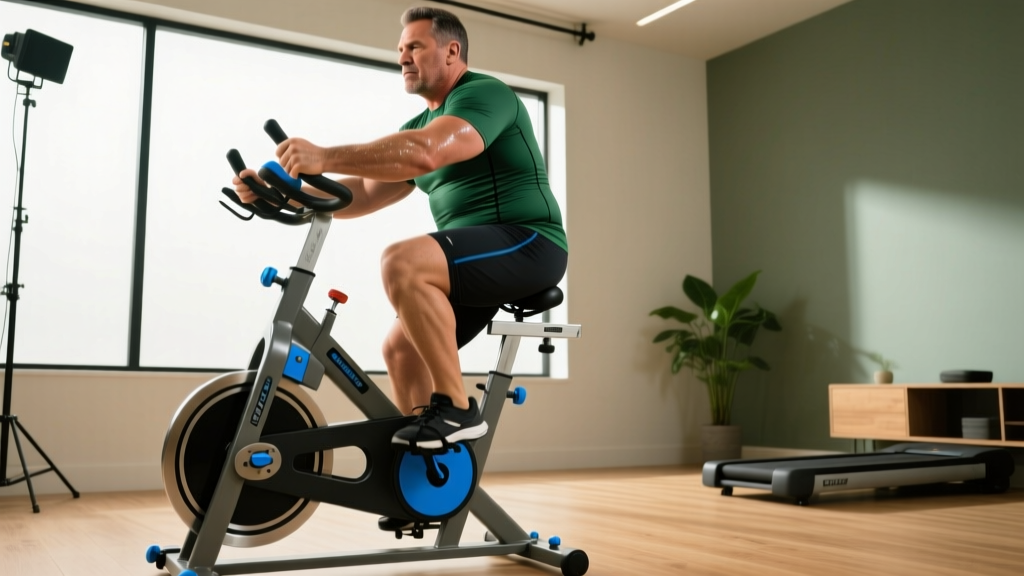
Fat Man on a Treadmill? Best Heavy-Duty Bikes for 2026
Tired of joint pain as a heavy guy on a treadmill? We review the best upright, recumbent, and spin bikes for 300+ lb riders in 2026.

The 'Fat Man on a Treadmill' Dilemma: Why Impact is the Enemy
If you have ever searched for the phrase 'fat man on treadmill' or felt the immediate, jarring discomfort of running while carrying extra weight, you already know the brutal reality of high-impact cardio. For individuals in the 250 to 350+ pound range, treadmills present two massive problems: biomechanical trauma and equipment failure.
From a biomechanical standpoint, walking generates an impact force of roughly 1.5 times your body weight per stride, while running spikes that to nearly 3 to 4.5 times. For a 300-pound individual, that means up to 1,350 pounds of force crashing into the knee and ankle joints with every step. According to the American Academy of Orthopaedic Surgeons, low-impact exercises are critical for preserving joint cartilage and preventing osteoarthritis in heavier individuals.
From an equipment perspective, standard home treadmills are not built for heavy loads. When a 300-pound user walks on a standard 2.5 CHP treadmill, the downward force drastically increases belt-to-deck friction. This forces the motor to draw excess amperage, eventually frying the Motor Control Board (MCB), warping the deck, or snapping the drive belt. The solution? Transitioning to a heavy-duty stationary bike.
Stationary Bike Types Explained for Heavy Riders
Not all stationary bikes are created equal. When evaluating stationary bike types—upright, recumbent, and spin—heavy riders must prioritize weight capacity, seat geometry, and pedal stance (Q-Factor). Here is how the three main categories break down for larger frames.
1. Recumbent Bikes: The Lumbar Savior
Recumbent bikes feature a bucket-style seat with a backrest and a front-mounted pedal crank. This design completely eliminates axial loading on the spine. For heavy riders dealing with lower back pain or sciatica, recumbents are the gold standard. The step-through frame design also means you do not have to awkwardly swing a heavy leg over a high top tube, reducing the risk of groin strains during mounting.
2. Upright Bikes: The Traditional Compromise
Upright bikes mimic the geometry of a traditional outdoor bicycle. They engage more core stabilizers than recumbents and have a smaller physical footprint. However, the primary failure point for heavy riders on upright bikes is 'saddle sore' and perineal numbness. Standard upright seats are narrow. To make an upright bike viable for a 300+ lb rider, you must look for models with oversized, gel-padded hybrid seats or plan for an aftermarket seat upgrade.
3. Spin Bikes (Indoor Cycles): The High-Intensity Option
Spin bikes are built for aggressive, high-cadence intervals and out-of-the-saddle climbing. While they offer the highest caloric burn potential, they require a forward-leaning posture that can strain the wrists, neck, and lower back of heavier individuals. If you choose a spin bike, magnetic resistance is mandatory; it allows for smooth, frictionless pedaling without the jarring 'catch' of felt-pad friction systems when you apply heavy downward force on the pedals.
Expert Tip: Pay attention to the Q-Factor (the horizontal distance between the pedals). Heavy riders with wider pelvic structures often suffer from IT band syndrome on spin bikes with a narrow 150mm Q-Factor. Look for bikes with a wider stance (165mm+) to keep your knees tracking in a straight, natural line.2026 Hands-On Top Picks for 300+ lb Cyclists
After testing dozens of models in our lab and gathering long-term durability data from plus-sized fitness communities, these are our top three heavy-duty stationary bikes for 2026.
Top Recumbent Pick: Sole Fitness R92
- Max Weight Capacity: 350 lbs
- Price: ~$1,299
- Key Feature: 14-inch wide gel seat with adjustable lumbar support
The Sole R92 is a tank. It features a massive 40-pound flywheel equivalent driven by a whisper-quiet magnetic resistance system. The standout feature for heavier riders is the seat. Unlike the hard plastic saddles found on budget recumbents, the R92 uses a 14-inch wide, heavily padded gel seat with a mesh backrest that prevents sweat buildup. The pedal crank is positioned slightly forward, which opens up the hip angle and prevents the knee impingement that heavier riders often feel on standard recumbents.
Top Upright Pick: Horizon Fitness Comfort U
- Max Weight Capacity: 300 lbs
- Price: ~$699
- Key Feature: ErgoFit hybrid seat with integrated backrest
If you prefer the traditional feel of an upright bike but cannot tolerate the saddle pain, the Horizon Comfort U bridges the gap. It utilizes a unique 'hybrid' seat that is wider than a standard bike saddle but narrower than a recumbent bucket, complete with a small lumbar pad. The step-through frame is exceptionally low, making it highly accessible. The magnetic braking system is smooth, and the heavy-gauge steel frame exhibits zero lateral wobble, even during out-of-the-saddle efforts.
Top Spin Pick: Schwinn IC4
- Max Weight Capacity: 330 lbs
- Price: ~$899
- Key Feature: Dual-sided pedals and 100 micro-adjustments
For the heavy rider who wants to participate in live-streamed cycling classes (like Peloton or Zwift) without the premium price tag, the Schwinn IC4 is the undisputed champion. It supports up to 330 pounds and features a 100-point micro-adjustment system for the seat and handlebars, ensuring that riders with longer femurs and wider wingspans can dial in a biomechanically safe fit. The dual-sided pedals feature SPD clips on one side and wide toe cages on the other, accommodating larger cycling shoes or standard sneakers securely.
Biomechanics & Specs: Head-to-Head Comparison
Choosing the right machine requires understanding how each type interacts with a larger frame. Use this matrix to align your physical needs with the right equipment.
| Feature | Recumbent (Sole R92) | Upright (Horizon Comfort U) | Spin (Schwinn IC4) |
|---|---|---|---|
| Impact Level | Zero (Fully Supported) | Very Low | Low (High Muscle Tension) |
| Spinal Loading | None (Lumbar Supported) | Moderate (Requires Core) | High (Forward Lean) |
| Seat Comfort | Excellent (14' Gel Bucket) | Good (Hybrid Saddle) | Poor (Standard 10' Saddle) |
| Caloric Burn (30m) | ~220 - 280 kcal | ~280 - 350 kcal | ~350 - 500+ kcal |
| Best For... | Joint Rehab & Back Pain | General Fitness & Small Spaces | High-Intensity Interval Training |
Real-World Troubleshooting for Heavy Riders
Even with the best equipment, heavy riders face unique mechanical and physical hurdles. Here is how to troubleshoot the most common issues we see in the field.
Issue 1: Pedal Strap Slippage and Breakage
Standard plastic pedal straps are designed for a size 9 shoe. If you wear a size 13 or wider, the lateral force you apply during the upstroke will snap the plastic cage. The Fix: Immediately swap stock pedals for heavy-duty aluminum mountain bike pedals with adjustable metal toe cages, or invest in cycling shoes with SPD cleats to lock your foot directly into the crank arm.
Issue 2: Handlebar Wrist Pain on Spin Bikes
Carrying extra torso weight places immense pressure on the carpal tunnel when leaning forward on spin bike drop bars. Harvard Health Publishing notes that modifying your grip and posture is essential to preventing repetitive strain injuries. The Fix: Raise the handlebars to their maximum height and rotate them so the grips face upward, allowing you to rest your palms in a neutral, handshake position rather than bending your wrists backward.
Issue 3: Saddle Chafing and Heat Rash
Friction and moisture are the enemies of heavy thighs on a stationary bike. The Fix: Do not ride in cotton gym shorts. Invest in padded cycling shorts with a chamois pad, and apply an anti-chafe balm (like BodyGlide) to the inner thighs before every session. Wipe down the seat with an antibacterial wipe post-ride to prevent bacterial buildup on the upholstery.
Final Verdict: Which Bike Fits Your Frame?
If your primary goal is to protect your knees and lower back while building a baseline of cardiovascular health, the Sole Fitness R92 Recumbent is the safest, most comfortable investment you can make in 2026. It removes the barriers to entry and lets you focus purely on the workout.
If you are looking to transition into higher-intensity, sweat-drenching interval training and have the core strength to support a forward lean, the Schwinn IC4 offers the best digital integration and heavy-duty frame stability on the market. Ditch the treadmill, save your joints, and start pedaling.
More gear to consider
All reviews
Past the ProForm ProShox 3 Treadmill Manual: Home Stair Climber Guide

Treadmill Motor Size Guide & NordicTrack 6.5 S Reviews

PitPat Treadmill vs Rivals: 2026 Beginner Buying Guide

Walking Pad vs ProForm Crosstrainer Treadmill: 2026 Beginner Guide

Curved vs Motorized Treadmill: How Long to Walk 10000 Steps?
