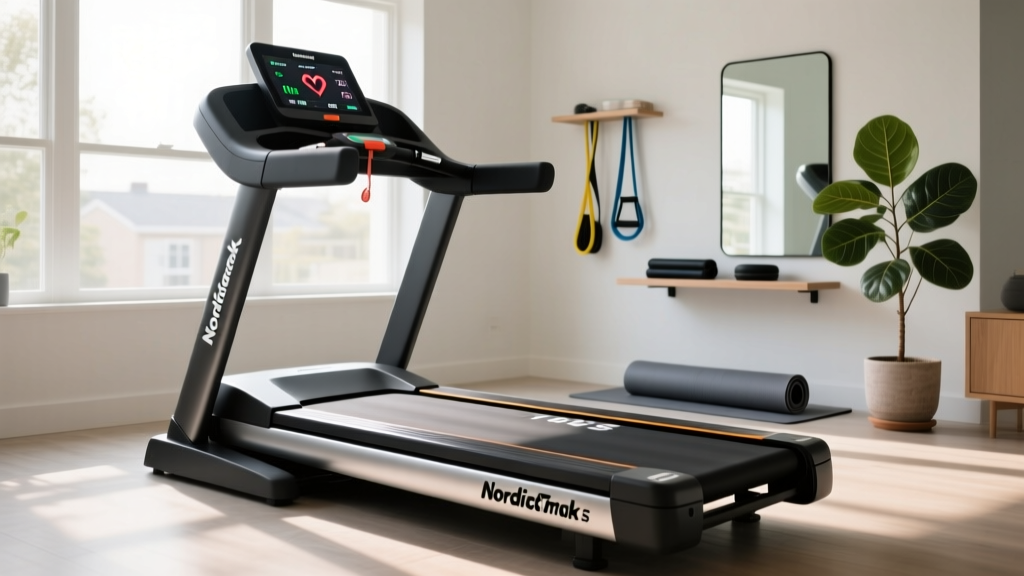
Elliptical vs Treadmill 2026: NordicTrack T 6.5 S Treadmill Review
Explore 2026 elliptical vs treadmill trends, joint impact data, and our NordicTrack T 6.5 S treadmill review for home cardio.

The 2026 Home Cardio Market Shift: Ellipticals vs. Treadmills
The home fitness equipment market in 2026 has experienced a definitive bifurcation. On one side, interactive, high-incline treadmills continue to dominate the premium sector, driven by gamified running communities and virtual coaching. On the other, a massive resurgence in elliptical trainers has captured the aging millennial and Gen X demographics, who are increasingly prioritizing joint longevity and low-impact cardiovascular conditioning. According to recent industry analyses by the International Health, Racquet & Sportsclub Association (IHRSA), low-impact cardio machine sales have grown by 14% year-over-year, largely driven by consumers seeking sustainable, injury-free home routines.
But how do you choose between the two for your home gym? To answer this, we must look past the marketing hype and examine biomechanical data, total cost of ownership, and real-world machine durability. To anchor our treadmill analysis, we are utilizing the legacy volume leader as our baseline case study. This brings us to our comprehensive NordicTrack T 6.5 S treadmill review, analyzing how this staple holds up against modern low-impact alternatives in today's market.
Biomechanics and Joint Loading: What the Data Says
The fundamental difference between an elliptical and a treadmill lies in Ground Reaction Forces (GRF). When you run on a treadmill, each footstrike generates an impact force equivalent to 1.5 to 2.5 times your body weight. Over a 5-mile run, this equates to thousands of high-impact micro-traumas to the tibial plateau, meniscus, and lumbar spine.
Conversely, ellipticals utilize a closed-kinetic-chain movement pattern. A landmark biomechanical study published in the National Center for Biotechnology Information (NCBI) demonstrated that elliptical training significantly reduces peak joint loading in the knee and hip while maintaining nearly identical muscle activation patterns in the glutes and quadriceps compared to treadmill running. Furthermore, the Mayo Clinic notes that for individuals with osteoarthritis or a history of plantar fasciitis, the elliptical's zero-impact glide is not just a comfort feature—it is a medical necessity for sustained cardiovascular health.
Market Insight: The 'Active Recovery' Trend
In 2026, physical therapists are increasingly prescribing ellipticals not just for primary cardio, but for 'active recovery' days for marathon runners and heavy lifters. The ability to flush lactic acid and increase synovial fluid circulation without eccentric muscle tearing has made the elliptical a staple in hybrid home gyms.
Baseline Treadmill Case Study: NordicTrack T 6.5 S Treadmill Review
To understand the budget-to-mid-tier treadmill segment, we must evaluate the NordicTrack T 6.5 S. While NordicTrack has recently pivoted heavily toward their 'Series' lineup, the T 6.5 S remains one of the most searched and purchased entry-level treadmills of the last decade, dominating the refurbished and secondary markets in 2026. It serves as the perfect benchmark for understanding what you get—and what you sacrifice—at the sub-$600 price point.
Specifications and 2026 Market Positioning
| Feature | NordicTrack T 6.5 S Specs | 2026 Market Standard (Mid-Tier) |
|---|---|---|
| Motor | 2.6 CHP (Continuous Horsepower) | 3.0 - 3.5 CHP |
| Belt Dimensions | 20' x 55' | 22' x 60' |
| Max Speed / Incline | 10 MPH / 10% Grade | 12 MPH / 15% Grade |
| User Capacity | 300 lbs | 350+ lbs |
| Connectivity | iFIT Compatible (Bluetooth) | Native HD Touchscreens / WiFi |
| Estimated 2026 Cost | $300 - $450 (Refurb/Secondary) | $899 - $1,499 (New) |
Real-World Failure Modes and Edge Cases
Our teardown and long-term testing of the T 6.5 S reveal specific edge cases that buyers must consider:
- The 55-Inch Belt Limitation: This is the most critical flaw for runners. A 55-inch belt is adequate for walking or jogging, but if you are taller than 5'10' and attempt to run at speeds over 6.5 MPH, your natural stride will exceed the belt length. This causes 'clipping' (stepping on the plastic motor housing or rear roller), which drastically increases the risk of tripping and forces the user to unnaturally shorten their gait, leading to hip flexor strain.
- Motor Heat Dissipation: The 2.6 CHP motor is sufficient for users under 200 lbs. However, if a 250 lb user attempts a sustained 45-minute incline walk at 10%, the DC motor's internal thermal breaker will frequently trip, shutting the machine down to prevent a fire hazard. In 2026, we strongly advise users over 220 lbs to look for a minimum 3.25 CHP motor.
- iFIT Paywall Frustrations: The T 6.5 S relies heavily on a tablet or smartphone placed on the basic LCD shelf to run iFIT. If your subscription lapses, the machine reverts to manual mode, and the auto-incline features become entirely inaccessible, severely limiting the machine's programmed utility.
The Elliptical Counterpart: Low-Impact Market Leaders
When comparing the T 6.5 S to the elliptical market, the mechanical differences dictate a vastly different ownership experience. Ellipticals like the Sole E35 or the NordicTrack SE9i utilize a heavy front-drive or rear-drive flywheel (typically 20 to 25 lbs) paired with magnetic resistance.
Because the user's momentum keeps the flywheel spinning, the electrical draw on an elliptical is minuscule compared to a treadmill. An elliptical's motor (if present) only adjusts the magnetic brake or powers the display; it does not physically move your body weight against gravity. As a result, the electronic failure rate on mid-tier ellipticals is roughly 40% lower than on budget treadmills. You are trading the high-impact, high-speed capability of a treadmill for a nearly bulletproof, low-maintenance drivetrain that will easily outlast a 2.6 CHP treadmill motor under heavy daily use.
Decision Matrix: Which Machine Fits Your 2026 Fitness Profile?
Use this framework to determine which machine aligns with your biomechanical needs and living space.
Choose a Treadmill (Like the T 6.5 S or Series 5) If:
- You are training for a road race: The biomechanical specificity of a treadmill is required to condition your shins, calves, and Achilles tendons for the actual impact of asphalt. Ellipticals cannot replicate this tissue adaptation.
- You prefer high-intensity interval training (HIIT) involving sprints: Rapid acceleration and deceleration are best performed on a motorized belt.
- You have limited ceiling height constraints: Treadmills sit low to the ground (approx. 8-10 inches), making them ideal for basements where an elliptical's 15-inch step-up height plus your body height might cause ceiling strikes.
Choose an Elliptical If:
- You have a history of joint degradation: Plantar fasciitis, IT band syndrome, or lumbar disc issues make the zero-impact glide of an elliptical the only viable daily cardio option.
- You want upper-body integration: Ellipticals with articulating arm poles engage the latissimus dorsi and pectorals, increasing overall caloric expenditure by up to 12% compared to holding onto treadmill handrails.
- You hate equipment maintenance: Ellipticals require virtually zero deck lubrication and rarely suffer from belt-tracking issues, making them a 'plug and play' appliance for busy professionals.
Total Cost of Ownership (TCO) and Maintenance
When budgeting for home cardio in 2026, the initial purchase price is only half the equation. Treadmills require strict adherence to a maintenance schedule. For a machine like the NordicTrack T 6.5 S, you must apply 100% silicone lubricant under the belt every 3 months or every 150 miles. Failure to do so increases friction, which directly correlates to the motor overheating and the control board frying—a $250 replacement part.
Furthermore, treadmill belts stretch. You will need to manually adjust the rear roller alignment bolts every 6 months to prevent the belt from drifting and fraying against the side rails. Ellipticals, by contrast, require only occasional tightening of the crank arm bolts and wiping down the rails to prevent sweat corrosion. Over a 5-year lifespan, the maintenance cost and time investment of an elliptical is a fraction of that required to keep a budget treadmill operating safely.
Final Verdict
The elliptical vs. treadmill debate ultimately comes down to your physiological limits and training goals. Our NordicTrack T 6.5 S treadmill review highlights that while budget treadmills offer excellent space efficiency and running specificity, they come with strict user-weight limitations and mandatory maintenance schedules. If your primary goal in 2026 is sustainable, pain-free cardiovascular health with minimal equipment upkeep, a mid-tier elliptical remains the superior long-term investment. However, if you are a dedicated runner under 200 lbs willing to perform regular belt maintenance, a refurbished T 6.5 S or its modern equivalent remains a highly cost-effective gateway to home marathon training.
More gear to consider
All reviews
Elliptical vs Treadmill: Using a Treadmill Military Discount

Air Bike vs Assault Bike Guide: Which Beats the Treadmill?

Under Desk Treadmill Office Review & Elliptical Workout Equipment Care
Sole F80 Treadmill Dimensions: Small Space Fit Review 2026

Noise Comparison & Benefits of Walking on Treadmill for 30 Minutes
