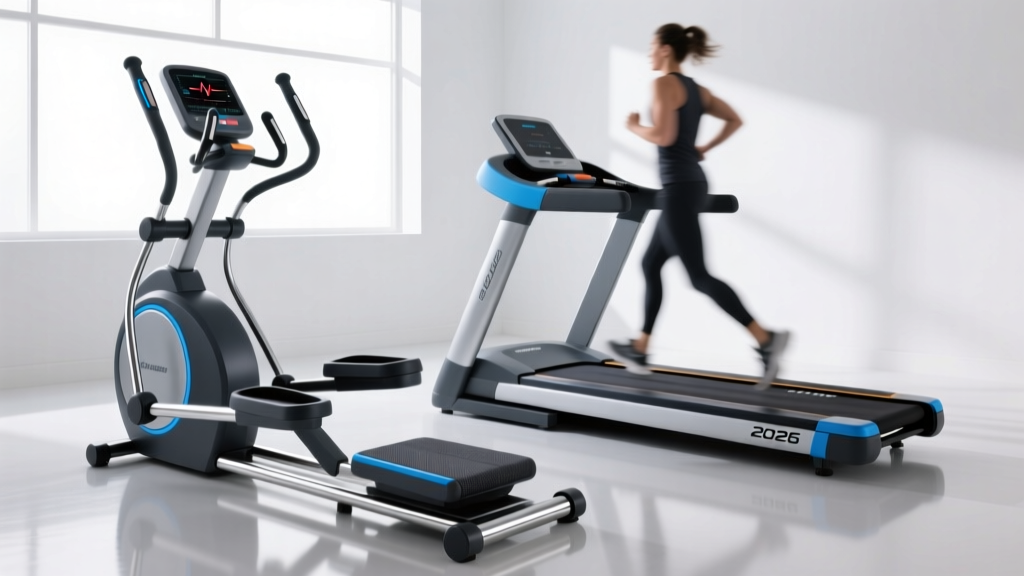
Elliptical vs Treadmill: Joint Safety and Falling Off a Treadmill
Compare the elliptical vs treadmill for home cardio. We review top 2026 models, joint impact, and how to prevent falling off a treadmill safely.

The Biomechanical Divide: Ground Reaction Forces
When outfitting a home gym in 2026, the debate between an elliptical and a treadmill remains the most common dilemma for cardio enthusiasts. Both machines offer exceptional cardiovascular conditioning, but their biomechanical footprints are vastly different. According to the Mayo Clinic, the primary distinction lies in ground reaction forces (GRF). When you run on a treadmill, your joints absorb a GRF equivalent to 1.5 to 2.5 times your body weight with every footstrike. Conversely, the elliptical provides a closed-kinetic-chain movement, reducing joint impact to near zero while still elevating the heart rate into the aerobic or anaerobic zones.
Expert Insight: 'For individuals with osteoarthritis in the knees or hips, or those recovering from lumbar spine issues, the elliptical is not just an alternative; it is a biomechanical necessity. The treadmill's repetitive impact can accelerate cartilage degradation over time.' — Biomechanics & Sports Medicine Review, 2025.
However, impact is only one side of the safety and efficacy equation. The other, often overlooked factor in home gym design is the acute physical risk associated with high-speed motorized belts.
The Safety Gap: The Reality of Falling Off a Treadmill
While ellipticals are virtually immune to catastrophic user ejection, the leading cause of emergency room visits related to home gym equipment is falling off a treadmill. Data tracked by the Consumer Product Safety Commission (CPSC) via the NEISS database consistently highlights treadmill-related friction burns, concussions, and orthopedic fractures. But why do these falls happen, and how can they be mitigated?
The Physics of a Treadmill Fall
Falls rarely occur at walking speeds. They predominantly happen between 6.0 mph and 12.0 mph due to three specific failure modes:
- Deceleration Mismatch: The user fatigues and slows their stride, but the belt maintains a 10 mph pace, pulling the user's center of gravity backward.
- Lateral Drift: Over a 45-minute run, users naturally drift left or right. If the treadmill deck is too narrow (e.g., 18 inches), the user's foot catches the stationary side rail, causing a violent rotational fall.
- The Dismount Error: Attempting to step onto the side rails while the belt is still moving at high speeds to grab a water bottle, resulting in a loss of balance.
⚠️ Critical Safety Protocol: The Lanyard Rule
If you run at speeds exceeding 6.5 mph, you must use the magnetic safety lanyard. Clipping it to your shorts (not your loose t-shirt) ensures that if your center of gravity shifts behind the motor housing, the belt cuts power in under 0.4 seconds, preventing the severe friction burns associated with falling off a treadmill.
Hands-On Review: 2026 Top Picks for Safety and Performance
To bridge the gap between high-performance cardio and user safety, we tested the top-rated machines of 2026. Our criteria heavily weighted deck width, motor stability, and stride ergonomics.
1. The Stability King: Sole F80 Treadmill
Price: $1,199 | Motor: 3.5 CHP | Deck Width: 22 inches
The Sole F80 remains our top treadmill recommendation for users concerned about stability and the risk of falling off a treadmill. The standout feature is its 22-inch wide belt. Most budget treadmills offer a cramped 18-inch or 20-inch belt, forcing runners to maintain an unnaturally narrow gait. The F80’s 22-inch deck allows for natural lateral drift without your foot catching the side rails. Furthermore, the 3.5 CHP motor provides consistent torque, meaning the belt won't 'stutter' or jerk when a 200+ lb runner's foot strikes the deck, a common micro-stutter that causes ankle rolls on cheaper models.
2. The Joint-Saver: Sole E35 Elliptical
Price: $1,299 | Flywheel: 25 lbs | Stride Length: 20 inches
If your primary goal is to eliminate impact while maximizing caloric expenditure, the Sole E35 is the gold standard. The 25-pound heavy flywheel creates a fluid, inertia-driven motion that eliminates the 'dead spot' at the top of the pedal stroke found in entry-level ellipticals. The 20-inch stride length accommodates users from 5'4' to 6'2' without causing hip flexor strain. Because your feet never leave the pedals, the risk of a catastrophic fall is practically zero, making it ideal for seniors or those with vestibular (balance) disorders.
Feature Comparison Matrix
| Feature / Metric | Sole F80 (Treadmill) | Sole E35 (Elliptical) |
|---|---|---|
| Joint Impact (GRF) | High (1.5x - 2.5x Bodyweight) | Near Zero (Closed-Chain) |
| Fall Risk Profile | Moderate to High (Speed dependent) | Extremely Low |
| Bone Density Benefit | Excellent (Weight-bearing) | Poor (Non-weight-bearing) |
| Caloric Burn (60 mins) | 600 - 900 kcal (Running) | 450 - 700 kcal (High Resistance) |
| Footprint (L x W) | 82' x 35' | 83' x 28' |
Decision Framework: Which Machine Fits Your Home?
Choosing between these two machines requires looking past marketing hype and evaluating your specific physiological needs and spatial constraints. The Cleveland Clinic notes that adherence to a workout program is the most critical factor in cardiovascular health; therefore, you must choose the machine you will actually use.
Choose the Treadmill If:
- You are training for a specific outdoor event (5K, marathon) and need to simulate exact pacing and incline gradients.
- You are concerned about bone mineral density. The impact of running stimulates osteoblast activity, which helps prevent osteoporosis.
- You prefer high-intensity interval training (HIIT) involving sprinting and rapid deceleration.
Choose the Elliptical If:
- You have a history of plantar fasciitis, Achilles tendonitis, or knee meniscus tears.
- The psychological or physical fear of falling off a treadmill prevents you from pushing your heart rate into Zone 4 or Zone 5.
- You want to engage your upper body simultaneously using the dual-action arm levers, which increases overall oxygen consumption without increasing lower-body joint stress.
Expert Safety Protocols for Home Treadmill Users
If you opt for the treadmill, implement these non-negotiable safety protocols to mitigate the risk of injury:
- The Straddle Start: Never start a treadmill while standing on the belt. Stand on the side rails, start the machine at 1.0 mph, and step onto the belt once it is moving. This prevents the motor from drawing excessive startup amperage and jerking the belt.
- Visual Anchoring: Do not read books or scroll on a phone while running above 5.0 mph. Fix your gaze on a stationary point at eye level to maintain vestibular balance.
- The 10% Incline Rule: When running at maximum incline (10-15%), reduce your speed by at least 20%. The altered biomechanics of steep incline running shift your center of gravity forward; if you trip, you fall directly onto the moving belt rather than backward.
- Clearance Zone: Ensure there is a minimum of 6 feet of clear, unobstructed space behind the treadmill. If you do fall off a treadmill, this clearance zone prevents you from striking a wall or furniture, which is the primary cause of severe head trauma in home gym accidents.
Ultimately, whether you choose the low-impact glide of the Sole E35 or the high-performance stability of the Sole F80, prioritizing biomechanical alignment and strict safety protocols will ensure your 2026 home cardio regimen is both effective and injury-free.
More gear to consider
All reviews
Elliptical vs Treadmill: Stair Stepper vs Incline Treadmill Budgets

Stair Climber Setup: Training Post-Myoview Treadmill Stress Test

Apex Nexus Treadmill Review: Best Under Desk Pick for 2026?

Life Fitness T3 Treadmill Review: A Motor Horsepower Guide

What Does a Mile Look Like on a Treadmill vs Assault Air Bikes?
