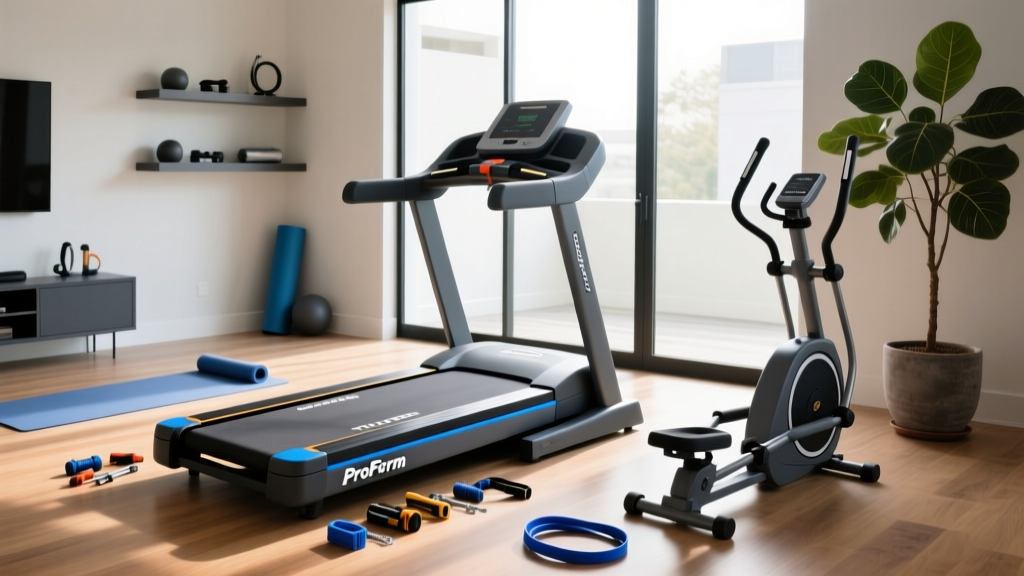
Elliptical vs Treadmill: Space Layouts & Circuit Breaker Safety
Compare ellipticals and treadmills for home cardio. Learn space optimization layouts, clearance needs, and how to prevent a tripped treadmill circuit breaker.

The Spatial Reality: Footprint, Clearance, and Ceiling Geometry
When designing a home cardio zone, the debate between an elliptical and a treadmill extends far beyond joint impact and calorie burn. From a space optimization and layout design perspective, these two machines interact with your room's geometry in fundamentally different ways. In 2026, with home square footage at a premium and multi-use spaces becoming the norm, understanding the 3D spatial requirements of your cardio equipment is critical before making a $2,000+ investment.
Let us look at the physical footprint of two industry-leading models: the NordicTrack Commercial 2450 (treadmill) and the Sole E95 (elliptical). While their length and width are comparable, their vertical spatial demands are vastly different.
- Treadmill Footprint (NordicTrack 2450): 80" L x 38" W. Deck height sits at roughly 9 to 10 inches off the floor.
- Elliptical Footprint (Sole E95): 82" L x 31" W. Step-up height is roughly 12 inches, but the user remains at their natural standing height.
The CPSC 39-Inch Safety Rule
According to the U.S. Consumer Product Safety Commission (CPSC), you must maintain a minimum of 39 inches of clear space behind any treadmill. This is not merely a suggestion; it is a critical safety buffer to prevent severe friction burns and impact injuries in the event of a fall. Ellipticals, being closed-loop kinetic systems where the user's feet never leave the pedals, do not require this massive rear ejection zone. This allows you to place an elliptical much closer to a wall, saving up to 12 square feet of usable floor space in a compact home gym layout.
Electrical Zoning and the Dreaded Treadmill Circuit Breaker
One of the most overlooked aspects of home gym layout design is electrical infrastructure. This is where the spatial planning of a treadmill diverges sharply from an elliptical, often resulting in the infamous treadmill circuit breaker trip—a frustrating failure mode that halts workouts and can degrade the machine's internal electronics over time.
Treadmills require massive electrical current to overcome the friction of the belt and the weight of the user. A premium treadmill with a 3.5 to 4.0 Continuous Horsepower (CHP) motor, such as the Sole F80 or Horizon 7.4, can draw between 12 and 15 amps under heavy load, with startup surges pushing even higher. If you plug a treadmill into a standard 15-amp bedroom circuit that is also sharing load with a space heater, an air conditioner, or even a high-draw gaming PC, the treadmill circuit breaker will trip almost immediately.
Ellipticals, conversely, are incredibly efficient. Many are self-powered via electromagnetic resistance, and even motorized models (which adjust the ramp incline) rarely draw more than 2 to 3 amps. You can safely plug an elliptical, a TV, a fan, and a sound system into a single standard 15-amp household circuit without ever worrying about a power cutoff.
| Machine Type | Avg. Power Draw | Circuit Requirement | Layout Constraint |
|---|---|---|---|
| Heavy-Duty Treadmill (3.5+ CHP) | 12A - 18A | Dedicated 20-Amp Circuit | Must be routed to main panel; limits placement |
| Light Treadmill / Walking Pad (2.0 HP) | 6A - 9A | Standard 15-Amp Circuit | Can share circuit with low-draw electronics |
| Motorized Elliptical (e.g., Sole E95) | 1.5A - 3A | Standard 15-Amp Circuit | Highly flexible; can share with AV equipment |
| Self-Powered Elliptical (e.g., LifeFitness) | 0A (Generates own) | None | Can be placed in room center or away from outlets |
"When planning a home gym layout, always map your electrical panels first. Running a new dedicated 20-amp line for a treadmill can cost between $300 and $600 depending on your home's wiring. If your ideal spatial layout is far from the main electrical panel, an elliptical offers a zero-cost electrical alternative."
— Home Gym Infrastructure Guidelines, National Fire Protection Association (NFPA) electrical best practices (NFPA NEC)
Acoustic Space and Vibration Dampening
Space optimization is not just about visual footprint; it is also about acoustic space. In multi-story homes or shared living environments, the kinetic energy transferred to the floor dictates where you can place your machine.
Treadmills generate severe low-frequency impact noise. Every footstrike sends a shockwave through the floor joists. To optimize a treadmill layout, you must invest in high-density rubber flooring (at least 3/8" thick, costing roughly $2.50 to $4.00 per square foot) and place the machine away from shared walls or directly above quiet zones like home offices. Furthermore, folding treadmills, while saving visual space when stored, often suffer from compromised deck rigidity, amplifying the acoustic footprint during use.
Ellipticals are virtually impact-free. Because the user's feet never leave the pedals, the force exerted on the floor is limited to the static weight of the machine and the user, plus minor lateral sway. This allows you to place an elliptical on upper floors, over hardwood, or in close proximity to shared walls without requiring expensive acoustic dampening mats, vastly expanding your layout options.
Biomechanical Zoning: Stride Clearance and Sightlines
When designing the ergonomic zone around your cardio machine, you must account for the user's dynamic envelope—the space their body occupies while in motion.
The Elliptical Arm-Swing Envelope
While ellipticals save space behind the machine, they demand more lateral and frontal clearance. A commercial-grade elliptical with a 20-inch stride length requires the user's arms to extend fully forward and backward. If you are placing the machine in a corner or an alcove, you must leave at least 15 inches of clearance on the sides and front to prevent knuckles from scraping against walls or furniture. Additionally, the moving arm levers can pose a hazard to pets or small children walking past the machine, necessitating a wider "safe zone" around the perimeter.
Treadmill Sightlines and AV Integration
Treadmills lock the user into a forward-facing posture, making them highly conducive to AV-integrated layouts. Designing a treadmill space usually involves centering the machine directly in front of a wall-mounted television or a window. Ellipticals, particularly those with moving arm levers, cause the user's upper body to sway slightly, which can make focusing on a small screen or reading a tablet more difficult, often requiring larger, wider screens positioned further back in the room.
Decision Matrix: Which Machine Fits Your Room?
Use the following layout matrix to determine which machine aligns with your specific spatial and infrastructural constraints.
| Room Constraint | Choose Treadmill If... | Choose Elliptical If... |
|---|---|---|
| Low Ceilings (< 8 ft) | You only use flat inclines and are under 5'10". | You want full incline/resistance without head-strike risk. |
| Shared 15A Electrical Circuit | You are buying a low-HP walking pad or light jogger. | You want a heavy-duty, high-resistance workout without tripping the treadmill circuit breaker. |
| Wall-Flush Placement | Impossible (Requires 39" rear CPSC clearance). | Highly viable (Only requires minimal side/front arm clearance). |
| Upper Floor / Shared Walls | You are willing to invest in premium acoustic matting. | You need silent, impact-free operation for household harmony. |
Expert Troubleshooting: When the Power Cuts Out
If you have already committed to a treadmill layout and find yourself constantly resetting a tripped treadmill circuit breaker, do not simply swap the breaker for a higher amperage—this is a severe fire hazard. Instead, follow these layout-correction steps:
- Check the Extension Cord: Never use a standard household extension cord. If you must extend the reach of your layout, use a heavy-duty, 12-gauge (or lower) cord rated for 20 amps, kept under 6 feet in length.
- Isolate the Circuit: Map your breaker panel. Turn off the breaker your treadmill is on and walk through the house to see what else loses power. Unplug all other devices (especially HVAC units, space heaters, and dehumidifiers) from that specific loop.
- Lubricate the Belt: A dry treadmill belt increases friction, forcing the motor to draw excess amperage. Applying 100% silicone lubricant every 3 months can reduce motor amp draw by up to 15%, potentially saving your breaker from tripping during high-speed sprints.
Ultimately, choosing between an elliptical and a treadmill for home cardio requires looking past the spec sheet and examining the room itself. By mapping your ceiling heights, respecting the CPSC safety perimeters, and auditing your electrical panel before purchase, you will create a home cardio space that is safe, functional, and optimized for years of uninterrupted training.
More gear to consider
All reviews
XTERRA 6.6 Treadmill vs Stationary Bikes: Budget & Value

What Number is 12 Incline on a Treadmill? Curved vs Motorized

Pronounce Treadmill Workouts Obsolete: Air Bike vs Assault Bike Maintenance Guide
Air Bike vs Assault Bike Care & ProForm Treadmill Console Not Working

NordicTrack T Series 10 Treadmill Review & Compact Cardio Picks 2026