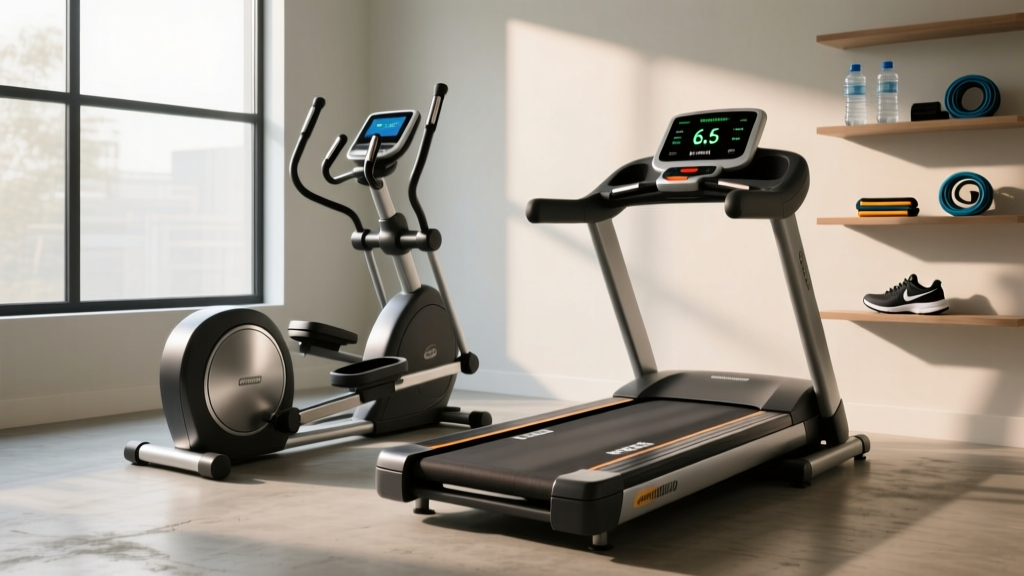
Elliptical vs Treadmill: Is 30 Min on Treadmill Everyday Worth the Cost?
Comparing elliptical vs treadmill for home cardio? We break down the true costs, ROI, and value of committing to 30 min on treadmill everyday.

The Home Cardio Investment: Setting the Baseline
When building a home gym, the debate between an elliptical and a treadmill is the most common crossroads for fitness enthusiasts. Both machines offer exceptional cardiovascular benefits, but they differ drastically in biomechanics, footprint, and long-term financial impact. Many buyers are specifically motivated by the popular 30 min on treadmill everyday challenge—a daily benchmark proven to improve heart health, manage weight, and boost mental clarity. But if your goal is daily, consistent use, does a treadmill actually offer a better return on investment (ROI) than an elliptical?
As a senior equipment analyst reviewing the 2026 cardio market, I look past the glossy marketing and focus on the total cost of ownership. This means analyzing upfront pricing, hidden maintenance fees, electricity draw, depreciation, and the physiological ROI of your daily 30-minute sessions. Let us break down the exact numbers to help you decide which machine deserves your floor space and your budget.
Quick Value Summary: If your primary goal is high-calorie expenditure and bone-density maintenance, the treadmill wins the physiological ROI. If your goal is joint preservation, near-zero maintenance, and lower electricity costs over a 10-year lifespan, the elliptical is the superior financial asset.The Upfront Cost Matrix: 2026 Market Pricing
The barrier to entry for both machines is surprisingly similar, but the ceiling for premium models diverges. Treadmills require expensive continuous-duty motors and heavy-duty decks, which drives up the cost of premium units. Ellipticals rely on flywheels and pivot arms, keeping manufacturing costs slightly more contained at the high end.
| Machine Category | Budget Pick (Under $800) | Mid-Range ($800 - $1,300) | Premium ($1,500+) |
|---|---|---|---|
| Treadmill | Horizon T101 ($699) | Sole F80 ($1,199) | NordicTrack 2450 ($2,199) |
| Elliptical | Schwinn 430 ($699) | Sole E35 ($1,099) | Bowflex Max M9 ($2,299) |
Value Insight: At the mid-range tier—the sweet spot for daily users—the Sole F80 treadmill and the Sole E35 elliptical are priced almost identically. However, the Sole F80 features a 3.5 Continuous Horsepower (CHP) motor, while the E35 utilizes a 20-pound magnetic flywheel. The treadmill's motor is a complex, heat-generating component that will eventually require servicing; the elliptical's flywheel is a simple mass of metal that will virtually never fail.
The Daily Durability Test: Sizing for the 30-Minute Habit
Committing to 30 min on treadmill everyday puts a specific, predictable load on your machine. That is roughly 15 to 20 miles per week, depending on your speed. This daily habit exposes the weakest link in budget treadmills: the motor controller board.
Treadmill Motor Sizing for Daily Use
If you are walking or jogging 30 minutes daily, you must purchase a treadmill with a minimum of 2.5 CHP (Continuous Horsepower). Do not confuse this with 'Peak Horsepower,' a marketing gimmick used on sub-$500 models. A 2.0 CHP motor running 30 minutes every single day will overheat, degrade the internal wiring, and likely fry the motor controller board within 18 to 24 months. Replacing a controller board costs between $150 and $300, instantly destroying your budget machine's value proposition.
Elliptical Flywheel and Pivot Tolerances
Ellipticals do not have motors to burn out, but they do have pivot arms and rail bearings. For a daily 30-minute user, the critical spec is the flywheel weight. A flywheel under 15 pounds (common in budget models) will result in a jerky, momentum-breaking stride that places uneven stress on the pedal bearings. For daily use, a 20-pound flywheel (like the one on the Sole E35) ensures smooth inertia, drastically reducing wear and tear on the machine's moving joints.
Hidden Costs: Maintenance, Electricity, and Space
The sticker price is just the beginning. Let us calculate the hidden operational costs of running these machines daily in 2026.
- Treadmill Belt Lubrication: Treadmill decks require 100% silicone lubrication to prevent friction from destroying the motor. If you walk 2.5 miles a day (30 mins at 5 mph), you cover 75 miles a month. Most manufacturers require lubrication every 150 miles. That means a $15 bottle of silicone lube every two months ($90/year).
- Elliptical Rail Cleaning: Ellipticals require zero lubrication on their tracks. You simply need to wipe the rails with a microfiber cloth and rubbing alcohol once a week to prevent dust buildup from degrading the polyurethane wheels. Cost: $5/year.
- Electricity Draw: As of 2026, the average US electricity rate hovers around $0.17 per kWh. A treadmill with a 3.0 CHP motor draws roughly 600 to 700 watts under a 180-pound load. Running it for 30 minutes daily consumes about 10.5 kWh per month, costing roughly $21.50/year. An elliptical uses magnetic resistance and draws less than 50 watts (mostly for the LCD console), costing less than $2.00/year.
"Over a 5-year lifespan, a daily treadmill user will spend approximately $550 more on electricity, belt lubrication, and potential belt replacements compared to an elliptical user. When budgeting, always factor in the 'friction tax' of motorized belts."
Caloric ROI & Joint Biomechanics: What Does Your Body Get?
Financial value means nothing if the machine does not deliver physiological results. Is the physical toll of the treadmill worth the caloric burn?
The Calorie Burn Equivalence
According to comprehensive metabolic data published by Harvard Medical School, the caloric expenditure between the two machines is remarkably similar when effort is matched. A 155-pound individual engaging in a vigorous 30-minute session will burn approximately 335 calories on an elliptical trainer, and roughly 335 calories running on a treadmill at a 5.2 mph pace (11.5 min/mile). However, if your 30-minute treadmill routine consists of a moderate 3.5 mph walk, the burn drops significantly to about 149 calories. The elliptical forces full-body engagement (pushing and pulling the arm levers), which naturally elevates the heart rate and caloric burn even at lower perceived exertion levels.
Joint Reaction Forces (JRF)
The most critical differentiator is impact. The Mayo Clinic highlights that weight-bearing exercises like treadmill walking or running are essential for maintaining bone mineral density. However, running on a treadmill generates joint reaction forces equivalent to 2.5 to 3 times your body weight with every footstrike. Over a year of daily 30-minute runs, that is hundreds of thousands of high-impact repetitions on your knees, hips, and lumbar spine.
Conversely, the elliptical provides a closed-kinetic-chain movement. Your feet never leave the pedals, reducing joint impact to near zero while still activating the glutes, quadriceps, and hamstrings. If you have a history of meniscus tears, plantar fasciitis, or lower back pain, the elliptical offers a vastly superior long-term health ROI by preventing costly orthopedic surgeries down the line.
Space, Depreciation, and Resale Value
Home gym equipment is notorious for rapid depreciation. If you decide to upgrade or move in three years, which machine protects your capital better?
Footprint Analysis: A standard mid-range treadmill (like the Sole F80) measures roughly 82 inches long by 35 inches wide, and requires an additional 24 inches of clearance behind it for safety. It also cannot be folded while plugged in without engaging the hydraulic latch. A mid-range elliptical (like the Sole E35) measures 70 inches by 28 inches. The elliptical saves roughly 40% of your floor space, a massive financial benefit if you are paying high rent per square foot in an urban apartment.
Resale Market Realities: Treadmills depreciate by 40% to 50% the moment they are assembled. Furthermore, the used treadmill market is highly depressed because buyers are terrified of inheriting a machine with a hidden motor defect or a worn-out deck. Ellipticals, having fewer complex electronic and motorized failure points, hold their value slightly better (depreciating around 30% to 40%) and sell much faster on secondary markets like Facebook Marketplace or Craigslist.
Final Verdict: Which Machine Wins Your Budget?
The decision ultimately hinges on your specific physiological needs and your tolerance for ongoing maintenance.
Choose the Treadmill If:
- Your primary goal is training for outdoor road races (5Ks, marathons) and you need to adapt your biomechanics to pavement striking.
- You want to maximize bone density through high-impact, weight-bearing loading.
- You are willing to pay the 'friction tax' (lubrication, higher electricity bills, and eventual belt replacements) to support your 30 min on treadmill everyday goal.
- You have the physical space to accommodate an 8-foot footprint and the budget for a 3.0+ CHP motor ($1,000+ minimum).
Choose the Elliptical If:
- You want the highest caloric burn per minute with the lowest perceived joint impact.
- You are recovering from joint injuries, or want to proactively protect your knees and lower back for decades of daily use.
- You want a 'set it and forget it' machine with virtually zero maintenance, negligible electricity costs, and a smaller spatial footprint.
- You are on a strict budget and want to maximize the lifespan of a sub-$800 machine without risking a motor burnout.
Both machines are phenomenal tools for cardiovascular health. But when you run the math on long-term ownership, the elliptical is the undisputed champion of low-maintenance financial value, while the treadmill remains the premium, high-impact choice for dedicated runners willing to pay the upkeep costs.
More gear to consider
All reviews
Elliptical vs Treadmill Value: How to Recenter a Treadmill Belt
NordicTrack Apex 4100i Treadmill: Best Folding Pick For Small Spaces

ProForm 430i Treadmill: Feature Comparison & Common Buying Mistakes
Automatic Treadmill vs Walking Pad: 2026 Head-to-Head
Troubleshooting Your Pregnancy Treadmill Workout: Curved vs Motorized Mistakes
