Elliptical vs Treadmill: Walking on a Treadmill to Lose Weight in 2026
Analyzing 2026 market trends: elliptical vs treadmill for home cardio. Discover if walking on a treadmill to lose weight outpaces elliptical training.

For a 20-minute session, a high-resistance elliptical workout burns approximately 10% to 15% more total calories than a moderate incline treadmill walk. However, walking on a 15% incline treadmill activates the posterior chain muscles significantly more and provides essential weight-bearing bone density benefits. This guide is designed for busy adults and fitness enthusiasts seeking time-efficient, 20-minute cardio routines for weight loss without compromising joint health. Your optimal choice depends on whether your primary goal is maximum immediate calorie expenditure or long-term lower-body muscle development.
Key Takeaways
- Calorie Burn: A 20-minute elliptical session burns roughly 223 calories for a 185-pound individual, edging out the 190 calories burned on a 15% incline treadmill.
- Muscle Activation: Incline treadmill walking targets the glutes and hamstrings 30% more effectively than the elliptical.
- Joint Impact: The elliptical provides zero-impact motion, making it superior for users with knee or lower back pain.
Calorie Burn and Weight Loss Metrics
When evaluating a 20 min elliptical vs walking incline treadmill workout, total energy expenditure is the primary metric for weight loss. According to metabolic data published by Harvard Medical School, a 185-pound person burns 335 calories in 30 minutes on an elliptical. Scaled to a 20-minute timeframe, this equates to 223 calories.
Conversely, walking at 3.5 mph on a flat treadmill burns roughly 178 calories in 20 minutes for the same individual. Elevating the deck to a 15% incline increases this metabolic demand, pushing the 20-minute burn to approximately 190 calories. The elliptical maintains a slight caloric advantage due to the simultaneous engagement of the upper body through moving handlebars.
Muscle Activation and Biomechanics
Posterior Chain Engagement
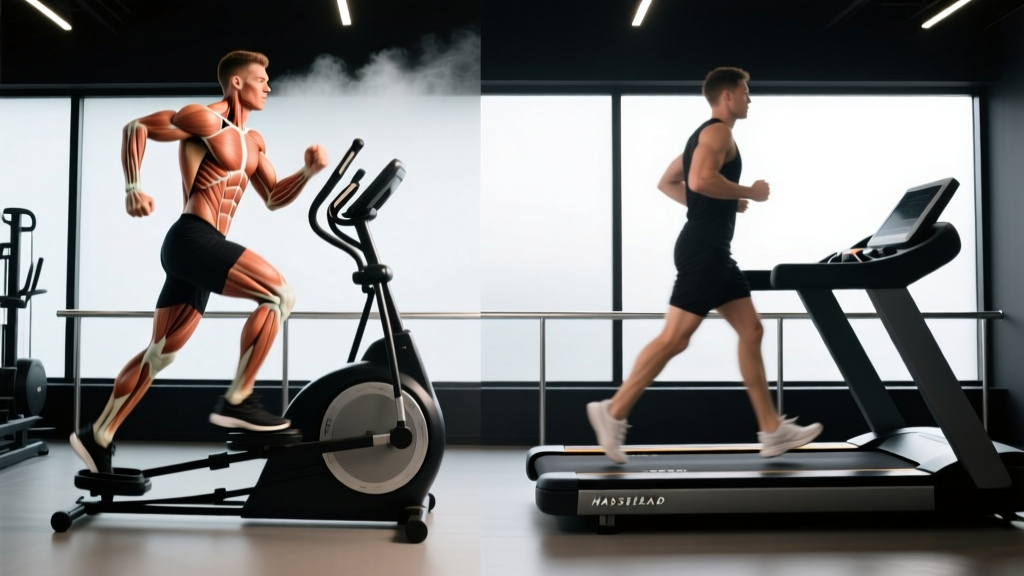
While the elliptical offers full-body movement, the incline treadmill forces the lower body to work against gravity. Research indexed by the National Institutes of Health demonstrates that increasing treadmill gradient to 12% or higher significantly amplifies electromyographic (EMG) activity in the gluteus maximus and biceps femoris.
If your goal is to sculpt the lower body while performing cardiovascular exercise, the incline treadmill is biomechanically superior. The elliptical relies on momentum once the flywheel is spinning, which can reduce active muscle tension if the user does not manually increase the magnetic resistance.
Defining the Equipment
Elliptical Cross-Trainer: A stationary cardiovascular machine that simulates stair climbing, walking, or running without causing excessive pressure to the joints, utilizing a continuous oval motion path for the pedals and synchronized moving handlebars.
Incline Treadmill Walking: A weight-bearing cardiovascular exercise performed on a motorized belt where the front deck is elevated to a specific gradient percentage, forcing the posterior chain muscles to work against gravity during each stride.
Joint Impact and Injury Prevention
Joint preservation is a critical factor for long-term workout consistency. The elliptical is a closed-kinetic-chain exercise, meaning your feet never leave the pedals. This eliminates the ground reaction forces associated with walking or running.
Incline treadmill walking, despite being lower impact than running, still generates a ground reaction force equal to 1.2 to 1.5 times your body weight with every step. For individuals managing patellofemoral pain syndrome or plantar fasciitis, the 20-minute elliptical workout is the definitively safer option.
20-Minute Workout Protocols
Use this decision framework and comparison matrix to select the correct 20-minute protocol for your current fitness level and physical condition.
| Feature | 20-Min Elliptical Intervals | 20-Min Incline Treadmill Walk |
|---|---|---|
| Caloric Expenditure | ~223 kcal | ~190 kcal |
| Target Heart Rate | 140 BPM - 160 BPM | 120 BPM - 140 BPM |
| Joint Stress | Minimal (Zero Impact) | Moderate (Weight-Bearing) |
| Primary Muscles | Quads, Chest, Back | Glutes, Hamstrings, Calves |
20-Minute Workout Decision Checklist
- Choose the Elliptical if: You are recovering from a lower-body injury, want to engage your upper body, or need to maximize calorie burn in a strict 20-minute window.
- Choose the Incline Treadmill if: You want to improve bone mineral density, target your glutes, or prefer a natural walking gait over a fixed machine pathway.
Frequently Asked Questions
Is 20 minutes on the elliptical enough to lose weight?
Yes, provided it creates a caloric deficit. A daily 20-minute elliptical session burns roughly 1,500 extra calories per week. According to the American Council on Exercise, combining this daily expenditure with a moderate dietary deficit yields approximately one pound of fat loss every two to three weeks.
Does walking on an incline burn more fat than the elliptical?
Incline walking keeps the heart rate in Zone 2 (typically 120 to 140 BPM), which optimizes the percentage of energy derived from fat oxidation. The elliptical often pushes users into Zone 3 or 4, burning more total calories but a lower percentage of fat specifically. Total caloric deficit remains the primary driver of weight loss regardless of the fuel source.
Which is better for bad knees: elliptical or incline treadmill?
The elliptical is vastly superior for bad knees. The continuous, gliding pedal motion eliminates the repetitive heel-strike impact forces that aggravate meniscus tears and osteoarthritis during treadmill walking, even at slow speeds.
Conclusion and Next Steps
Choosing between the elliptical and the incline treadmill ultimately depends on your joint health and muscle-targeting goals. The elliptical wins for pure 20-minute calorie burn and joint preservation, while the incline treadmill excels at posterior chain development and bone health. To begin, commit to the 20-Minute Elliptical Interval Protocol on your next gym visit, tracking your heart rate to ensure you hit the 140 BPM threshold for maximum metabolic output.
More gear to consider
All reviews
Stair Climber Machine Home Guide vs LiveStrong Treadmill LS 10.0 T
Can Walking on a Treadmill Lose Belly Fat? Home Stair Climber Guide

Image 15.0 R Treadmill: 2026 Features & Buying Guide
NordicTrack A2105 Treadmill vs Walking Pads: 2026 Guide
ProForm 12.0 Treadmill vs Elliptical: Maintenance & Longevity Guide