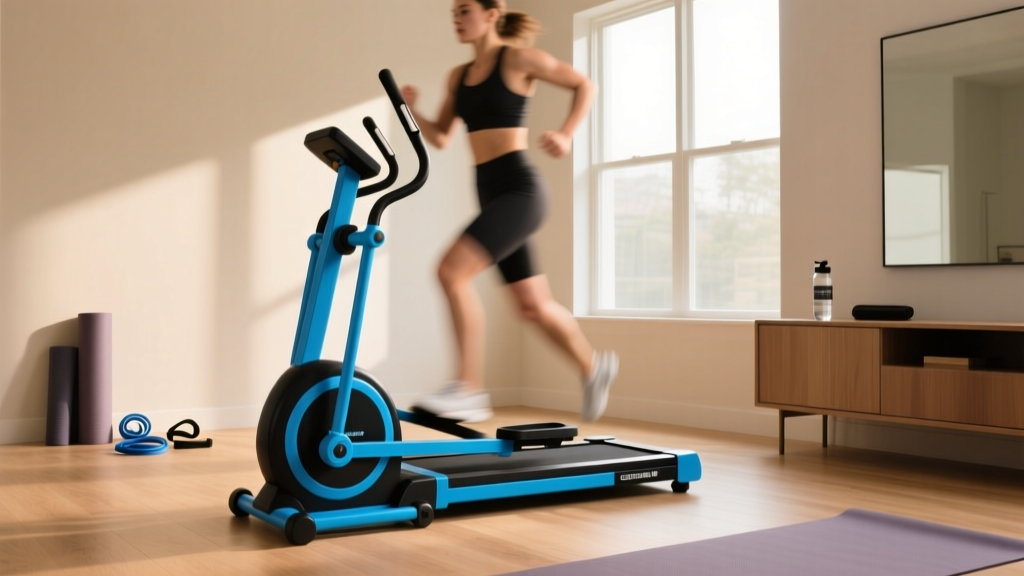
Elliptical vs Treadmill: How Long to Walk on Treadmill to Get 10k Steps
We break down elliptical vs treadmill costs, ROI, and exactly how long to walk on treadmill to get 10k steps for maximum home cardio value in 2026.

When outfitting a home gym in 2026, the debate between buying an elliptical or a treadmill almost always comes down to three factors: joint impact, space constraints, and budget. But for the data-driven fitness enthusiast, the real question revolves around daily volume and time efficiency. Specifically, if your primary goal is hitting daily step targets, you need to know the exact time investment required and how the return on investment (ROI) compares across both machines.
In this comprehensive value analysis, we break down the biomechanics, the hidden maintenance costs, and the exact math behind your daily cardio goals to help you make the most financially sound equipment decision for your home.
The Daily Grind: How Long to Walk on Treadmill to Get 10k Steps?
The 10,000-step benchmark remains the gold standard for daily movement, though Harvard Health Publishing notes that significant cardiovascular benefits can be realized at lower thresholds. However, for those strictly targeting the 10k mark on a treadmill, the time commitment is dictated by your stride length and walking speed.
The average adult walking stride is approximately 2.35 feet. Therefore, 10,000 steps equates to roughly 23,500 feet, or 4.45 miles. Here is exactly how long it takes to walk on a treadmill to get 10k steps based on standard speed settings:
- At 3.0 mph (Moderate Brisk Walk): 89 minutes (1 hour, 29 minutes)
- At 3.5 mph (Fast Walk): 76 minutes (1 hour, 16 minutes)
- At 4.0 mph (Power Walk): 67 minutes (1 hour, 7 minutes)
The Elliptical Equivalent: Strides, Time, and Caloric ROI
Ellipticals do not measure 'steps' in the traditional sense; they measure strides. Furthermore, because an elliptical engages both the upper and lower body simultaneously while eliminating the impact deceleration of foot strikes, your heart rate elevates much faster than it does during treadmill walking.
To achieve the equivalent cardiovascular and caloric output of a 90-minute, 10,000-step treadmill walk, you only need approximately 45 to 55 minutes of moderate-to-vigorous elliptical training. According to the CDC's Physical Activity Guidelines, 150 minutes of moderate-intensity aerobic activity per week is the baseline for health. An elliptical allows you to hit this weekly quota in just three 50-minute sessions, whereas a treadmill walker relying solely on step-counting would need to walk for nearly two hours daily to match the same systemic exertion.
2026 Budget Breakdown: Upfront Costs & Depreciation
When analyzing the budget, we must look beyond the sticker price and evaluate the cost-to-lifespan ratio. Below is a comparison of highly rated 2026 entry-level and mid-tier models from leading brands like Horizon and Sole.
| Machine Type | Model (2026) | MSRP | Motor / Resistance | Expected Lifespan |
|---|---|---|---|---|
| Treadmill (Entry) | Horizon T101 | $799 | 2.5 CHP Continuous | 5-7 Years |
| Treadmill (Mid) | Sole F63 | $1,199 | 3.0 CHP Continuous | 8-10 Years |
| Elliptical (Entry) | Schwinn 430 | $899 | Magnetic Eddy Current | 7-9 Years |
| Elliptical (Mid) | Sole E95 | $1,899 | Heavy-Duty Magnetic | 10-12 Years |
At first glance, entry-level treadmills appear to be the budget-friendly option. However, treadmills rely on high-friction moving parts (the belt rubbing against the deck), which accelerates wear and tear. Ellipticals utilize magnetic resistance and sealed pivot bearings, resulting in a longer functional lifespan and a lower depreciation rate over a decade of use.
Hidden Costs: Maintenance, Electricity, and Space
The true financial divergence between these two machines appears in the hidden operational costs. A budget analysis is incomplete without factoring in electricity draw and routine maintenance.
1. Electricity Consumption
Treadmills require a motor to physically move a belt against the friction of a user's body weight. Under a 180 lb load at 3.5 mph, a standard treadmill motor draws between 600 to 700 watts of continuous power. Conversely, ellipticals use magnetic resistance systems. The only electricity required is to power the display console and the electromagnetic brake, drawing a negligible 15 to 50 watts. Over five years of daily use, the treadmill will add a noticeably higher sum to your annual utility bills.
2. Maintenance and Replacement Parts
- Treadmill Maintenance: Requires 100% silicone belt lubrication every 150 miles (approx. $12 per bottle). Walking belts stretch and eventually require replacement ($80–$150), and deck friction can lead to motor control board failures ($200+ part cost) if neglected.
- Elliptical Maintenance: Requires occasional wiping of the rails and tightening of crank bolts. The primary failure point is the pivot joint bearings, which typically cost around $30 to replace every 4 to 5 years.
3. The Spatial Footprint ROI
Treadmills generally require a footprint of 30 by 70 inches, plus an additional 20 inches of clearance behind the machine for safety fall-off. Ellipticals require a similar floor footprint (approx. 30 by 75 inches) but introduce a vertical clearance issue. Because the user's feet elevate 10 to 15 inches above the base rail at the peak of the stride, you must add at least 15 inches to your total height to ensure you do not strike the ceiling. If you are retrofitting a basement gym with low ceilings, an elliptical might force expensive remodeling, negating its budget advantages.
The Value Analysis Framework: Which Should You Buy?
To determine which machine offers the best value for your specific situation, apply this decision matrix based on your primary constraints:
- The Time-Poor Professional (Winner: Elliptical)
If you cannot dedicate 90 minutes to figure out how long to walk on treadmill to get 10k steps, the elliptical is your best ROI. You will achieve superior cardiovascular conditioning and caloric expenditure in half the time, maximizing the value of your equipment purchase relative to your schedule. - The Strict Step-Tracker & Runner (Winner: Treadmill)
If your fitness ecosystem revolves around step counting, closing smartwatch rings, or training for outdoor road races, the treadmill is non-negotiable. Wearable accelerometers struggle to accurately count elliptical strides without third-party cadence sensors, making the treadmill the only reliable way to log exact step data. - The Joint-Conscious Aging Athlete (Winner: Elliptical)
As noted by experts at the American Heart Association, consistent aerobic activity is vital for long-term heart health, but joint preservation is equally critical. The zero-impact nature of the elliptical prevents the repetitive micro-trauma associated with treadmill walking, saving you thousands in potential physical therapy and orthopedic consultations down the line.
Final Verdict
If your budget is strictly capped under $800 and your primary goal is casual, low-intensity walking while watching television, an entry-level treadmill like the Horizon T101 provides adequate value. However, when analyzing the long-term ROI, time efficiency, and mechanical longevity, the elliptical emerges as the superior financial and physiological investment for the modern home gym. By cutting your daily workout time in half while matching the cardiovascular benefits of a 10,000-step treadmill walk, the elliptical pays dividends in both your wallet and your most valuable asset: your time.
More gear to consider
All reviews
Stair Climber Setup: What Is the 15-3-25 Treadmill Challenge Alternative?
Best Treadmill That You Power: 2026 Walking Pad Review

Treadmill Abuse Trends 2026: Belt Maintenance & Market Data

Air Bike vs Assault Bike: Avoiding the Pesticide Treadmill

How Much Do Treadmills Weigh? Walking Pad Comparison Guide