Elliptical vs Treadmill: Do You Need an LA Fitness Treadmill?
Designing a home cardio zone? We compare elliptical vs. treadmill footprints, ceiling clearances, and if you need a commercial LA Fitness treadmill layout.

The Commercial Footprint Myth: Deconstructing the LA Fitness Treadmill
As home gym design evolves in 2026, spatial efficiency has become the ultimate luxury. When homeowners begin planning their cardio zones, a common psychological trap emerges: the belief that they must replicate the exact footprint and heavy-duty feel of a commercial LA Fitness treadmill to achieve a legitimate workout. Typically, the machines you see lining the windows at a commercial gym are Life Fitness Integrity Series or Precor TRM 731 models. These are engineering marvels, but they are also spatial behemoths designed for high-traffic facilities, not a 150-square-foot spare bedroom.
Choosing between an elliptical and a treadmill for home cardio is rarely just about joint impact or calorie burn; it is fundamentally a geometry problem. Bringing a commercial-grade treadmill footprint into a residential layout creates severe bottlenecks, dictating the flow of the entire room. In this guide, we break down the exact spatial, vertical, and structural realities of integrating these cardio machines into your home, helping you decide if a massive treadmill footprint is worth the sacrifice, or if an elliptical offers superior spatial ROI.
Dimensional Showdown: Treadmills vs. Ellipticals
To understand the spatial commitment, we must look beyond the manufacturer's 'footprint' claims and examine the operational envelope. Below is a comparative matrix of standard commercial and premium home cardio machines.
| Machine Type & Model | Length x Width | Step-Up / Deck Height | Weight | Est. Price (2026) |
|---|---|---|---|---|
| Commercial Treadmill (Life Fitness Club Series) |
82' x 32' | 8.5' | 380 lbs | $7,500+ |
| Premium Home Treadmill (NordicTrack Commercial 1750) |
76.5' x 30' | 8.0' | 310 lbs | $2,599 |
| Premium Home Elliptical (Sole E95) |
76' x 28' | 14.0' (Pedal Apex) | 236 lbs | $1,999 |
| Compact Elliptical (Bowflex Max Trainer M9) |
49' x 30.5' | 12.0' | 150 lbs | $2,299 |
While the raw length of a premium home treadmill and a premium elliptical appears similar (around 76 inches), the operational footprint tells a vastly different story, particularly regarding safety buffers and vertical clearance.
The Hidden Space Saver: Rear Fall Zones and ASTM Standards
The most critical, yet frequently ignored, aspect of cardio layout design is the rear clearance zone. According to safety guidelines aligned with ASTM International standards for fitness equipment, treadmills require a massive rear egress zone to prevent severe friction burn injuries in the event of a fall.
⚠ The Treadmill Fall Zone Rule:You must maintain a minimum of 48 to 60 inches (4 to 5 feet) of completely unobstructed space directly behind any treadmill. Placing a treadmill flush against a wall, a window, or a weight rack is a severe safety hazard.
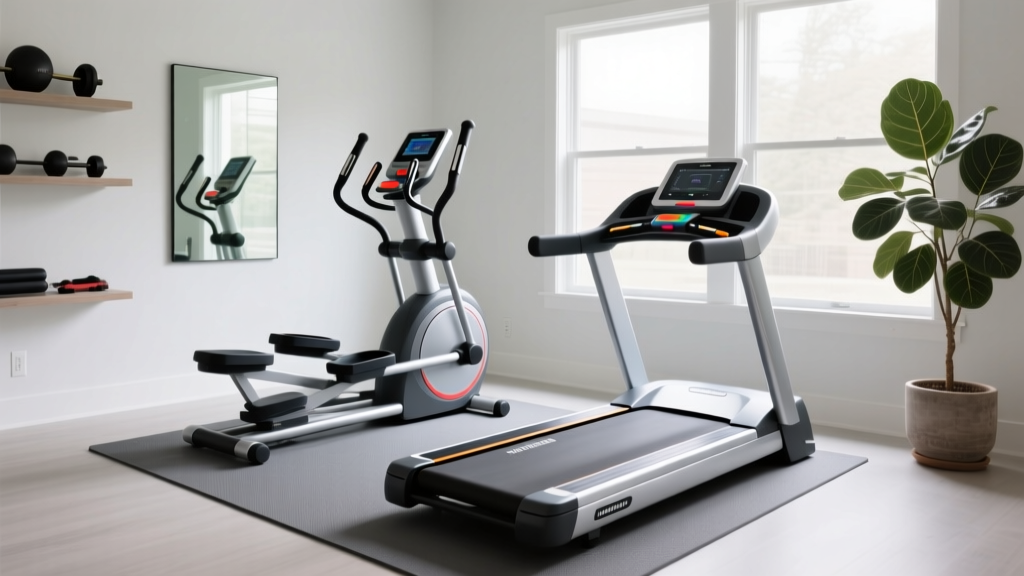
This means a 76-inch treadmill actually consumes 136 inches (over 11 feet) of linear room length. Conversely, because an elliptical restricts the user's feet to a fixed, clipped-in stride path, the risk of being ejected backward is virtually zero. Ellipticals generally only require 12 to 24 inches of rear clearance for mounting and dismounting. In a rectangular spare bedroom, choosing an elliptical over a treadmill instantly frees up 3 to 4 feet of linear space, allowing you to integrate a functional stretching zone or a compact dumbbell rack.
The Vertical Trap: Ceiling Height and Step-Up Geometry
When optimizing a home gym layout, particularly in basements or attics, vertical space is just as valuable as floor area. This is where the 'step-up' height of the machine dictates your ceiling requirements.
Calculating Your Vertical Envelope
A commercial LA Fitness treadmill sits relatively low to the ground (an 8.5-inch deck height). However, ellipticals require a complex flywheel and crank arm mechanism beneath the foot pedals, resulting in a pedal apex that can sit 12 to 15 inches off the floor. When you add the user's height and the upward reach of their arms during an elliptical stride, you can easily scrape the ceiling.
📐 The Ceiling Clearance Formula:User Height + Machine Step-Up Height + 6 Inches (Hand Clearance) = Minimum Safe Ceiling Height.
Example: A 6'0' (72') user on a Sole E95 (14' step-up) requires a minimum ceiling height of 92' (7 feet, 8 inches). If your basement ceiling is 7 feet, an elliptical will result in knuckle impacts on the drywall.
Furthermore, consider your window sills. Many home gym layouts place cardio machines facing a window for natural light and distraction. The towering handlebars of an upright elliptical can easily block or collide with low-set residential window sills, whereas the sloping console of a treadmill usually clears standard 36-inch sill heights.
Subfloor Dynamics: Weight Distribution and Matting
Space optimization also involves protecting the structural integrity of your room. The flooring matting required for these machines alters the usable dimensions and acoustics of the space.
- Treadmills (Dynamic Harmonic Vibration): A 200 lb runner on a treadmill generates impact forces up to 2.5 times their body weight with every footstrike. This creates harmonic vibrations that travel through the subfloor, rattling drywall and disturbing adjacent rooms. Treadmills require dense, heavy-duty 3/4-inch vulcanized rubber horse stall mats cut to size, which adds significant weight to the floor joists.
- Ellipticals (Static Point-Loads): Ellipticals eliminate the 'pounding' impact, but they concentrate the user's entire static weight onto four small leveling feet. Over time, this immense point-load pressure will permanently dent hardwood floors and compress standard carpet padding. Ellipticals require high-density EVA foam interlocking tiles or a specialized equipment mat to disperse the point-load, which is generally lighter and easier to cut to fit awkward room corners.
Cardio Efficacy in Confined Spaces
From a physiological standpoint, the spatial compromise does not require a cardiovascular compromise. The Centers for Disease Control and Prevention (CDC) recommends at least 150 minutes of moderate-intensity aerobic activity per week for substantial health benefits. Both treadmills and ellipticals easily fulfill this requirement.
Furthermore, the American Heart Association (AHA) notes that consistency in aerobic exercise is the primary driver of cardiovascular health, rather than the specific modality. If a treadmill's massive rear fall-zone requirement forces you to place it in a cramped, uninviting corner facing a blank wall, your adherence to the 150-minute weekly goal will plummet. An elliptical that fits perfectly in the center of your room, allowing for proper airflow from your HVAC vents and an open line of sight to your television, will yield superior long-term health outcomes simply by virtue of better spatial integration.
Final Verdict: Designing Your Cardio Zone
Do you need a commercial LA Fitness treadmill in your home? Unless you are dedicating a massive 300+ square foot open garage bay exclusively to running, the answer is a resounding no. The spatial penalties of commercial and premium treadmills—specifically the 5-foot rear safety zone and the heavy acoustic matting requirements—make them hostile to standard residential layouts.
Quick Decision Matrix for Home Layouts
- Choose the Treadmill If: You have a room longer than 14 feet, standard 8-foot+ ceilings, dedicated 20-amp electrical circuits, and you prioritize running biomechanics over floor space.
- Choose the Elliptical If: You are optimizing a square room (e.g., 10x10), have low basement ceilings, share walls with noise-sensitive areas, and want to reclaim 4 feet of linear space for free weights or yoga.
'The best home cardio machine is the one that fits your room's geometry so seamlessly that it removes all friction from your daily workout habit. Measure your fall zones before you measure your stride.'
By prioritizing spatial flow, safety buffers, and vertical clearance, you can build a highly efficient, commercial-quality cardio zone in 2026 without sacrificing the livability of your home.
More gear to consider
All reviews
Curved vs Motorized Setup: How to Turn On a Matrix Treadmill

12/3/30 Treadmill Belt Maintenance: Space Layouts & Lube Guide
Air Bike vs Assault Bike: Budget and Matrix Treadmill App Value

Horizon T101 Treadmill Manual Motor HP vs. Sole F63 Comparison

Stair Climber Mistakes and Alter-G Treadmill Alternatives