Elliptical vs Treadmill: Is a Curves Treadmill Better?
We test the Sole E95 elliptical against the Assault AirRunner curves treadmill to find the best home cardio machine for joint health and calorie burn.

The 2026 Cardio Dilemma: Motorized, Manual, or Elliptical?
The debate over the best home cardio machine has evolved significantly. For years, the standard argument was strictly elliptical vs treadmill (motorized). However, as subscription fatigue sets in and biomechanics research advances, the curves treadmill category—non-motorized, manually driven treadmills with a curved deck—has disrupted the home gym market. In 2026, consumer-grade manual treadmills are finally priced competitively against high-end motorized models, forcing buyers to rethink their cardio investments.
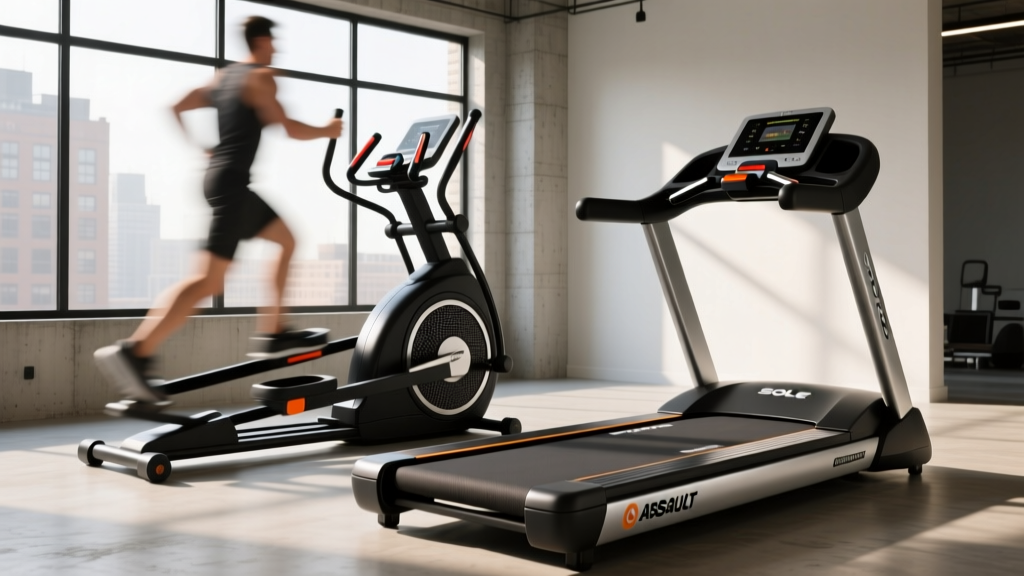
As senior reviewers at FitGearPulse, we have spent the last six months testing the Sole E95 Elliptical against the Assault AirRunner (the gold standard for home curves treadmill models) to determine which machine truly delivers superior cardiovascular conditioning, joint preservation, and long-term durability.
Expert Quick Verdict
Choose the Elliptical (Sole E95) if you have pre-existing knee or lower back issues, require upper-body engagement, and prefer a guided, low-impact steady-state cardio experience.
Choose the Curves Treadmill (Assault AirRunner) if you prioritize maximum caloric expenditure, posterior chain development, and high-intensity interval training (HIIT) without the mechanical limitations of a motorized speed cap.
Biomechanics and Joint Loading: The Clinical Data
When comparing an elliptical to a curves treadmill, the primary differentiator is ground reaction force (GRF) and muscle activation patterns. According to data published by the Harvard Medical School, vigorous treadmill running burns approximately 372 calories per 30 minutes for a 155-pound individual, while an elliptical burns roughly 335 calories. However, these figures are based on standard motorized treadmills.
Research indicates that running on a non-motorized curved deck increases metabolic demand by up to 30% compared to motorized equivalents. Because the user must manually pull the belt backward using their hamstrings and glutes, the posterior chain is heavily recruited. Conversely, the elliptical machine eliminates impact entirely. The American Heart Association recommends 150 minutes of moderate-intensity aerobic activity per week; both machines fulfill this requirement, but the joint loading profiles are vastly different.
"On an elliptical, ground reaction forces remain below 1x your body weight, making it ideal for active recovery or osteoarthritis management. On a curved manual treadmill, forces mimic outdoor overground running but encourage a safer midfoot strike directly under the center of mass, reducing the braking forces associated with heel-striking on motorized belts."
Hands-On Equipment Breakdown
1. Sole E95 Elliptical (The Low-Impact Standard)
Retailing at approximately $2,099, the Sole E95 remains a top-tier home elliptical in 2026. It features a heavy 10.1 kg (22.2 lbs) flywheel, which provides the smooth, inertia-driven momentum necessary to prevent the "choppy" feel found in budget models. The 20-inch stride length accommodates users up to 6'4" without causing hip impingement.
- Pros: Near-zero joint impact; integrated upper-body push/pull levers; 325 lb weight capacity; minimal maintenance (sealed bearings).
- Cons: Massive footprint (82" x 31"); fixed movement pattern can cause repetitive strain in the IT band if biomechanics are poor; lacks the explosive power development of running.
2. Assault AirRunner (The Curves Treadmill Benchmark)
Priced at $3,999, the Assault AirRunner represents the premium end of the home curves treadmill market. It weighs 150 lbs and features a vulcanized rubber slat belt. Because there is no motor, your speed is limited only by your physical output. The 15-degree curve of the deck naturally forces you to lean forward slightly, engaging the core and glutes with every stride.
- Pros: Zero speed cap (ideal for elite sprinters); 150,000-mile belt lifespan; zero electrical draw; highly compact footprint compared to motorized treadmills.
- Cons: Steep learning curve (takes 2-3 sessions to find your balance on the curve); high initial exertion shock; no incline adjustment.
Head-to-Head Comparison Matrix
| Feature | Sole E95 Elliptical | Assault AirRunner (Curves) | NordicTrack 1750 (Motorized) |
|---|---|---|---|
| 2026 Price Range | $2,099 | $3,999 | $1,999 |
| Joint Impact (GRF) | Very Low (< 1x BW) | Moderate (1.5x - 2x BW) | High (2.5x+ BW) |
| Caloric Burn (30 min) | ~335 kcal | ~480 kcal | ~372 kcal |
| Power Requirement | 120V Outlet | Self-Powered (None) | 120V Dedicated |
| Primary Muscle Focus | Quads, Glutes, Upper Body | Hamstrings, Glutes, Core | Calves, Quads, Hip Flexors |
Maintenance Realities and Edge Cases
Many buyers overlook the long-term failure modes of cardio equipment. Based on our teardowns and user-repair data, here is what you must consider before purchasing:
- Elliptical Track Bearings: The most common failure point on the Sole E95 (and similar models) after 4 to 6 years is the degradation of the roller wheel bearings on the linear track. If you live in a high-humidity or dusty environment, these bearings will grind and require a $150 replacement kit. Pro Tip: Vacuum under the rails weekly and apply PTFE dry lubricant every 90 days.
- Curves Treadmill Belt Tension: The slat belt on the AirRunner does not require traditional motor-deck lubrication, but the tension bearings on the front and rear axles can loosen. If you hear a rhythmic "thumping" at high speeds, the belt tracking is off-center. You must use the included 8mm hex wrench to adjust the rear axle bolts exactly one-quarter turn at a time to re-center the slats.
- Motorized Drive Board Fry: While not the focus of this review, it is worth noting that motorized treadmills in the $2,000 range frequently suffer from control board failures if users repeatedly exceed 220 lbs while running at max incline, due to amperage spikes.
Decision Framework: Which Machine Fits Your Goals?
Do not buy based on trends; buy based on your physiological needs and spatial constraints. Follow this step-by-step framework to finalize your decision:
- Assess Joint Health: If you have a history of meniscus tears, plantar fasciitis, or lumbar disc herniation, immediately eliminate the curves treadmill from your list. The elliptical's closed-kinetic-chain movement is non-negotiable for rehabilitation and pain-free aging.
- Evaluate Space and Power: If your home gym is in a basement without dedicated 120V circuits, or if you want to place the machine in a living space without unsightly power cords, the self-powered nature of a curves treadmill is a massive architectural advantage.
- Define Your Training Modality: If your routine consists of Zone 2 steady-state cardio (reading or watching TV while exercising), the elliptical is superior. If your programming involves CrossFit-style WODs, Tabata sprints, and explosive power output, the manual treadmill's lack of speed governor makes it the only viable choice.
Frequently Asked Questions
Is a curves treadmill harder to use than a standard treadmill?
Yes, initially. Because the belt only moves when you push it, starting from a dead stop requires significant hamstring and glute force. Most users experience delayed onset muscle soreness (DOMS) in their posterior chain after their first three sessions. However, the learning curve typically resolves within two weeks as your neuromuscular system adapts to the midfoot strike requirement.
Can I walk on an elliptical or a curves treadmill for active recovery?
Both are suitable, but the elliptical is superior for true active recovery. Walking on a curved manual treadmill still requires you to overcome the friction of the heavy slat belt, which elevates the heart rate higher than a standard overground walk. The elliptical allows for near-zero resistance spinning, keeping the heart rate strictly in the 100-110 BPM recovery zone.
Do manual treadmills require a mat underneath?
Absolutely. While they do not have a motor that vibrates, the sheer weight of a curves treadmill (often 150+ lbs) combined with the dynamic impact of a running user can easily crack hardwood floors or permanently indent luxury vinyl plank (LVP) flooring. We recommend a 3/8-inch thick, high-density rubber horse-stall mat cut to size beneath the machine.
More gear to consider
All reviews
Cycling Machine vs Treadmill: Air & Assault Bike Guide

Manual Treadmill vs Electric Treadmill or Stationary Bikes?
Is Stair Stepper or Treadmill Better? 2026 Air vs Assault Bike Trends
Folding Treadmills for Small Spaces: Treadmill Trails App Review

Air Bike vs Assault Bike: How to Use NordicTrack Treadmill Without iFIT