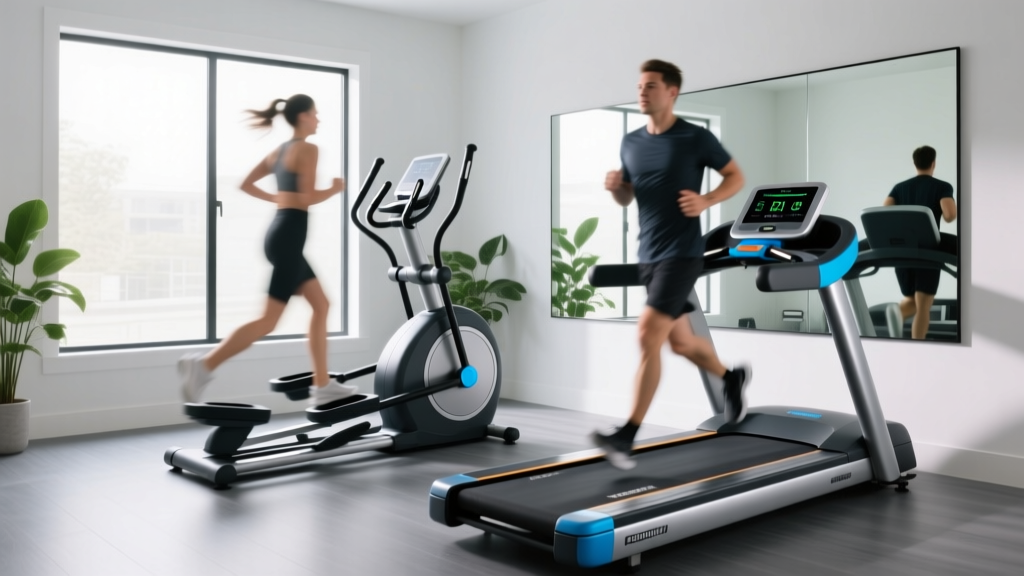
Elliptical vs Curved Deck Treadmill: Home Cardio Value Breakdown
Is a premium elliptical or a curved deck treadmill the better home cardio investment? We break down the costs, ROI, and long-term value.

When building a dedicated home gym in 2026, the debate between an elliptical and a motorless treadmill often centers on biomechanics and joint impact. However, from a strict financial perspective, the true cost of ownership tells a vastly different story. While both machines serve the ultimate goal of cardiovascular health, their budget breakdowns, maintenance liabilities, and long-term value propositions diverge sharply after the initial purchase. In this comprehensive value analysis, we pit the premium magnetic elliptical against the manual curved deck treadmill to determine which machine actually respects your wallet over a five-to-ten-year lifespan.
The Upfront Capital: 2026 Pricing Tiers
The barrier to entry for high-end home cardio has shifted. Inflation and supply chain adjustments have stabilized, but premium engineering still commands a premium price. When comparing a top-tier elliptical to a commercial-grade curved deck treadmill, the initial MSRP is only the first line item in your budget breakdown.
| Machine Category | Reference Model (2026) | Base MSRP | Delivery & Assembly | Required Electrical |
|---|---|---|---|---|
| Premium Elliptical | NordicTrack FS14i FreeStride | $2,799 | $199 | 120V Dedicated Outlet |
| Curved Deck Treadmill | AssaultRunner Pro | $3,299 | Free (Curbside) / $299 (In-home) | None (100% Manual) |
| Budget Elliptical | Schwinn 470 | $899 | $149 | Standard 120V Outlet |
At first glance, the elliptical appears to be the more budget-friendly option. However, the upfront cost of a curved deck treadmill includes a heavy-duty steel frame and vulcanized rubber slat belts that are engineered to outlast the electronic components inherent in motorized or magnetic resistance machines.
Operational Costs and Maintenance Realities
The true financial divergence between these two machines occurs in years two through five. A curved deck treadmill operates entirely on human power, eliminating the most expensive failure points found in traditional cardio equipment: drive motors, control boards, and motorized incline actuators.
The Curved Deck Treadmill Maintenance Edge
Because a manual curved treadmill lacks an electric motor, your ongoing operational costs are virtually zero. The primary maintenance requirement is keeping the running track clean and occasionally lubricating the sealed bearings. According to manufacturer specifications, the sealed bearings on models like the TrueForm Trainer or AssaultRunner are rated for 150,000 miles. The only major capital expenditure you might face is replacing the rubber slat belt after 7 to 10 years of heavy use, which typically costs between $350 and $500.
Elliptical Drivetrain and Electronics Depreciation
Ellipticals, particularly those with interactive HD touchscreens and magnetic eddy-current resistance, carry hidden financial liabilities. The consoles on smart ellipticals run on proprietary operating systems that can become obsolete, and replacement control boards out of warranty routinely cost $400 to $600. Furthermore, the internal drive belts and crank arm bearings are subject to repetitive lateral stress. If a drive belt snaps or a crank bearing fails in year four, you are looking at a $250 parts cost plus $150 in technician labor.
Subscription Fees and Energy Consumption
In 2026, the 'hardware-as-a-service' model dominates the smart fitness space. To unlock the full value of a premium elliptical, users are often pushed toward monthly content subscriptions.
- Elliptical Subscription Costs: Platforms like iFIT or JRNY cost between $15 and $40 per month. Over a five-year period, a $15/month subscription adds $900 to your total cost of ownership.
- Elliptical Energy Draw: A magnetic resistance elliptical with an active HD screen and cooling fan draws roughly 150 to 300 watts during use. If you exercise for an hour a day, this adds approximately $12 to $18 annually to your utility bill.
- Curved Treadmill Costs: Zero. The curved deck treadmill requires no electricity and relies on free, built-in LCD telemetry screens or third-party wearable integration (like Apple Watch or Garmin) for tracking, completely bypassing the subscription trap.
Biomechanical ROI: Caloric Burn vs. Joint Impact
Financial value must be weighed against physiological return on investment. The Centers for Disease Control and Prevention (CDC) recommends at least 150 minutes of moderate-intensity aerobic activity per week. Both machines fulfill this requirement, but their efficiency profiles differ.
Studies consistently show that manual, non-motorized treadmills require the user to generate the belt's momentum, resulting in a 15% to 30% higher caloric expenditure and heart rate response compared to motorized treadmills at the same perceived exertion level.
Conversely, the elliptical provides a zero-impact environment. The American Heart Association emphasizes the importance of sustainable cardiovascular routines, particularly for aging populations or those recovering from lower-body injuries. If your knees or hips cannot tolerate the repetitive ground-reaction forces of running—even on the forgiving surface of a curved deck treadmill—the elliptical offers a superior biomechanical ROI by ensuring you can actually complete your weekly cardio quotas without injury downtime.
Space and Installation Value Matrix
Floor space is a premium commodity in home gyms. When calculating the value per square foot, the physical footprint and installation requirements must be factored into your budget.
| Dimension / Requirement | Premium Elliptical (e.g., FS14i) | Curved Deck Treadmill (e.g., AssaultRunner) |
|---|---|---|
| Footprint (L x W) | 71.5 x 35.5 inches | 70 x 33 inches |
| Machine Weight | 285 lbs | 280 lbs |
| Ceiling Clearance Needed | User Height + 15 inches | User Height + 5 inches |
| Floor Reinforcement | Rarely required | Recommended for high-impact sprinting |
While the footprints are nearly identical, the elliptical requires significant vertical clearance due to the upward elliptical path of the pedals. If you are finishing a basement gym with low ceilings (under 8 feet), the elliptical may physically disqualify itself, making the low-profile curved deck treadmill the only viable high-end option.
The 5-Year Total Cost of Ownership (TCO) Projection
To truly understand the budget breakdown, we must project the five-year TCO for a dedicated user exercising 5 hours per week.
Scenario A: Premium Smart Elliptical
- Base MSRP & Delivery: $2,998
- 5-Year Electricity ($15/yr): $75
- 5-Year Content Subscription ($15/mo): $900
- Estimated Out-of-Warranty Repair (Year 4): $350
- 5-Year TCO: $4,323
Scenario B: Commercial Curved Deck Treadmill
- Base MSRP & In-Home Delivery: $3,598
- 5-Year Electricity: $0
- 5-Year Content Subscription: $0 (Using free third-party apps)
- Estimated Maintenance (Bearing lube, belt tensioning): $50
- 5-Year TCO: $3,648
The Verdict: Which Machine Wins Your Budget?
If your primary metric is long-term financial value and raw caloric output, the curved deck treadmill is the undisputed winner. Despite a higher upfront MSRP, the complete elimination of subscription fees, electricity costs, and complex electronic repairs results in a significantly lower 5-year TCO. It is a buy-it-for-life piece of analog fitness equipment.
However, if your budget must account for joint preservation, rehabilitation, or a preference for guided, interactive coaching, the premium elliptical provides indispensable physiological value that a manual treadmill cannot replicate, justifying the higher long-term operational costs.
Ultimately, the best cardio machine is the one you will use consistently. Evaluate your physical limitations, your ceiling height, and your tolerance for monthly software fees before swiping your credit card. For more in-depth equipment teardowns and buying guides, continue exploring our comprehensive cardio machine reviews.
More gear to consider
All reviews
Folding Treadmill Review: How Long to Walk 5 Miles on Compact Models

Curved Manual vs Motorized Treadmill: How to Fix a Slipping Belt

How to Lose Weight on a Treadmill Fast: Compact Portable Picks

Does Strava Track Treadmill Runs? Motor & Tech Compared
The Mike Tyson Daughter Treadmill: Compact Portable Cardio Guide
