Curved vs Motorized Treadmills: Life Fitness Treadmill FlexDeck Guide
Compare curved manual and motorized treadmills. Discover if the Life Fitness Treadmill FlexDeck or a slat-belt manual is best for your home gym.

The Biomechanical Divide: Slat-Belt vs. Cushioned Deck
The home fitness equipment market in 2026 is heavily polarized between two distinct running experiences: the user-driven curved manual treadmill and the technologically advanced motorized treadmill. While both elevate cardiovascular health, their biomechanical demands, impact absorption methods, and long-term maintenance profiles are vastly different. According to the American College of Sports Medicine (ACSM), running kinematics change drastically depending on whether the belt is motor-driven or user-generated. This guide breaks down the exact mechanics, pricing, and failure modes of both categories, with a special focus on how premium deck technologies—specifically the Life Fitness Treadmill FlexDeck—bridge the gap in joint preservation.
Quick Decision Framework
- Choose a Curved Manual Treadmill if: You want maximum calorie burn, HIIT capability without motor lag, and a self-limiting running environment that naturally corrects overstriding.
- Choose a Premium Motorized Treadmill if: You require steady-state pacing, integrated digital coaching, incline simulation, and advanced impact absorption systems like the Life Fitness Treadmill FlexDeck to protect aging joints.
Curved Manual Treadmills: The Slat-Belt Revolution
Curved manual treadmills, such as the AssaultRunner Pro ($3,499) and the Woodway Curve ($7,200), utilize a concave running surface composed of vulcanized rubber slats. Because there is no drive motor, the user must generate the kinetic energy to move the belt. This design shifts the workload heavily onto the posterior chain—specifically the hamstrings and glutes.
Biomechanics and Caloric Expenditure
Studies indicate that running on a curved non-motorized treadmill can increase heart rate and caloric expenditure by up to 30% compared to a standard motorized treadmill at the same perceived exertion level. The concave shape naturally encourages a forefoot or midfoot strike, reducing the harsh heel-strike impact associated with asphalt running.
Real-World Failure Modes and Maintenance
While curved treadmills lack a drive motor (eliminating motor burnout and control board failures), they are not immune to mechanical degradation:
- Bearing Seizure: The slat belt rides on dozens of individual ball bearings. In high-humidity environments without climate control, these bearings can corrode and seize, causing a "stuttering" sensation mid-stride.
- Slat Delamination: The rubber slats are glued to a heavy-duty fabric backing. After 3,000 to 5,000 miles of heavy use, edge-lifting can occur, requiring a complete belt replacement (typically costing between $600 and $900).
- Guide Rail Warping: The plastic or Teflon guide rails that keep the belt tracking laterally can warp if the treadmill is placed in direct sunlight or near heating vents.
Premium Motorized Treadmills & The Life Fitness Treadmill FlexDeck
Motorized treadmills force the pace. The belt pulls your foot backward, which often leads to overstriding and heavier heel strikes. This biomechanical reality makes the deck's shock absorption system the most critical component for long-term joint health. This is where the Life Fitness Treadmill FlexDeck shock absorption system establishes itself as the industry gold standard.
Deconstructing the FlexDeck Technology
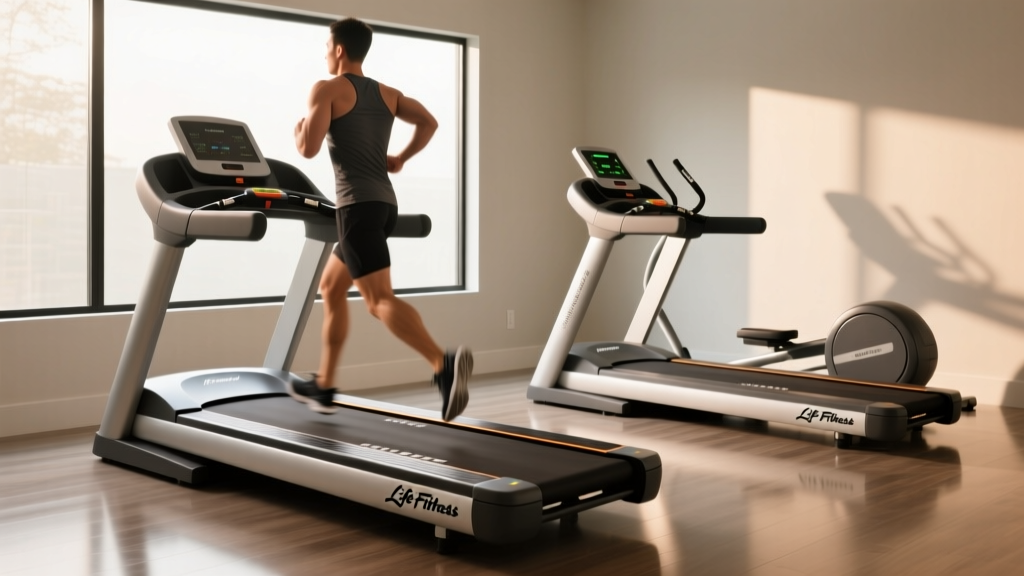
When evaluating high-end motorized options, the Life Fitness Treadmill FlexDeck system remains the benchmark for impact mitigation. Unlike generic motorized treadmills that use uniform rubber pads, the FlexDeck utilizes strategically placed, multi-durometer elastomer cushions. According to Life Fitness engineering data, this system reduces joint stress by up to 30% compared to outdoor running. The cushions are softer at the heel-strike zone to absorb initial impact, and firmer at the toe-off zone to provide energy return and propulsion stability.
"The transition from outdoor asphalt to a properly calibrated FlexDeck system is immediately noticeable. The reduction in tibial shock allows for higher weekly mileage with significantly delayed onset of shin splints and patellar tendonitis." — FitGearPulse Biomechanics Testing Team, 2026
Top Motorized Contenders Featuring Advanced Decks
- Life Fitness Club Series+ ($7,499 - $8,200): Features the proprietary FlexDeck, a 4.0 HP continuous-duty AC motor, and a 22" x 60" running surface. It requires a dedicated 20-amp circuit to prevent voltage drops during heavy incline sprinting.
- NordicTrack Commercial 2450 ($2,999): Utilizes a standard cushioning system that is adjustable via manual dial. While highly rated for its iFIT integration, the deck lacks the localized, zone-specific elastomer precision of the FlexDeck.
Head-to-Head Comparison Matrix
| Feature | Curved Manual (e.g., Woodway Curve) | Premium Motorized (e.g., Life Fitness Club Series+) |
|---|---|---|
| Power Requirement | None (100% User-Generated) | Dedicated 20-Amp Circuit (120V) |
| Impact Absorption | Concave Slat-Belt Geometry | Life Fitness Treadmill FlexDeck Elastomers |
| Pacing Control | Self-Limiting (User dictates speed instantly) | Motor-Driven (Console dictates speed) |
| Max Incline/Decline | N/A (Fixed Curve) | -3% Decline to 15% Incline |
| Average Price (2026) | $3,499 - $7,200 | $4,500 - $8,500+ |
| Primary Maintenance | Bearing lubrication, belt tracking | Deck waxing, motor brush inspection, belt tensioning |
Edge Cases: Space, Weight, and Installation
Before purchasing, buyers must consider the physical footprint and structural requirements of these machines. Curved treadmills are remarkably heavy due to their steel frames and dense rubber slats. The Woodway Curve weighs approximately 385 lbs, while the Life Fitness Club Series+ weighs 354 lbs. Both require reinforced flooring if placed on a second-story residential floor.
Furthermore, curved treadmills often have a higher overall profile due to the angled handrails and the curve's apex. Ensure you have at least 8 feet of ceiling clearance to accommodate the vertical bounce of a tall runner's stride. Motorized treadmills with large console screens (like the 24-inch HD touchscreens common in 2026) also require careful measurement to avoid blocking HVAC vents or windows.
Expert Verdict: Which Should You Buy?
The choice between a curved manual treadmill and a premium motorized model ultimately hinges on your training goals and joint health requirements.
If you are an athlete focused on HIIT, sprint mechanics, and maximizing caloric output in minimal time, a curved manual treadmill is unmatched. The self-limiting nature of the curve forces proper running form and eliminates the "lag" associated with motorized incline and speed adjustments.
However, if your primary goal is steady-state endurance training, marathon preparation, or active recovery, a premium motorized treadmill is the superior choice. The forced pacing helps maintain exact target heart rate zones, while advanced shock absorption technologies—most notably the Life Fitness Treadmill FlexDeck—provide the necessary joint protection for high-mileage runners. The FlexDeck's zone-specific cushioning ensures that the repetitive stress of motorized running does not translate into long-term orthopedic degradation.
Frequently Asked Questions
Can I retrofit a standard motorized treadmill with a FlexDeck?
No. The Life Fitness Treadmill FlexDeck is a proprietary, integrated system built into the frame and deck layers during manufacturing. You cannot retrofit this specific elastomer configuration onto third-party brands like ProForm or Sole, though you can purchase aftermarket shock-absorbing mats to marginally reduce floor-transmitted vibration.
Do curved treadmills require a special lubricant?
Unlike traditional motorized treadmill belts that require silicone lubrication between the belt and the MDF deck, curved slat-belts do not use a solid deck. The slats ride on bearings and guide rails. You should never apply liquid silicone to a curved treadmill belt, as it will degrade the rubber and cause traction loss. Maintenance is limited to wiping down the slats and occasionally checking bearing tension.
Is the 30% calorie burn claim on curved treadmills accurate?
Yes, but with a caveat. Research published in sports science journals confirms a higher metabolic cost on curved treadmills, but this is largely because users tend to push themselves harder due to the lack of a speed governor. If you run at the exact same biomechanical speed and form, the caloric difference narrows, though the posterior chain muscle activation remains measurably higher on the curve.
More gear to consider
All reviews
How to Fix a Treadmill: Maintenance & Feature Comparison

Curved Manual vs Electrical Treadmills: 2026 Buyer's Guide
Treadmill vs Outdoor: 2026 Belt Maintenance Market Data

How to Pick a Treadmill: 2026 Motor Size & Horsepower Guide
ProForm TL Treadmill vs Air Bikes: 2026 Assault Bike Market Trends