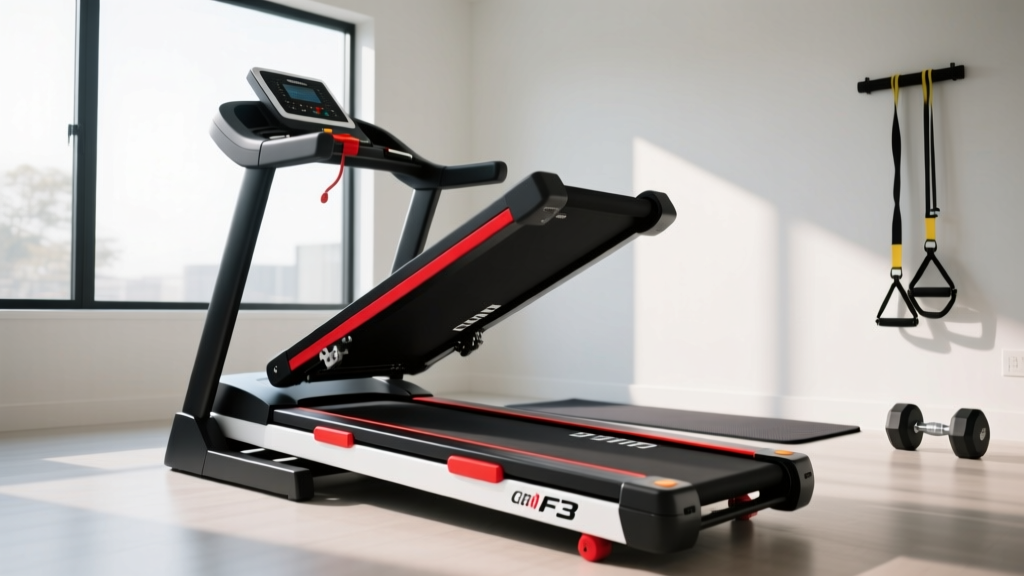
F3 Folding Treadmill: Small Space Review & Maintenance Guide
Read our F3 folding treadmill review for small spaces, plus expert maintenance and longevity tips to keep your compact cardio machine running perfectly.

As urban living spaces shrink and home fitness evolves in 2026, the demand for compact, stowable cardio equipment has never been higher. The F3 folding treadmill has emerged as a top contender for apartment dwellers and condo owners who refuse to compromise on workout quality. However, folding treadmills face unique mechanical stresses that their commercial, non-folding counterparts do not. Hinge fatigue, compact motor heat retention, and smaller roller diameters all accelerate wear and tear if neglected.
In this comprehensive review and maintenance guide, we evaluate the F3 folding treadmill as a small-space solution and provide a deep-dive, expert-level maintenance protocol to ensure your machine lasts for years, not just months.
F3 Folding Treadmill Review: Is It the Best for Small Spaces?
The F3 folding treadmill is engineered specifically for spatial efficiency without entirely sacrificing the biomechanics of a natural stride. Unlike ultra-budget walking pads that top out at 4.0 MPH, the F3 offers a legitimate running experience. Below is a breakdown of its core specifications and spatial footprint.
| Specification | F3 Folding Treadmill Details |
|---|---|
| Motor | 2.5 CHP (Continuous Horsepower) |
| Running Surface | 18' x 50' (Adequate for users up to 6'1') |
| Folded Dimensions | 32' L x 28' W x 65' H |
| Folding Mechanism | Hydraulic Soft-Drop Cylinder |
| Max User Weight | 275 lbs |
| Roller Diameter | 1.5' (Front and Rear) |
The Verdict for Small Spaces: The F3's 28-inch folded width allows it to slide neatly into standard bedroom closets or tuck behind a sofa. However, the 1.5-inch rollers are smaller than the 2.5-inch rollers found on commercial gym treadmills. Smaller rollers rotate faster at the same belt speed, generating more friction and heat, which makes strict maintenance non-negotiable.
The Hidden Cost of Compact Treadmills: Wear and Tear
When evaluating any folding treadmill for small spaces, buyers often overlook the mechanical compromises required to make a machine fold. According to safety and equipment guidelines outlined by the Consumer Product Safety Commission (CPSC), moving parts and folding hinges are primary areas for mechanical failure and potential pinch hazards in home gym equipment.
The F3 folding treadmill utilizes a dual-hinge pivot system and a hydraulic strut. Every time you fold and unfold the deck, lateral stress is applied to the frame welds and the pivot pins. Furthermore, the compact motor hood on the F3 restricts ambient airflow compared to full-sized models. If dust accumulates in the motor compartment, the 2.5 CHP motor will overheat, triggering the internal thermal reset switch and degrading the copper windings over time.
Essential Maintenance Schedule for the F3
To maximize the longevity of your F3 folding treadmill, you must adhere to a strict maintenance cadence. Compact machines require more frequent attention than heavy-duty commercial units.
| Frequency | Maintenance Task | Time Required |
|---|---|---|
| After Every Use | Wipe down handrails and console with a damp microfiber cloth to remove corrosive sweat salts. | 2 mins |
| Weekly | Vacuum the floor beneath and immediately behind the motor hood intake vents. | 5 mins |
| Monthly | Inspect belt alignment and test deck tension. | 10 mins |
| Bi-Annually | Apply 100% silicone lubricant to the deck; grease folding hinge pivot pins. | 20 mins |
| Annually | Remove motor hood, blow out carbon dust from the motor brushes, and check drive belt tension. | 30 mins |
Belt Alignment and Tension: A Step-by-Step Guide
A misaligned belt on the F3 will shave off the edges of the running surface and overwork the motor. If your belt drifts to the left or right, follow this precise adjustment protocol:
- Locate the Tension Bolts: Find the two 10mm hex bolts at the very rear of the treadmill, on the left and right sides of the end cap.
- The Quarter-Turn Rule: Using the provided Allen wrench, turn the bolt on the side the belt is drifting toward by exactly one-quarter (1/4) turn clockwise.
- Test and Repeat: Run the treadmill at 3.0 MPH. Walk on it gently. If it still drifts, apply another 1/4 turn. Never turn the bolts more than a half-turn at a time, or you risk over-tensioning and snapping the drive belt.
- The Lift Test: To check overall tension, turn the machine off. Lift the belt from the exact center of the deck. You should achieve exactly 2 to 3 inches of lift. If it lifts higher, it is too loose; if lower, it is too tight.
Lubrication: The Lifeblood of Compact Motors
Because the F3 features a compact 18' x 50' running area, users' footsteps are concentrated over a smaller surface zone, leading to localized deck wear. Proper lubrication reduces the coefficient of friction, preventing the 2.5 CHP motor from drawing excess amperage.
- Product: Use only 100% pure liquid silicone treadmill lubricant. Avoid spray aerosols, which contain propellants that degrade the belt.
- Application: Loosen the belt slightly. Lift the edge and squeeze exactly 15ml (about half a standard applicator bottle) in a zig-zag pattern down the center of the deck.
- Distribution: Tighten the belt back to the 2-3 inch lift specification. Run the treadmill at 2.0 MPH for 5 minutes while gently walking side-to-side to spread the silicone evenly.
Troubleshooting Common F3 Folding Mechanism Failures
The defining feature of the F3 folding treadmill is also its most vulnerable component. Here is how to troubleshoot and maintain the folding hardware.
1. Hydraulic Soft-Drop Cylinder Leaks
If the deck slams down rapidly when you release the safety latch, the hydraulic strut has lost its internal pneumatic pressure. This is a common failure mode around year three of ownership.
The Fix: You must replace the gas spring strut. Measure the extended length of your current strut (typically 280mm for the F3). A replacement OEM or compatible aftermarket strut costs between $45 and $65 online. Replacement requires only a 12mm wrench to remove the two retaining bolts.
2. Hinge Pin Squeaks and Lateral Play
A squeaking noise when folding or unfolding the deck indicates metal-on-metal friction at the main pivot joints.
The Fix: Apply a small dab of white lithium grease directly to the pivot pin shaft. Wipe away any excess. If you notice lateral play (the deck wiggles side-to-side when locked in the upright position), tighten the 14mm locking nuts on the pivot bolts until the wiggle ceases, but ensure the deck still folds smoothly without binding.
Pro-Tip from the Repair Bench: Keep your F3 folding treadmill in the upright, locked position whenever it is not in active use. Leaving it deployed on the floor for weeks at a time invites dust bunnies to settle directly into the motor intake grill, which is positioned just inches from the floor.
Maximizing Motor Longevity in Small-Space Environments
Small spaces like apartments and spare bedrooms often have carpeting, which acts as a massive dust trap. When the F3's cooling fan engages, it acts like a vacuum cleaner, pulling pet dander, carpet fibers, and dust directly into the motor housing.
According to cardiovascular and home fitness safety guidelines supported by organizations like the American Heart Association, maintaining a safe, unobstructed environment around your exercise equipment is vital not just for physical safety, but for equipment longevity. Ensure at least 24 inches of clearance behind the F3 for airflow and emergency egress.
Electrical Best Practices: The F3's 2.5 CHP motor can draw up to 12 amps under heavy load. Plug it directly into a dedicated 15-amp wall outlet. Never use a standard household extension cord, as the voltage drop will cause the motor to run hotter and shorter its lifespan. If you must use an extension cord, it must be a heavy-duty, 12-gauge appliance cord rated for 15 amps.
Final Thoughts on the F3 Folding Treadmill
The F3 folding treadmill remains an excellent, space-saving investment for small-space living in 2026, provided you respect its mechanical limits. By committing to a bi-annual silicone lubrication schedule, keeping the motor hood free of carpet dust, and promptly addressing hydraulic strut wear, you can easily push the lifespan of this compact machine past the 7-to-10-year mark. Treat the folding hinges and compact motor with care, and the F3 will deliver reliable, space-efficient cardio for years to come.
More gear to consider
All reviews
What Treadmills Does Orangetheory Use? Air Bike Maintenance Guide

Vibration Plate vs Treadmill: Why Spin & Recumbent Bikes Win

Omni Virtual Reality Treadmill vs Rowing: 2026 Guide
Treadmill Sprints Guide: Assault AirRunner vs Sole F85

Rowing Machine Buying Guide: Rower vs 15 Incline Treadmill
