Elliptical vs Treadmill Space: Air Assault Treadmill Layout Guide
Compare elliptical vs treadmill footprints for home gyms. Discover space layouts, ceiling clearances, and if an air assault treadmill fits your room.

The Spatial Dilemma: Elliptical vs Treadmill for Home Cardio
When designing a home gym in 2026, the debate between an elliptical vs treadmill for home cardio extends far beyond joint impact and caloric burn. It is fundamentally a question of spatial geometry, room layout, and architectural constraints. While traditional fitness guides focus solely on biomechanics, a true space optimization strategy requires analyzing the three-dimensional footprint, ceiling clearance, acoustic vibration, and thermal output of your chosen machine.
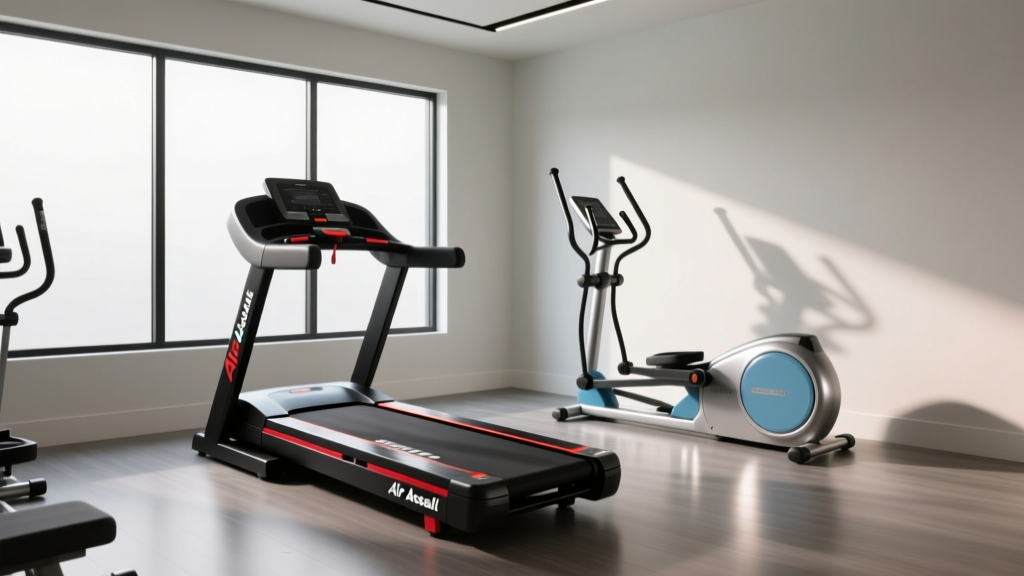
This is especially critical when introducing specialized equipment like a curved, non-motorized air assault treadmill into a residential space. Unlike standard motorized decks, air assault treadmills feature a pronounced curved apex and heavy-duty slat belts that drastically alter how you must configure your room. Below, we break down the exact measurements, layout frameworks, and spatial edge cases you need to consider before purchasing your next cardio centerpiece.
The 2026 Footprint & Clearance Matrix
To understand how these machines consume space, we must look beyond the manufacturer's stated "footprint" and account for operational clearance—the space required for mounting, dismounting, and safe arm extension. The table below compares a premium elliptical, a standard motorized treadmill, and a leading air assault treadmill.
| Machine Category | 2026 Benchmark Model | Static Footprint (L x W) | Operational Clearance Needed | Deck/Pedal Apex Height | Avg. Market Price |
|---|---|---|---|---|---|
| Front-Drive Elliptical | Sole Fitness E95 | 70" x 32" | +24" rear, +12" sides | 12" - 15" (pedal max) | $1,499 |
| Motorized Treadmill | NordicTrack Commercial 1750 | 80" x 35" | >+36" rear, +15" sides8" (deck height) | $2,799 | |
| Air Assault Treadmill | Assault Fitness AirRunner | 70" x 33" | +24" rear, +12" sides | 10" - 12" (slat apex) | $3,999 |
The Hidden Space Saver: Curved vs. Motorized
A common misconception is that all treadmills require an 80-inch length. However, because an air assault treadmill is self-powered and lacks a bulky front motor housing, its physical length is often 10 to 12 inches shorter than a comparable motorized treadmill. This makes the air assault treadmill surprisingly viable for narrow galley-style home gyms or converted walk-in closets, provided the width accommodates the wider side-rails necessary for curved belt stability.
Vertical Space: The Ceiling Clearance Trap
The most frequent layout failure in home gym design is ignoring vertical clearance. Hitting your head on a ceiling fan or drywall during a high-incline sprint is a severe safety hazard. Because ellipticals and air assault treadmills elevate the user differently, the ceiling height requirements vary drastically.
⚠ Critical Ceiling Clearance Formulas (2026 Standards)- Elliptical: User Height + 15 inches (Accounts for pedal apex and head bob).
- Motorized Treadmill: User Height + 10 inches (Standard 8" deck + bounce).
- Air Assault Treadmill: User Height + 14 inches (The curved running surface elevates the user's center of mass higher at the apex of the stride, and the lack of shock absorption increases vertical head oscillation).
If your basement gym has a standard 8-foot (96-inch) ceiling, a 6-foot-tall user (72 inches) will have 24 inches of clearance. This is perfectly safe for a motorized treadmill, but leaves only a 10-inch margin on an elliptical or an air assault treadmill, which becomes dangerous during high-intensity intervals where vertical bounce increases. In low-ceiling environments, a low-step-up motorized treadmill is the only code-safe option.
Layout Configurations: Airflow and Thermal Mapping
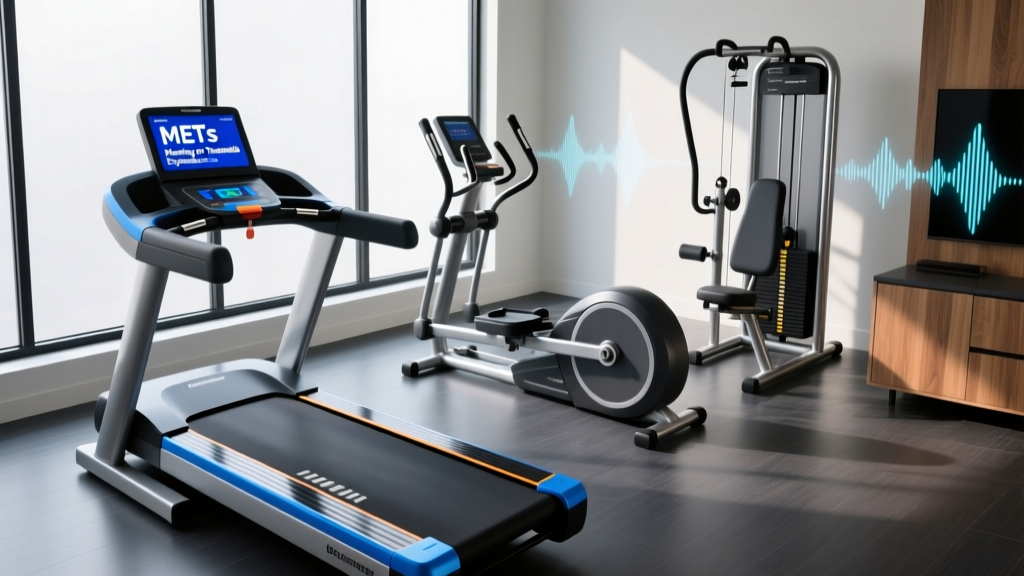
Space optimization isn't just about where the machine fits; it's about how the machine interacts with the room's HVAC and airflow. According to sports science data regarding metabolic equivalents (METs), running on a curved air assault treadmill requires up to 30% more energy output than running on a motorized treadmill at the same perceived speed. This translates directly to increased thermal output and sweat dispersion.
Optimal Placement Strategies
- The Cross-Ventilation Layout (Air Assault Treadmills): Never place an air assault treadmill in a dead corner. The high thermal output requires a minimum of 3 feet of clearance in front of an open window or a direct-line wall-mounted fan. Position the machine parallel to the room's primary airflow path.
- The Media-Wall Integration (Ellipticals): Ellipticals operate at a lower, steadier heart rate zone for most users. They are ideal for "media walls" where the machine faces a television or monitor. Because the user's head remains relatively stationary compared to the bounce of running, ellipticals can be placed 18 to 24 inches closer to a screen than treadmills without causing motion sickness or eye strain.
- The Perimeter Sprint Zone (Motorized Treadmills): Motorized treadmills require a massive rear egress zone for safety. If a user falls or hits the emergency stop, they are propelled backward. Layouts must ensure a 3-foot clear drop-zone behind the deck, free of dumbbells, benches, or walls.
Acoustic Layouts and Vibration Transfer
When designing a multi-use space or a second-floor home gym, acoustic footprint is just as important as physical footprint. The mechanical operation of these three machines generates vastly different vibration frequencies, which dictates where they can be placed in your home's layout.
"The continuous low-frequency hum of an elliptical's magnetic flywheel is easily masked by background noise, making it ideal for shared living spaces or apartment layouts. Conversely, the heavy impact thud of a motorized treadmill requires specialized decoupling flooring to prevent structural resonance." — Home Gym Acoustic Guidelines, Garage Gym Reviews
An air assault treadmill utilizes a heavy rubber slat belt running on ball bearings. It eliminates the loud "slap" of a motorized belt but generates a deep, rhythmic rumble. If your layout places the gym above a finished living space, you must install a high-density rubber vulcanized mat (minimum 3/8" thick) specifically under the front roller of the air assault treadmill, where the downward striking force is concentrated.
The Folding Myth vs. Fixed Frame Reality
Many buyers opt for folding motorized treadmills to save space, assuming they solve the layout dilemma. However, from a structural engineering perspective, folding hinges introduce mechanical failure points. By 2026, the fitness industry has largely pivoted away from folding mechanisms on premium machines due to the lateral wobble they introduce during sprinting.
Neither high-end ellipticals nor air assault treadmills fold. The rigid, welded steel frame of an elliptical vs treadmill fixed-frame setup ensures biomechanical alignment and longevity. If your space optimization strategy relies on folding a machine vertically after every use, you are sacrificing structural rigidity for a marginal gain of roughly 4 square feet of floor space. For dedicated home gyms, fixed-frame layouts utilizing wall-mirrors to create the illusion of space are vastly superior to folding compromises.
Final Decision Framework: Choosing by Room Dimensions
Use this quick spatial audit to finalize your cardio equipment layout:
- Choose the Elliptical if: Your ceiling height is under 8 feet, your room is narrower than 6 feet, or you are placing the machine in a multi-purpose room where low acoustic transfer is mandatory.
- Choose the Motorized Treadmill if: You have a long, narrow room (minimum 10 feet in length) to accommodate the deck plus the 3-foot rear safety zone, and you require built-in digital integration for guided programming.
- Choose the Air Assault Treadmill if: You have a compact but well-ventilated space (like a converted garage or basement), you want to eliminate the electrical draw of a 4.0 HP motor, and you prioritize a shorter, high-intensity footprint over long, steady-state endurance layouts.
Ultimately, mapping your room's vertical clearance, thermal dynamics, and acoustic vulnerabilities will dictate whether an elliptical, a standard treadmill, or an air assault treadmill becomes the most efficient engine for your home cardio layout.
More gear to consider
All reviews
Rowing Machine Guide: What Does the Treadmill Target vs. Rowing?

NordicTrack Commercial 2450 Treadmill: Setup & Feature Comparison
2026 Market Trends: Portable Cardio vs. Treadmill Advantages

Treadmill Not Working? Belt Maintenance and Lubrication Fixes

Echelon Treadmill vs. Stationary Bike Types: Space Guide