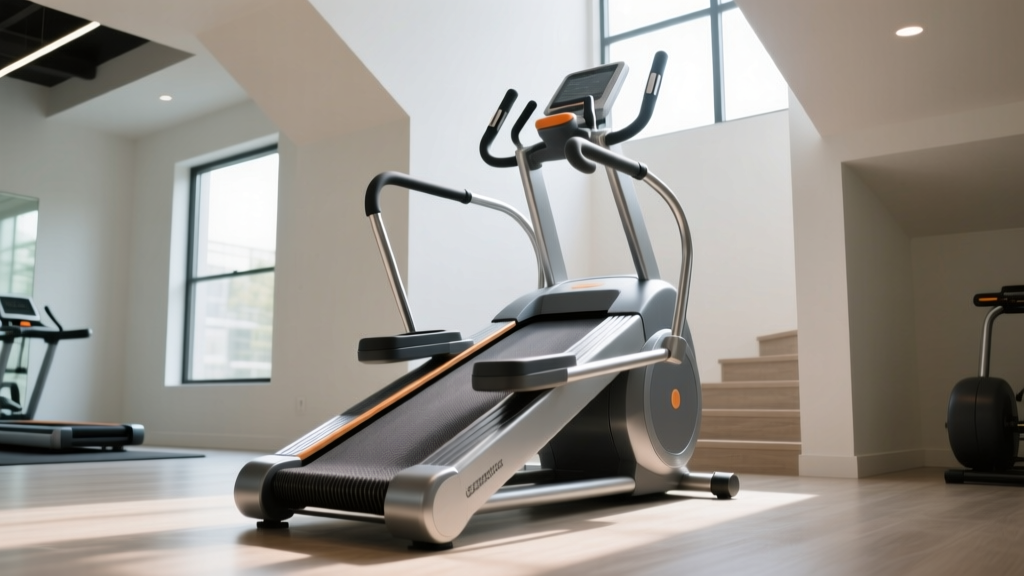
Home Stair Climber Guide: What Is 15 Incline on Treadmill in Degrees?
Master home cardio with our stair climber guide. We compare stepper mechanics and answer what is 15 incline on treadmill in degrees for beginners.

When setting up a home gym, beginners often debate between buying a treadmill or a dedicated stair climber. You have likely seen viral fitness trends promoting steep treadmill walking, leading to a very common biomechanical question: what is 15 incline on treadmill in degrees? Understanding the mathematical and physiological difference between a steep treadmill grade and the vertical climb of a stair climber is critical for protecting your joints and maximizing your cardiovascular gains.
This step-by-step guide will demystify the math behind treadmill inclines, compare the biomechanics of both machines, and walk you through exactly how to choose and use a stair climber for home use in 2026.
The Core Question: What is 15 Incline on Treadmill in Degrees?
Many beginners mistakenly believe that a 15% incline on a treadmill equals a 15-degree angle. This is a fundamental misunderstanding of how incline is measured. Treadmill incline is measured in percent grade (rise over run), not degrees.
A 15% grade means the belt rises 15 units vertically for every 100 units it travels horizontally. To convert this to degrees, we use the arctangent function (atan(0.15)). The actual answer to 'what is 15 incline on treadmill in degrees' is approximately 8.53 degrees.
Why This Math Matters for Your Joints
While 8.53 degrees sounds modest, walking at a continuous 15% grade forces your ankle into extreme dorsiflexion. According to sports biomechanics research, this sustained angle places immense eccentric load on the Achilles tendon and plantar fascia. If you are a beginner with tight calves, a 15% treadmill incline can quickly lead to Achilles tendinopathy or shin splints. This is precisely why many home-gym owners pivot to stair climbers, which utilize a different biomechanical pathway.
Biomechanics: Treadmill Incline vs. Home Stair Climbers
To make an informed decision for your home gym, you need to understand how your body interacts with these two distinct cardio machines. The Cleveland Clinic notes that stair climbers uniquely target the posterior chain while minimizing the sheer force on the lower leg tendons that steep treadmills exacerbate.
| Feature | Treadmill (15% Grade / 8.5°) | Home Stair Climber (Vertical Stepper) |
|---|---|---|
| Primary Muscle Focus | Calves, Hamstrings, Glutes | Quadriceps, Gluteus Maximus, Core |
| Joint Impact | Low impact, but high Achilles strain | Zero impact, high hip/knee flexion |
| Footwear Requirement | High-drop running shoes recommended | Flat-soled cross-trainers or barefoot |
| Spatial Footprint | Large (approx. 70" L x 30" W) | Compact (approx. 45" L x 30" W) |
Step-by-Step: Choosing the Right Home Stair Climber in 2026
If you have decided that a stair climber is the safer, more efficient choice for your home, follow this step-by-step framework to select the right model based on your budget and space constraints.
Step 1: Determine Your Machine Type
Home stair climbers generally fall into two categories: Mini Steppers (pedal-based, no handrail) and Vertical Climbers / StepMills (rotating stairs or large stride elliptical hybrids). Mini steppers are best for apartments; vertical climbers are best for serious cardiovascular conditioning.
Step 2: Match Your Budget to Top 2026 Models
- The Budget Apartment Pick: Sunny Health & Fitness SF-S902 (Approx. $85)
This mini-stepper features hydraulic resistance cylinders and a 15-inch step height. It lacks a motorized console but is perfect for beginners needing a low-profile machine that slides under a bed. Limitation: The range of motion is too short to build elite climbing endurance. - The Mid-Range Hybrid: Bowflex Max Trainer M9 (Approx. $2,299)
This machine blends an elliptical with a stair climber. It features a 14-inch vertical stride and magnetic resistance. The JRNY app integration provides adaptive coaching, making it ideal for beginners who need guided progression without the knee strain of a traditional stepmill. - The Premium Powerhouse: ProForm Pro HIIT H14 (Approx. $1,899)
Featuring a unique 14-inch vertical and 38-inch horizontal elliptical path, this machine simulates the exact biomechanics of climbing a ladder. It includes a 14-inch HD touchscreen and auto-adjusting magnetic resistance. It is widely considered the gold standard for home stair climbing in 2026.
⚠️ The Handrail Trap: A Beginner's Warning
According to the American Council on Exercise (ACE), leaning heavily on the handrails of a stair climber reduces your caloric expenditure by up to 30% and completely disengages your core stabilizers. Always use the rails purely for balance, keeping your torso upright and your hands resting lightly on the sensors.
Your First 4 Weeks: A Beginner's Step-by-Step Routine
Transitioning to a stair climber requires conditioning your hip flexors and glutes. Do not jump into 45-minute sessions on day one. Follow this 4-week acclimation protocol.
- Week 1: Neuromuscular Acclimation (15 Minutes)
Focus entirely on posture. Keep your chest up, shoulders back, and push through your heels. Alternate between 2 minutes of stepping at a moderate cadence (60 steps per minute) and 1 minute of active rest (slow pedaling). Repeat 5 times. - Week 2: Building Base Endurance (25 Minutes)
Increase the resistance level by 2 notches. Aim for a continuous 15-minute block at 70 SPM, followed by a 5-minute cool-down. You should be able to speak in short sentences but not hold a full conversation. - Week 3: Introduction to Glute Intervals (30 Minutes)
Introduce high-resistance intervals to target the gluteus maximus. Perform 1 minute of heavy resistance stepping (slow, deep pushes) followed by 2 minutes of light, fast recovery stepping. Repeat for 6 cycles. - Week 4: The 12-3-30 Stepper Equivalent (35 Minutes)
Simulate the famous treadmill trend safely. Set the machine to a medium-high resistance. Maintain a steady cadence of 80 SPM for 30 continuous minutes without touching the handrails. Finish with a 5-minute flush.
"The stair climber is unforgiving of poor posture. If you find yourself hunching over the console, the resistance is too high. Drop the level, stand tall, and let your glutes do the work, not your lower back." — Certified Strength and Conditioning Specialist (CSCS) Biomechanics Guideline
Frequently Asked Questions
Can I use a stair climber if I have bad knees?
Yes, but with caveats. Stair climbers are zero-impact, meaning there is no foot-strike shockwave traveling up your leg. However, they do require deep knee flexion. If you have patellofemoral pain syndrome, limit your range of motion by taking shallower steps on a hybrid machine like the Bowflex Max Trainer, rather than using a traditional rotating stepmill.
Is a 15% treadmill incline better for fat loss than a stair climber?
Not inherently. Fat loss is dictated by overall caloric deficit and heart rate zone maintenance. While a 15% incline (8.53 degrees) burns significant calories, many beginners are forced to hold onto the treadmill handrails to sustain the pace, which negates the metabolic benefit. A stair climber allows for a more natural, unsupported upright posture, often resulting in a higher true caloric burn for beginners.
How much ceiling clearance do I need for a home stair climber?
This is the most overlooked measurement in home gym planning. For vertical climbing machines like the ProForm HIIT H14, you must add your height plus 15 inches to the machine's peak step height. For a 6-foot-tall user, you need a minimum ceiling clearance of 8 feet to avoid head strikes at the top of the pedal stroke.
Final Thoughts
Understanding the reality behind treadmill inclines—knowing exactly what is 15 incline on treadmill in degrees—reveals why steep walking is not always the optimal choice for beginners. By shifting your focus to a dedicated home stair climber, you protect your Achilles tendons, engage your posterior chain more effectively, and optimize your spatial footprint. Follow the 4-week step-by-step protocol above, respect the handrail trap, and you will build a resilient, powerful cardiovascular base right in your living room.
More gear to consider
All reviews
Beyond the Treadmill Emoji: Belt Maintenance & Lubrication Costs

Walking Pad vs AFG Treadmill 7.1 AT: Common Mistakes & Fixes

Treadmill Generator vs Bikes: Upright, Recumbent & Spin Value
Treadmill Payment Plan No Credit Check vs Home Stair Climbers

Air Bike vs Assault Bike: Beating Treadmills with Interval Training
