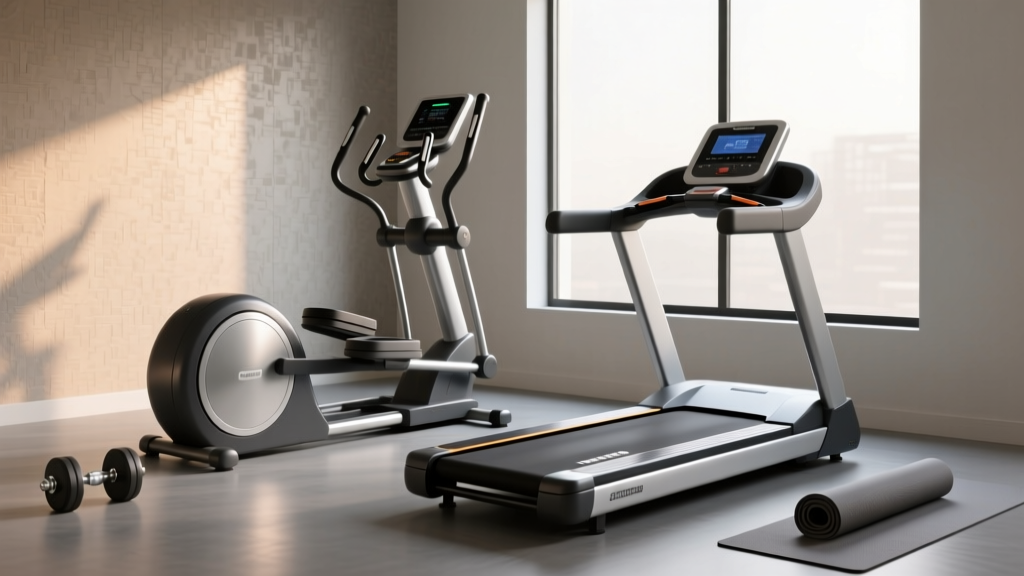
Elliptical vs Aerobic Exercise Treadmill: Budget & Value Guide
Compare the true costs of an elliptical vs an aerobic exercise treadmill. We break down 2026 pricing, maintenance, and long-term value for home gyms.

The True Cost of Home Cardio: Beyond the Sticker Price
When outfitting a home gym, the debate between an elliptical machine and an aerobic exercise treadmill usually centers on joint impact or calorie burn. However, as a senior equipment analyst at FitGearPulse, I see buyers make a critical mistake: they only look at the upfront retail price. In 2026, the true cost of ownership involves electrical requirements, spatial footprints, mandatory software subscriptions, and long-term mechanical failure rates.
If you are trying to decide where to allocate your fitness budget, this comprehensive value analysis breaks down the exact financial and biomechanical ROI of both machines. We will look past the marketing gloss and examine real-world pricing, specific model depreciation, and the hidden maintenance costs that drain your wallet years after the initial purchase.
The Upfront Capital: 2026 Pricing Tiers Compared
The entry-level market for both machines is saturated with sub-$500 options that we strongly advise against. These budget models feature lightweight flywheels (under 10 lbs on ellipticals) and low-continuous horsepower (CHP) motors (under 2.0 on treadmills) that burn out within 18 months of regular use. To get genuine value, you must target the mid-tier and premium segments.
| Tier | Elliptical Benchmark (Model / Price) | Aerobic Exercise Treadmill Benchmark (Model / Price) | Value Verdict |
|---|---|---|---|
| Entry-Mid ($600-$999) | Schwinn 430 / $799 | Sole F63 / $999 | Ellipticals offer better build quality at this price point; treadmills here often sacrifice deck cushioning. |
| Mid-Premium ($1,000-$1,500) | Sole E25 / $999 (Sale) or NordicTrack SE7i / $1,099 | ProForm Pro 9000 / $1,299 | Treadmills win on tech integration and heavy-duty frames in this bracket. |
| Premium ($1,600+) | Bowflex Max Trainer M9 / $1,999 | NordicTrack 1750 / $1,999 | Treadmills dominate the premium space with commercial-grade 3.5+ CHP motors and immersive incline/decline features. |
The 'Hidden' Cost Matrix: Footprint, Power, and Assembly
The sticker price is just the beginning. Home infrastructure dictates a massive portion of your long-term value proposition.
1. Electrical and Circuit Requirements
- Treadmills: A motorized aerobic exercise treadmill draws significant current, especially during incline acceleration. Most premium models (like the NordicTrack 1750) require a dedicated 20-amp circuit. If you plug it into a standard 15-amp bedroom circuit shared with a TV or AC unit, you risk tripping the breaker or degrading the treadmill's power supply. Upgrading your home electrical panel to add a dedicated 20A line costs between $250 and $450.
- Ellipticals: Because they rely on human kinetic energy and magnetic resistance rather than a drive motor, ellipticals draw less than 2 amps. They can be safely plugged into any standard 15-amp household outlet, saving you potential electrical retrofitting costs.
2. Spatial Footprint and Ceiling Clearance
While both machines occupy roughly 70 inches in length and 30 inches in width, the vertical clearance is where budgets break. An elliptical machine elevates the user by 10 to 15 inches at the peak of the stride. If you have standard 8-foot (96-inch) ceilings and are 6 feet tall, your head will be dangerously close to the ceiling, requiring costly basement or garage relocation. Treadmills keep you closer to the ground (deck height is usually 8-10 inches), making them vastly superior for rooms with low ceiling clearance.
The Subscription Tax: Software Paywalls in 2026
In the modern fitness landscape, hardware is often subsidized to push recurring revenue. You must factor in the 'Subscription Tax' when calculating 5-year ownership costs.
A $1,200 treadmill with a mandatory $39/month interactive coaching subscription will cost you $3,540 over five years. A $1,200 elliptical with a free, self-contained console remains exactly $1,200.
Brands like NordicTrack and ProForm heavily restrict manual mode functionality on their newer models if you do not subscribe to iFIT. Conversely, brands like Sole Fitness and Spirit offer robust, free out-of-the-box consoles with no mandatory paywalls. If your budget is strict and you despise recurring monthly fees, an elliptical from a 'hardware-first' brand offers vastly superior long-term financial value.
Long-Term Value & Maintenance: Where the Budget Bleeds
All cardio machines experience mechanical wear, but the type of wear dictates your repair bills. Here is a breakdown of the most common failure modes for both machines after the 2-year warranty expires.
Aerobic Exercise Treadmill Failure Modes
- Walking Belt Friction & Motor Burnout: If the silicone lubricant between the deck and belt dries out, friction increases. The motor works harder, draws excess amperage, and eventually fries the motor controller board. Replacement cost: $150-$250 for the board, plus labor.
- Incline Motor Gear Stripping: Frequent use of auto-incline features (especially interval programs that constantly shift the deck) wears down the plastic gears inside the incline lift motor. Replacement cost: $120-$180.
Elliptical Failure Modes
- Pivot Joint Bearing Degradation: Ellipticals have multiple articulating pivot points. Over 3 to 5 years, the grease inside these sealed bearings breaks down, leading to squeaking, grinding, and eventual joint seizure. Replacement cost: $40 for a bearing kit, but requires 2-3 hours of intensive teardown labor.
- Magnetic Resistance Servo Failure: The small servo motor that moves the magnet closer to the flywheel can lose calibration or burn out, resulting in stuck resistance levels. Replacement cost: $60-$90.
ROI on Health: Caloric Burn vs. Joint Longevity
Financial value means nothing if the machine causes an injury that sidelines you. According to the Mayo Clinic, ellipticals provide a low-impact aerobic workout that significantly reduces the compressive forces on the knees, hips, and lower back compared to the repetitive striking motion of a treadmill.
However, the Cleveland Clinic notes that treadmills offer superior weight-bearing benefits, which are crucial for maintaining bone density and preventing osteoporosis as you age. Furthermore, treadmills allow for precise speed and incline manipulation, making them the gold standard for Zone 2 cardio training and VO2 Max intervals.
- Choose the Treadmill if: You are training for outdoor running events, need to maximize bone density, and want precise control over pace and incline gradients.
- Choose the Elliptical if: You have a history of plantar fasciitis, meniscus tears, or lower back pain, and your primary goal is high-volume caloric expenditure with zero impact trauma.
The FitGearPulse Decision Framework: Which Machine Wins Your Wallet?
Use this diagnostic checklist to make your final purchasing decision based on your specific budget and home environment:
- Assess Your Electrical Panel: Do you have a dedicated 20-amp outlet in your desired workout space? If No, and you are unwilling to pay an electrician $300+ to install one, buy an elliptical.
- Measure Ceiling Clearance: Subtract your height from your ceiling height. Is the remainder less than 18 inches? If Yes, buy a treadmill (or a recumbent stepper); an elliptical will cause head-strike hazards.
- Calculate 5-Year Software Costs: Are you willing to pay $2,340 over five years for interactive mapping and auto-adjusting resistance? If No, avoid NordicTrack/ProForm treadmills and opt for a Sole or Spirit elliptical with a free console.
- Evaluate Joint History: Have you had knee or hip surgery in the last 5 years? If Yes, the biomechanical value of an elliptical far outweighs the running-specific benefits of a treadmill.
Frequently Asked Questions
Does an elliptical build as much muscle as an aerobic exercise treadmill?
No. While ellipticals engage the upper body (if using moving arm poles) and target the glutes during reverse-stride motions, a treadmill—especially when set to a 10-15% incline—forces the lower body to move your entire body weight against gravity, resulting in greater muscle activation in the calves, hamstrings, and glutes.
Which machine holds its resale value better?
Generally, high-end ellipticals hold their resale value slightly better than treadmills. Treadmills suffer from heavy cosmetic wear on the deck and motor degradation that is difficult for second-hand buyers to verify. A well-maintained Sole or Precor elliptical can often be resold for 40-50% of its original price, whereas used treadmills often depreciate by 70% or more due to the high cost of disassembly and transport.
Can I use a walking pad instead of a full treadmill to save money?
Walking pads (under-desk treadmills) are excellent for low-intensity NEAT (Non-Exercise Activity Thermogenesis) calorie burning. However, they lack the incline, deck cushioning, and motor power required for true aerobic conditioning or running. If your goal is cardiovascular health and Zone 2 training, a walking pad is not a viable financial substitute for a full-sized aerobic exercise treadmill.
More gear to consider
All reviews
Air Bike vs Assault Bike: What Does the Incline Number on a Treadmill Mean?

Rowing Guide: Real Ergs vs Dandy's World Treadmill Machine
Air Bike vs Assault Bike: Better Than 30 min on the treadmill?

Spin, Upright, Recumbent Bikes: How High is 12 Incline on Treadmill?

Air Bike vs Assault Bike Guide: Better Than ProForm 300i Treadmill?
