Elliptical vs Treadmill: Space Design & Treadmill Movie Setups
Compare ellipticals and treadmills for home gyms. Explore spatial footprints, ceiling clearances, and the ergonomics of the perfect treadmill movie setup.

The Spatial Dilemma: Footprint, Flow, and Entertainment
Designing a home cardio zone in 2026 requires balancing raw fitness performance with the architectural realities of your living space. When debating an elliptical vs treadmill for home cardio, most buyers focus solely on joint impact or calorie burn. However, from a space optimization and layout design perspective, the decision hinges on ceiling clearances, safety margins, and the increasingly popular 'treadmill movie' setup. Streaming long-form cinema or immersive series during 45-to-90-minute steady-state cardio sessions has become a staple of modern home gyms. Achieving this without inducing motion sickness or cluttering your room demands precise spatial planning.
This guide breaks down the exact measurements, ergonomic sightlines, and layout configurations needed to integrate either machine into your home, ensuring your fitness space is as functional as it is cinematic.
The Spatial Footprint: Clearances and Safety Zones
Before considering screen placement, we must address the physical footprint and the mandatory safety perimeters required by fitness industry standards. According to the American Council on Exercise (ACE), improper machine spacing is a leading cause of home gym injuries, particularly involving falls and entrapment.
Treadmill Clearance Requirements
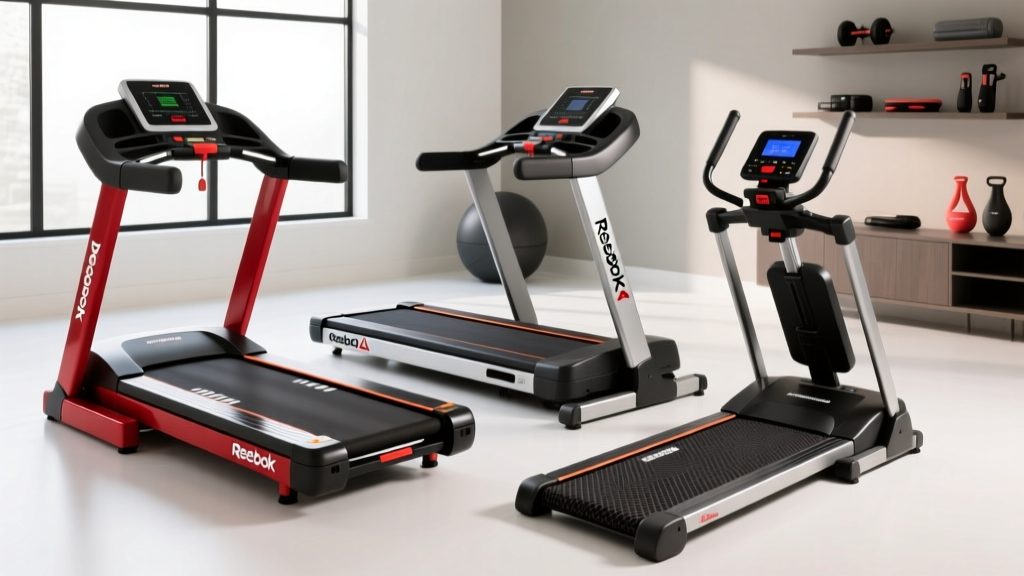
Treadmills are inherently longer and require a significant 'eject zone.' For a standard high-performance model like the Sole F80 (82.5 inches long) or the NordicTrack Commercial 2450 (79 inches long), you must allocate a minimum of 24 inches of clearance on both sides and a critical 48 inches of open space directly behind the deck. This rear clearance prevents severe friction burns or head trauma if a user falls off the moving belt.
Elliptical Clearance Requirements
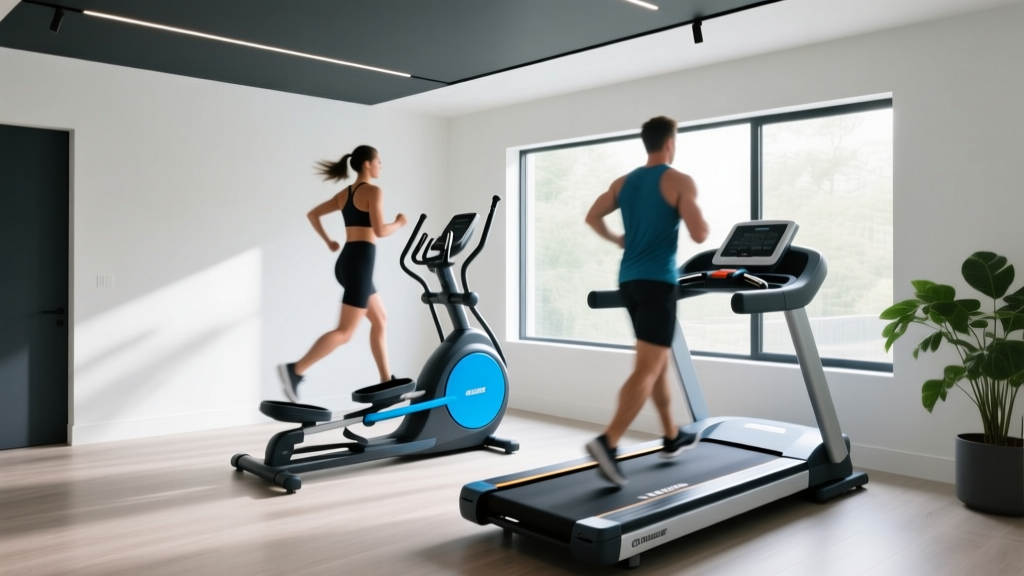
Ellipticals operate on a fixed pedal track, eliminating the rear ejection risk. A compact model like the Bowflex Max Trainer M9 (49 inches long) or a front-drive Horizon EX-59 requires only 12 inches of side clearance and 24 inches of rear clearance for pedal arm swing and mounting/dismounting.
| Machine Type | Avg. Length x Width | Side Clearance | Rear Safety Zone | Total Min. Floor Area |
|---|---|---|---|---|
| Standard Treadmill | 80' x 35' | 24' (each side) | 48' | ~75 sq. ft. |
| Compact Elliptical | 65' x 28' | 12' (each side) | 24' | ~35 sq. ft. |
| Folding Treadmill | 75' x 32' (Stored: 40') | 24' (each side) | 48' | ~65 sq. ft. (Active) |
Ceiling Height Math: Step-Up vs. Pedal Arc
Low ceilings (standard 8-foot or 96-inch heights) frequently dictate the elliptical vs treadmill debate. You must calculate the user's height plus the machine's maximum vertical displacement.
- Treadmill Deck Height: Most commercial-style treadmills have a step-up height between 8 and 10 inches. A 6-foot user (72 inches) on a 10-inch deck requires 82 inches of vertical space, leaving 14 inches of headroom in a standard 8-foot room. This is generally safe, but adding a ceiling fan or recessed lighting can create a hazard.
- Elliptical Pedal Arc: Ellipticals elevate the user higher. The pedal arc on a standard rear-drive elliptical can peak at 15 to 18 inches above the floor. That same 6-foot user will peak at 90 inches, completely maxing out an 8-foot ceiling and requiring a 9-foot or 10-foot ceiling for safe, upright posture.
Design Rule of Thumb: If your basement or garage gym has a ceiling lower than 94 inches, a low-profile treadmill (like the ProForm Pro 9000 with an 8-inch step-up) is significantly safer than a traditional elliptical.
Ergonomics of the 'Treadmill Movie' Experience
The 'treadmill movie' setup—mounting a large display or projector to stream films while walking or running—requires distinct spatial ergonomics compared to elliptical viewing. The biomechanics of running introduce vertical oscillation (bounce), which drastically alters how your eyes track a screen.
Visual-Vestibular Mismatch and Screen Distance
When running at 5.0 to 7.0 mph, your head bounces vertically by 2 to 4 inches per stride. If a screen is placed too close (under 5 feet), this bounce forces your eyes to constantly refocus, leading to visual fatigue and motion sickness. According to Mayo Clinic's fitness and wellness guidelines, maintaining a stable visual horizon is crucial for reducing exercise-induced nausea.
For an optimal treadmill movie layout, the screen must be positioned 6 to 9 feet away from the front of the treadmill deck. This distance minimizes the perceived vertical bounce and allows your peripheral vision to anchor on the stationary walls of the room.
Screen Height and Tilt
Because the treadmill deck elevates the user by 8-10 inches, a standard wall-mounted TV (typically centered at 42-48 inches for living room seating) will be too low, forcing the runner to look down and compromising their airway and spinal alignment. The Fix: Mount the center of your treadmill movie screen at 60 to 64 inches from the floor. For 2026 setups, ultra-short-throw (UST) laser projectors paired with ambient light rejecting (ALR) screens are ideal, as they eliminate the glare from overhead gym lights and can be placed on a low console table, saving valuable wall space.
The Elliptical Alternative: Close-Range Immersion
Ellipticals provide a smooth, linear glide with virtually zero vertical head bounce. This allows for a completely different spatial layout. You can mount a 32-inch monitor or use an articulating arm for a tablet just 18 to 24 inches from the user's face. This close-range setup is perfect for smaller rooms (e.g., a 10x10 bedroom gym) where projecting a massive treadmill movie is physically impossible due to throw-distance limitations.
Layout Configurations for Small Rooms (10x10 or Smaller)
When space is at a premium, the layout must prioritize multi-functionality and cable management. Here are two optimized layouts based on your machine choice.
Layout A: The Cinematic Treadmill Nook
- Placement: Position the treadmill facing a blank wall or a window with blackout shades. Do not place it facing an open doorway, as visual distractions break the immersion of the treadmill movie experience.
- Folding Mechanism: Utilize a hydraulic folding treadmill (e.g., Horizon 7.8). Ensure you have 70 inches of vertical wall clearance to store the deck upright when not in use.
- AV Integration: Install a swivel wall mount for a 55-inch OLED TV. Use a soundbar mounted directly below the screen to project audio forward, avoiding the need for rear surround speakers that require extra wiring across the room.
Layout B: The Corner Elliptical Command Center
- Placement: Tuck the elliptical into a 45-degree corner angle. This utilizes 'dead space' and naturally frames the user toward the center of the room.
- AV Integration: Mount a heavy-duty, gas-spring articulating arm to the adjacent side wall. This allows you to pull a 27-inch monitor directly into your line of sight, then push it flush against the wall when the machine is not in use.
- Storage: Use the wall space above the elliptical for floating shelves to hold resistance bands, heart rate monitors, and AV remotes.
Power, Cable Management, and Infrastructure
A critical, often overlooked aspect of home gym layout is electrical infrastructure. High-incline treadmills drawing heavy motor loads can trip standard shared circuits.
- Treadmills: Require a dedicated 15-amp or 20-amp circuit. Running a treadmill and a large AV receiver/home theater system on the same 15-amp breaker will frequently trip the switch during high-incline intervals. Plan your layout so the treadmill is within 6 feet of a dedicated outlet to avoid using extension cords, which are a major tripping hazard and a violation of electrical codes.
- Ellipticals: Most magnetic resistance ellipticals draw minimal current (under 3 amps) or are entirely self-generating (like the Technogym Skillbike or certain NordicTrack models). They can safely share a circuit with your AV equipment and lighting.
Cable Management: For the treadmill movie setup, run HDMI and power cables through the wall using a recessed cable management box. Exposed cables trailing from a TV to a media console near a moving treadmill belt are a catastrophic snag hazard.
The Verdict: Which Machine Wins for Your Space?
Choosing between an elliptical and a treadmill ultimately depends on your room's cubic volume and your entertainment priorities.
Choose the Treadmill If:
- You have a room with at least 75 square feet of unbroken floor space and a rear safety zone.
- Your ceilings are 8 feet or lower (making low-profile treadmills the safer option).
- The 'treadmill movie' experience is a priority, and you have a wall 6 to 9 feet away from the front of the deck for optimal, bounce-free viewing.
- You can install a dedicated 15-amp electrical circuit.
Choose the Elliptical If:
- You are designing a micro-gym in a bedroom or office (under 50 square feet).
- You have high ceilings (9+ feet) to accommodate the pedal arc.
- You prefer close-range screen immersion (monitors/tablets) over large-scale wall projections.
- You need to share an electrical circuit with your home office or entertainment center.
By treating your cardio equipment not just as fitness tools, but as permanent architectural and entertainment fixtures, you can create a home gym in 2026 that maximizes both your physical output and your viewing pleasure. Measure twice, check your breaker box, and enjoy the show.
More gear to consider
All reviews
Beyond Barry's Treadmills: 2026 Stationary Bike Market Trends

Head-to-Head Treadmill Motors: Matching HP to Workout Plan PDFs

Stationary Bike Types & What Does Incline Mean on a Treadmill?
Under Desk Treadmill Office Review & Curved Treadmill Pros and Cons

Walking Pad Guide 2026: Avoid the Treadmill Key Missing Issue