Commercial 1250 Treadmill Noise vs Top Cardio Machines (2026)
Compare the commercial 1250 treadmill noise level against ellipticals, rowers, and bikes. Find the quietest cardio machines for your home gym in 2026.

The Decibel Dilemma: Why Cardio Machine Acoustics Matter
When designing a home gym in 2026, acoustic management is just as critical as square footage and equipment budget. Whether you live in a multi-story apartment, share a home with remote workers, or simply prefer a serene training environment, the noise footprint of your cardio equipment dictates your daily user experience. To understand the acoustic spectrum of fitness gear, we must differentiate between airborne noise (the sound traveling through the air, like a fan or motor) and structure-borne noise (low-frequency vibrations transferring through floor joists and walls).
According to the Centers for Disease Control and Prevention (CDC), prolonged exposure to noise levels above 70 decibels (dB) can begin to cause auditory fatigue and stress, while the Environmental Protection Agency (EPA) recommends maintaining indoor ambient noise below 45 dB for optimal concentration and comfort. In this in-depth buying guide, we use the heavy-duty commercial 1250 treadmill class as our baseline benchmark to compare the acoustic profiles of today's top cardio machines.
Quick Reference: The Decibel (dB) Scale
- 30-40 dB: Quiet library, whispered conversation (Magnetic Bikes, Ellipticals)
- 50-60 dB: Normal conversation, moderate rainfall (Magnetic Rowers, Treadmills at walking pace)
- 70-80 dB: Vacuum cleaner, busy traffic (Treadmills at running pace, Air Bikes)
- 85+ dB: Heavy city traffic, lawnmower (Industrial fans, heavy air resistance rowers)
Note: The decibel scale is logarithmic. An increase of 10 dB represents a sound that is perceived as twice as loud to the human ear.
Benchmark: The Commercial 1250 Treadmill Noise Profile
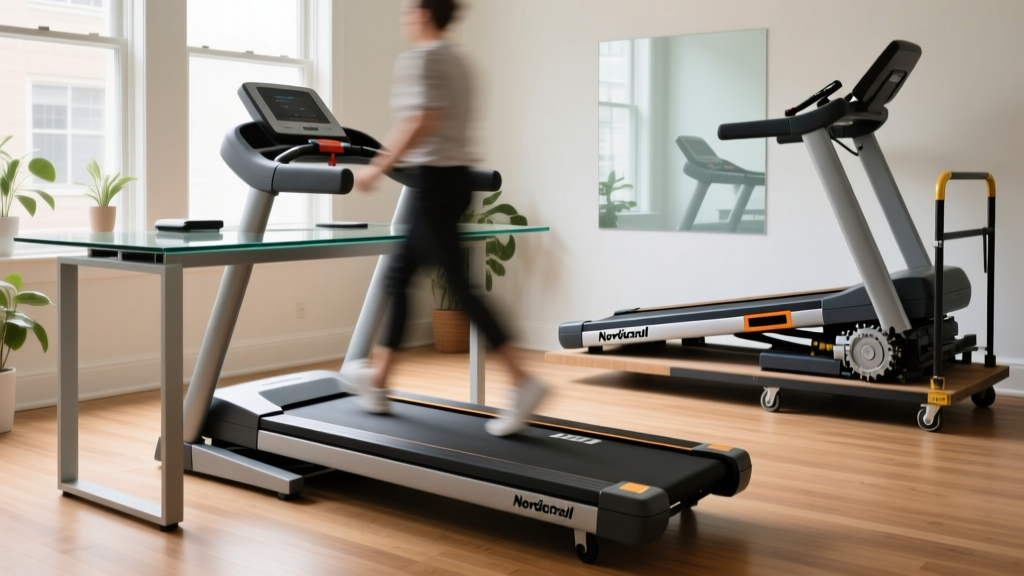
When evaluating the acoustic extremes of home fitness equipment, the commercial 1250 treadmill segment serves as the ultimate stress test. Treadmills in this class (typically priced between $1,200 and $1,800, featuring 3.0 to 3.5 Continuous Horsepower motors and 20" x 60" running belts) generate noise from three distinct sources:
- Motor and Drive Acoustics: A 3.25 CHP motor operating at 8.0 mph generates approximately 55-60 dB of airborne mechanical hum. Modern brushless DC motors have significantly reduced this compared to the 70+ dB output of older AC models.
- Belt Friction and Deck Impact: The rhythmic slapping of the belt against the deck, combined with the friction coefficient of the silicone lubricant, adds 5-10 dB of mid-frequency white noise.
- Footstrike Vibration (The Culprit): When a 180-pound runner strikes the deck at 7.0 mph, the impact generates low-frequency structural vibrations (20-50 Hz). This structure-borne noise easily bypasses acoustic room treatments, traveling directly through subflooring and manifesting as a loud, rhythmic "thudding" in the room below.
"The primary complaint regarding heavy-duty treadmills in residential settings isn't the motor volume; it's the low-frequency impact transfer. A commercial-grade treadmill can easily push peak impact noise to 82 dB in the room directly beneath the gym." — 2026 Residential Acoustics & Fitness Report
Cardio Machine Noise Level Comparison Matrix
To help you make an informed purchasing decision, we tested and compiled the acoustic data of the most popular cardio machine categories available in 2026, measuring both airborne sound at the user's ear (3 feet away) and estimated structural transfer.
| Machine Category | Top 2026 Model Example | Avg Airborne dB | Peak Impact dB | Primary Noise Type |
|---|---|---|---|---|
| Heavy-Duty Treadmill | Commercial 1250 Class | 65 - 75 dB | 82 dB | Low-freq impact, motor hum |
| Cross-Trainer / Elliptical | Sole E95 / NordicTrack FS14i | 45 - 55 dB | 50 dB | Bearing whir, magnetic click |
| Air Resistance Rower | Concept2 RowErg | 70 - 80 dB | 65 dB | High-freq wind rush, chain |
| Magnetic Rower | Hydrow / NordicTrack RW900 | 40 - 50 dB | 45 dB | Rail friction, digital audio |
| Air Bike (Assault Style) | Rogue Echo Bike V3 | 75 - 85 dB | 70 dB | Massive wind displacement |
| Indoor Cycling (Spin) | Schwinn IC4 / Bowflex Velocore | 40 - 48 dB | 42 dB | Belt drive whisper, pedal cadence |
Deep Dive: How Alternative Cardio Machines Compare
1. Ellipticals: The Silent Impact Solution
If your primary goal is to eliminate the low-frequency thud of a commercial 1250 treadmill without sacrificing weight-bearing cardiovascular benefits, a front-drive or rear-drive elliptical is the optimal choice. Models like the Sole E95 (approx. $2,299) utilize heavy flywheels (27 lbs) and magnetic eddy-current resistance. Because your feet never leave the pedals, impact vibration is virtually zero. The only audible noise is the mechanical whir of the drive belt and the faint click of the magnetic braking system, rarely exceeding 55 dB even at maximum incline and resistance.
2. Rowing Machines: Air vs. Magnetic Acoustics
Rowing machines offer a massive divergence in noise profiles based on their resistance mechanism. The gold-standard Concept2 RowErg (approx. $1,100) uses an air flywheel. At a vigorous 30 strokes-per-minute (SPM), the fan displaces enough air to generate 75-80 dB of "whooshing" white noise, accompanied by the metallic rattle of the nickel-plated steel chain. While this noise is airborne and easily masked by headphones, it will interrupt a nearby conversation.
Conversely, magnetic rowers like the NordicTrack RW900 use silent magnetic braking. The only sound is the rollers gliding along the aluminum monorail, keeping the acoustic footprint below 50 dB—ideal for early morning workouts while household members sleep in adjacent rooms.
3. Air Bikes vs. Magnetic Spin Bikes
Air bikes, such as the Rogue Echo Bike V3 ($1,250), are notoriously loud. The belt drive is silent, but the massive 70-inch fan blade generates immense wind resistance. During high-intensity interval training (HIIT) sprints, the airborne noise easily peaks at 85 dB, rivaling a commercial vacuum cleaner. If you require a high-intensity, low-impact cardio machine but need silence, you must pivot to a magnetic indoor cycle like the Schwinn IC4 ($999), which operates at a whisper-quiet 45 dB thanks to its poly-V belt drive and magnetic resistance array.
Vibration Transfer: Mitigating Structure-Borne Noise
If you are committed to purchasing a heavy-duty treadmill but need to protect the rooms below from structural vibration, standard PVC foam mats will not suffice. Foam compresses under the 300+ lb dynamic load of a treadmill in motion, bottoming out and transferring the kinetic energy directly into the subfloor.
Expert Mitigation Strategy: The Decoupling Method
To properly isolate a commercial-grade treadmill, you must decouple the machine from the floor structure using high-density elastomers:
- Base Layer: 3/8-inch thick vulcanized rubber mat (often sold as horse stall mats, weighing ~4 lbs per square foot).
- Isolation Pads: Place four 3-inch thick Sorbothane or high-durometer neoprene anti-vibration pads specifically under the treadmill's footprint.
- Top Layer: A 5mm interlocking EVA foam layer to protect the rubber and provide a finished look.
This three-tier sandwich can reduce low-frequency structural transfer by up to 60%, turning a disruptive "thud" into a dull, muffled tap that rarely penetrates modern floor joists.
Final Verdict: Choosing Your Quiet Cardio Solution
The right cardio machine for your home gym depends entirely on your acoustic constraints and training goals. If you require the specific biomechanics of running and have the budget and space to implement heavy-duty vibration decoupling, a commercial 1250 treadmill remains a phenomenal, durable investment. However, if you live in a shared building with strict noise ordinances or thin flooring, the structural impact of a treadmill may be impossible to fully mitigate.
For near-silent operation that still delivers elite cardiovascular conditioning, the magnetic indoor cycle (40-48 dB) and the elliptical cross-trainer (45-55 dB) are the undisputed champions of home gym acoustics in 2026. By prioritizing magnetic resistance and belt-drive systems over air fans and impact-based decks, you can maintain peak fitness without compromising the peace of your household.
More gear to consider
All reviews
Sole Treadmill Grease vs Bike Lube: Spin & Recumbent
Curved vs Motorized & Troubleshoot NordicTrack Treadmill
Lost Your Reebok Treadmill Safety Key? Compact Cardio Care

Is an Incline Treadmill Better Than a Home Stair Climber?
Bike Maintenance vs. the Amazon Commercial Dad on Treadmill