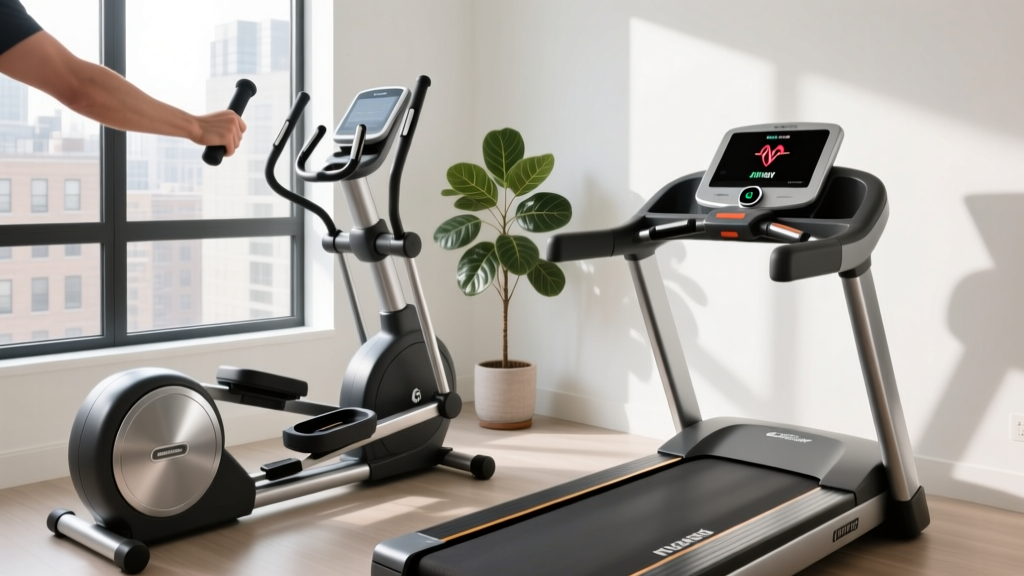
Elliptical vs Treadmill: Apple Watch Accuracy & Budget Guide
Compare elliptical vs treadmill costs, maintenance, and tracking accuracy. Discover what's more accurate: the treadmill or Apple Watch for home cardio.

Building a home gym in 2026 requires navigating a minefield of inflated MSRPs, subscription fatigue, and rapidly evolving wearable technology. When buyers narrow their choices down to the two undisputed titans of indoor cardio—the elliptical and the treadmill—the decision rarely comes down to just footprint or aesthetics. It hinges on long-term financial value, biomechanical longevity, and, increasingly, how seamlessly the machine integrates with your personal data ecosystem.
One of the most frequent questions we receive in the FitGearPulse lab bridges the gap between hardware and software: what's more accurate the treadmill or Apple Watch when tracking indoor cardio? The answer is not a simple binary. It requires a deep dive into sensor algorithms, arm-swing biomechanics, and the mechanical realities of both machines. Below, we break down the true cost of ownership, the hidden maintenance fees, and the data-tracking realities to help you decide which machine offers the highest return on investment for your home.
The Tracking Dilemma: What’s More Accurate, the Treadmill or Apple Watch?
To understand the value of your cardio investment, you must understand how your data is being captured. When users ask what's more accurate the treadmill or Apple Watch, they are usually noticing a discrepancy between the machine's digital console and their wrist-worn wearable. The truth is that the Apple Watch is an incredibly precise piece of engineering, but its accuracy is entirely dependent on the biomechanics of the machine you are using.
Sensor Reality Check
The Apple Watch relies on a combination of an optical heart sensor, a gyroscope, and an accelerometer. For indoor workouts where GPS is unavailable, the watch estimates distance and calorie burn based on your arm swing cadence and stride length algorithms. According to Apple's official calibration guidelines, the device learns your stride length during outdoor GPS-tracked sessions and applies that math to indoor sessions.
Why Treadmills Win the Accuracy War
On a treadmill, if you maintain a natural running or walking form (meaning you do not grip the handrails), your arm swing perfectly mimics outdoor locomotion. The Apple Watch's accelerometer reads this rhythmic movement, resulting in distance and calorie calculations that are typically within a 2% to 4% margin of error compared to the treadmill's belt-rotation sensors. In this scenario, the Apple Watch and a high-quality treadmill (like the Sole F80) are equally accurate, with the watch providing superior heart-rate-based calorie adjustments.
The Elliptical Blind Spot
Ellipticals introduce a massive variable: the handles. If you use an elliptical like the Schwinn 430 and grip the stationary handles, your arms remain still. The Apple Watch registers zero arm-swing cadence, leading the algorithm to drastically underreport your distance and active calorie burn—sometimes by as much as 20%. Even if you use the moving arm poles, the gliding motion does not match the impact-based stride algorithms the watch uses for walking or running. Therefore, if data accuracy is your primary motivator, the treadmill is the superior partner for your Apple Watch.
Elliptical vs. Treadmill: 2026 Budget Breakdown
Beyond tracking metrics, the initial capital outlay and long-term depreciation define the true value of your cardio machine. The 2026 fitness equipment market has seen a bifurcation: ultra-cheap Amazon imports that fail within 14 months, and premium legacy brands that hold their resale value. Here is how the budget breaks down across three distinct tiers.
| Tier | Treadmill Models & Pricing | Elliptical Models & Pricing | Value Proposition |
|---|---|---|---|
| Entry-Level (Under $800) |
Horizon T101 ($699) NordicTrack T Series 8 ($599) |
Schwinn 430 ($699) Sunny Health SF-E3912 ($349) |
Ellipticals offer better mechanical durability at the low end. Budget treadmills often suffer from weak continuous horsepower (CHP) motors that overheat. |
| Mid-Range ($800 - $1,500) |
Sole F80 ($999) Horizon 7.4 ($1,199) |
Sole E35 ($1,099) Nautilus E714 ($1,299) |
The sweet spot for both. Treadmills here feature 3.0+ CHP motors; ellipticals offer 20-inch strides and heavy flywheels. |
| Premium ($1,500+) |
NordicTrack 1750 ($1,599) Peloton Tread ($2,495) |
Bowflex Max M9 ($1,999) Sole E95 ($1,499) |
Treadmills dominate the premium space with interactive HD screens and auto-incline. Ellipticals focus on joint-saving suspension systems. |
Hidden Costs: Maintenance and Lifespan ROI
The purchase price is merely the entry fee. To accurately assess value, we must calculate the Total Cost of Ownership (TCO) over a standard 7-year lifespan. Treadmills and ellipticals degrade in fundamentally different ways, impacting your wallet differently over time.
Treadmill Maintenance Realities
- Belt Lubrication: Treadmill decks require 100% silicone lubrication every 150 miles or roughly every 3 months for active users. Cost: $15 per bottle.
- Belt Replacement: Friction eventually degrades the belt and deck. Expect to replace the walking belt every 4 to 6 years. Cost: $150 to $250 for parts, plus 2 hours of labor.
- Motor and Electronics: Treadmills draw significant continuous amperage. Power surges can fry the motor controller board. A replacement motor control board for a Sole F80 costs roughly $185.
- Energy Consumption: A 3.25 CHP motor running at 7.0 mph draws about 600-900 watts. Over a year of daily use, expect a $40-$60 addition to your annual electricity bill.
Elliptical Maintenance Realities
- Rail and Roller Cleaning: Dust accumulation on the guide rails causes micro-stutters and wears down the polyurethane wheels. Requires weekly wiping with a damp cloth (Cost: negligible).
- Pivot Joint Bearings: The sheer number of moving pivot points means bearings can dry out or squeak. Annual greasing with white lithium grease is required. Cost: $10 per can.
- Alternator/Generator Issues: Many mid-to-high-end ellipticals are self-powered or use internal alternators to power the console. These alternators can fail after 5+ years of heavy use, costing $120-$200 to replace.
- Energy Consumption: Negligible. Most modern ellipticals draw less than 15 watts, often powered entirely by the user's kinetic energy.
The ROI Takeaway: Ellipticals generally boast a lower Total Cost of Ownership. Without a high-friction belt dragging across a wooden deck, and without a massive continuous-duty motor fighting gravity and user weight, the mechanical wear-and-tear on an elliptical is significantly lower, resulting in fewer out-of-warranty repair bills.
Biomechanics, Joint Health, and Caloric Value
Financial value is meaningless if the machine causes an injury that sidelines you. The American Heart Association recommends at least 150 minutes of moderate-intensity aerobic activity per week to maintain cardiovascular health. Achieving this consistently requires a machine that respects your joint cartilage.
Treadmills, even those with advanced cushioning systems like the NordicTrack Runners Flex cushioning, still subject the knees, hips, and lower back to ground reaction forces equivalent to 1.5 to 3 times your body weight with every footstrike. For users over 40, or those with a history of meniscus tears or plantar fasciitis, the treadmill's repetitive impact can lead to inflammation, forcing you to abandon your routine.
Ellipticals, conversely, offer a closed-kinetic-chain movement. Your feet never leave the pedals, reducing joint impact to near zero while still elevating the heart rate into the target aerobic zone. Furthermore, the CDC's physical activity guidelines emphasize the importance of muscle-strengthening activities alongside cardio. Ellipticals with adjustable inclines and reverse-stride capabilities actively engage the glutes, hamstrings, and calves in a way that flat treadmill walking cannot, effectively giving you a hybrid cardio-and-resistance workout that maximizes the time-value of your exercise session.
The FitGearPulse Decision Matrix
To finalize your investment, map your specific profile to the frameworks below:
Choose the Treadmill If:
- Data Accuracy is Paramount: You want your Apple Watch or Garmin metrics to perfectly reflect your indoor distance and pace without manual calibration workarounds.
- You Train for Outdoor Events: You are actively training for a 5K, half-marathon, or marathon and need to simulate the exact biomechanics, impact, and incline gradients of outdoor roads and trails.
- Budget Allows for Mid-Tier or Higher: You have at least $900 to spend on a 3.0 CHP motor to ensure the machine doesn't stutter under your weight during sprint intervals.
Choose the Elliptical If:
- Joint Preservation is the Priority: You are managing arthritis, recovering from lower-body surgery, or are significantly overweight and need to mitigate ground reaction forces.
- You Want Lower Long-Term Maintenance: You prefer a machine with a lower TCO, zero belt lubrication requirements, and minimal electricity draw.
- You Are on a Strict Entry-Level Budget: A $600 elliptical will generally provide a smoother, more durable, and safer user experience than a $600 treadmill, which will likely suffer from a narrow running deck and a weak motor.
Ultimately, the 'best' value is the machine that aligns with your biomechanical needs and integrates seamlessly into your digital life. If you prioritize flawless wearable syncing and road-race simulation, invest in a mid-tier treadmill and commit to the belt maintenance. If you prioritize joint longevity, full-body engagement, and lower lifetime costs, the elliptical remains an unparalleled powerhouse for the home gym.
More gear to consider
All reviews
Virtuix Omni One Treadmill vs Standard: Belt Maintenance Cost Analysis

Optimize Treadmill Routines to Burn Fat: Belt Maintenance Guide

ProForm 770 EKG Treadmill Review: Small Space Value Analysis

Beginner's Horizon Treadmill Buying Guide: Features Compared

Stair Climber vs Hydrotherapy Treadmill: 2026 Home Guide
