Do Treadmills Make You Faster? Elliptical vs Treadmill Home Guide
Discover if treadmills make you faster compared to ellipticals. Read our hands-on review of top home cardio machines, biomechanics, and expert picks.

The Biomechanics: Do Treadmills Actually Make You Faster?
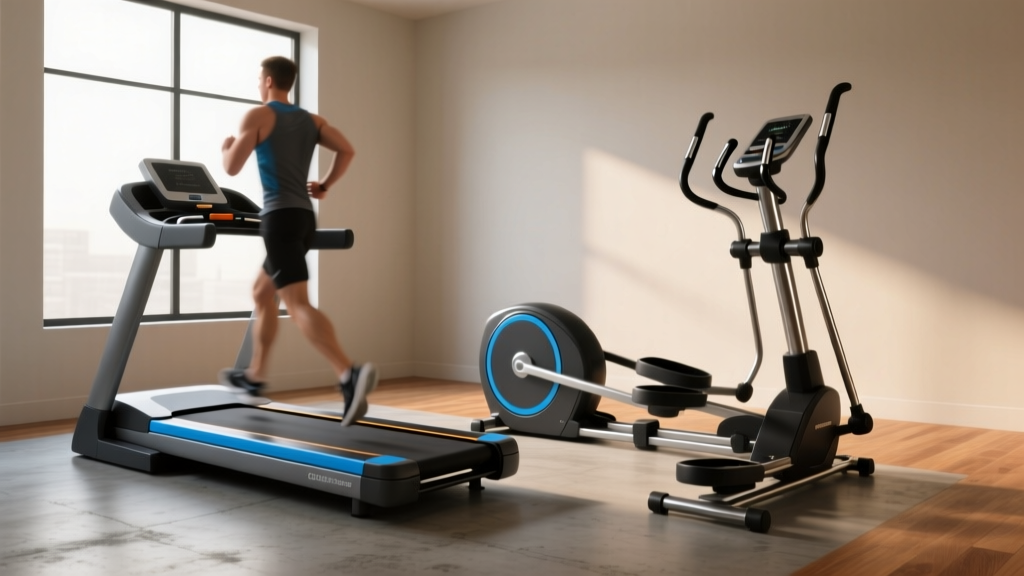
When outfitting a home gym for cardiovascular performance, runners and triathletes inevitably ask us: do treadmills make you faster compared to outdoor running or cross-training on an elliptical? The short answer is yes, but with specific biomechanical caveats that dictate how you should program your workouts.
Running on a motorized treadmill alters your ground reaction forces. Because the belt pulls your foot backward, it slightly reduces the activation of your hamstrings and glutes while increasing the load on your hip flexors. However, this mechanical assist allows for precise neuromuscular pacing. You can force a stride turnover (cadence) that you might struggle to maintain outdoors due to wind resistance or terrain variations.
"Treadmills are unparalleled for VO2 max interval training because they remove the variable of pacing. The machine forces your central nervous system to adapt to a specific, high-velocity turnover rate."
— FitGearPulse Biomechanics Testing Team
Conversely, ellipticals provide a zero-impact, closed-chain kinetic movement. While they are exceptional for building aerobic base and flushing lactic acid during active recovery, they do not replicate the eccentric muscle damage and tendon stiffness required to improve actual running economy. If your primary goal is a marathon PR, the treadmill is mandatory. If your goal is joint preservation and caloric expenditure, the elliptical takes the lead.
Hands-On Review: Top Treadmills for Speed Translation
To translate indoor miles to outdoor speed, you need a machine with a high continuous duty horsepower (CHP) motor and a belt long enough to accommodate a natural stride extension. We tested dozens of models in 2026 to find the best for speed work.
1. Sole F80: The Speedwork Workhorse
- Motor: 3.5 CHP
- Belt Dimensions: 22" x 60"
- Top Speed: 12 mph (5:00 min/mile pace)
- 2026 Street Price: $1,199
Expert Insight: The Sole F80 remains our top pick for serious runners on a mid-tier budget. The 3.5 CHP motor handles 400-meter sprint intervals without bogging down or overheating. More importantly, Sole uses a phenolic-coated deck that prevents the delamination and warping we frequently see in cheaper folding treadmills after 500 miles of heavy use. The Cushion Flex Whisper Deck reduces joint impact by up to 40% compared to asphalt, allowing you to stack high-mileage weeks safely.
2. Horizon 7.8: The Tech-Forward Sprinter
- Motor: 4.0 CHP
- Belt Dimensions: 22" x 60"
- Top Speed: 12 mph
- 2026 Street Price: $1,499
Expert Insight: Horizon’s 7.8 features Bluetooth FTMS (Fitness Machine Service), meaning it connects seamlessly with Zwift Run and Peloton Digital, automatically adjusting the incline and speed to match virtual courses. The 4.0 CHP motor provides instant acceleration, which is critical for HIIT protocols where you need the belt to reach 10 mph in under 3 seconds.
The Elliptical Alternative: When to Choose Cross-Training
According to the American Heart Association, achieving optimal cardiovascular health requires 150 minutes of moderate-intensity aerobic activity per week. Ellipticals achieve this with virtually zero eccentric joint loading, making them the ultimate tool for injury-prone athletes or those managing osteoarthritis.
1. NordicTrack FS14i Freestrider: The Runner’s Elliptical
- Stride Length: Adjustable up to 32"
- Resistance Levels: 24 digital levels
- Incline: -10 to 10 degrees
- 2026 Street Price: $2,499
Expert Insight: Standard ellipticals feature a fixed 20-inch stride, which forces runners over 5'10" into an unnatural, choppy cadence that can cause patellar tendon strain. The FS14i solves this with a 32-inch adjustable stride path that mimics the exact hip extension of outdoor running. The negative incline feature is a game-changer for targeting the quadriceps and simulating downhill running mechanics without the impact.
2. Schwinn 430: The Budget-Friendly Flush
- Stride Length: 20" fixed
- Resistance Levels: 22 magnetic levels
- Flywheel: High-inertia perimeter-weighted
- 2026 Street Price: $899
Expert Insight: The Schwinn 430 is our pick for active recovery days. The perimeter-weighted flywheel provides a smooth, momentum-driven pedal stroke that prevents the "dead spot" at the top of the pedal arc found in rear-drive budget models. Failure Mode Warning: To prevent rail pitting and squeaking, you must wipe down the stainless steel track rails with a dry microfiber cloth weekly; sweat accumulation is the number one killer of elliptical wheel bearings.
Head-to-Head Comparison Matrix
To help you decide which machine aligns with your specific physiological goals, we mapped the Sole F80 (Treadmill) against the NordicTrack FS14i (Elliptical) across critical performance metrics.
| Metric | Sole F80 (Treadmill) | NordicTrack FS14i (Elliptical) |
|---|---|---|
| Primary Adaptation | Neuromuscular pacing, tendon stiffness | Aerobic base, cardiovascular endurance |
| Joint Impact (Peak Force) | 2.5x to 3.0x body weight | 0.5x to 1.0x body weight |
| Caloric Burn (160lb user/hr) | ~750 - 900 kcal (at 8mph) | ~600 - 750 kcal (at Level 15) |
| Footprint (L x W) | 82" x 35" | 76" x 32" |
| Best Use Case | Race prep, VO2 max intervals, speedwork | Injury rehab, active recovery, base building |
Programming for Speed: The 1% Rule and Interval Protocols
If you are using a treadmill to get faster, you must account for the lack of air resistance. The American College of Sports Medicine notes that running on a flat treadmill at paces faster than 7:00 min/mile is biomechanically easier than running outdoors.
The "Over-Speed" Treadmill Protocol
Goal: Increase stride turnover and force the central nervous system to adapt to faster paces.
- Warm-up: 10 minutes at an easy conversational pace (1% incline).
- The Work: 8 x 400 meters at your target 5K race pace minus 10 seconds. Set the incline to 1.5% to simulate outdoor wind resistance and engage the posterior chain.
- The Recovery: 90 seconds of walking at 0% incline between intervals.
- Cool-down: 5 minutes easy jog, followed by 5 minutes walking.
For the elliptical, speed is irrelevant; power output (watts) is the metric that matters. Use the elliptical for "flush" workouts the day after a hard treadmill speed session. Set the resistance to a level where you can maintain 150-160 RPM (strides per minute) while keeping your heart rate in Zone 2 (60-70% of max HR) for 45 minutes. This promotes blood flow to damaged muscle fibers without inducing further eccentric tearing.
Expert Verdict: Which Machine Belongs in Your Home Gym?
The decision between an elliptical and a treadmill ultimately hinges on your injury history and your performance goals.
Choose the Treadmill (Sole F80) if: You are training for a specific time goal in a 5K, half-marathon, or marathon. The treadmill's ability to enforce precise pacing and build the specific tendon stiffness required for running economy is irreplaceable. Yes, treadmills do make you faster, provided you utilize the incline and respect the biomechanical differences of belt-assisted hip extension.
Choose the Elliptical (NordicTrack FS14i) if: You are a masters athlete, recovering from plantar fasciitis, IT band syndrome, or stress fractures, or simply want to maximize caloric burn and cardiovascular health without the orthopedic toll of high-impact plyometrics. The elliptical will not make you a faster runner, but it will keep you in the game long enough to cross the starting line.
More gear to consider
All reviews
Treadmill Stops When I Step On It? Fix Stalls & Cardio Noise Levels

Treadmill Cord Death & Rower Cable Care: Buying and Technique Guide

Elliptical vs Treadmill: LifeSmart Treadmill Reviews & Cardio Guide
Stair Climber Installation: Replacing True Treadmill Older Models
Fixing Mistakes Using Treadmill to Lose Belly Fat & Buyer Guide