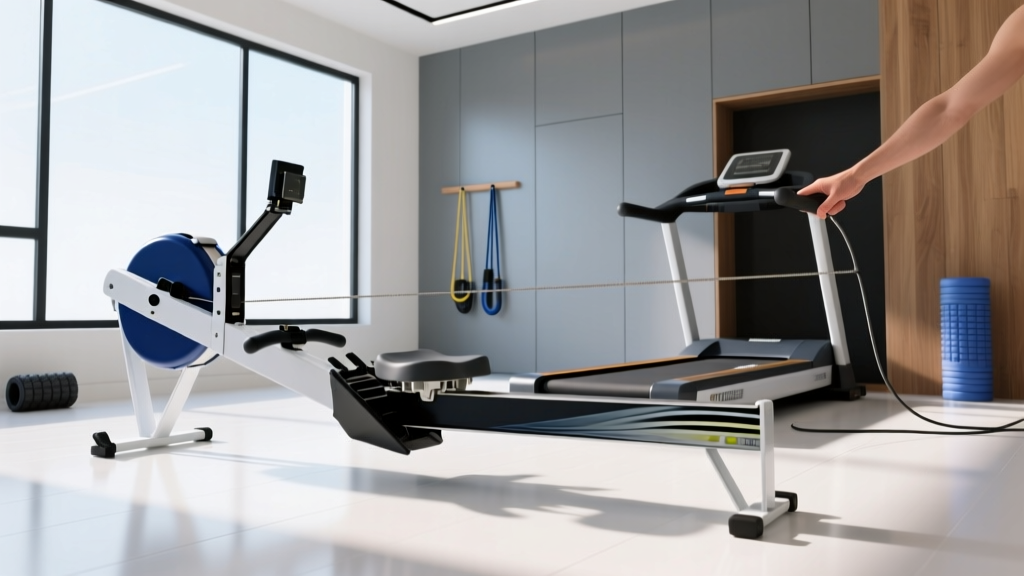
Beyond Denise Austin Treadmill Reviews: Elliptical vs Treadmill Space Guide
Searching Denise Austin treadmill reviews for compact cardio? We compare elliptical vs treadmill footprints, ceiling clearances, and 2026 layouts.

The Legacy of Compact Cardio: What Denise Austin Treadmill Reviews Teach Us
If you have spent any time researching space-saving home gym equipment over the last decade, you have likely encountered a myriad of Denise Austin treadmill reviews. In the late 2000s and early 2010s, fitness personality Denise Austin partnered with brands like ProForm to popularize the 'Walk Fit' series—ultra-compact, foldable treadmills designed specifically to slide under beds or tuck into narrow closets. These machines pioneered the mainstream demand for low-profile, apartment-friendly cardio.
However, as we navigate the home fitness landscape in 2026, the specific branded Denise Austin models have largely been discontinued, replaced by a new generation of smart walking pads, ultra-compact folding treadmills, and vertical elliptical trainers. The core intent behind those legacy searches remains identical: How do I get an effective cardiovascular workout without sacrificing my living room floor plan?
This brings us to the ultimate spatial dilemma for modern home gym designers: the elliptical vs. treadmill debate. While traditional fitness guides focus solely on calorie burn and joint impact, this guide approaches the decision through the lens of space optimization, layout design, and architectural constraints.
Footprint Face-Off: 2026 Elliptical vs. Treadmill Dimensions
When planning a home gym layout, the 'footprint' is your primary metric. However, you must evaluate three distinct measurements: the active footprint (space needed while in use), the folded footprint (storage), and the operational clearance (swing radius and safety margins).
| Machine Category (2026 Models) | Active Floor Footprint (L x W) | Folded / Stored Footprint | Required Safety Clearance | Avg. Price Range |
|---|---|---|---|---|
| Traditional Motorized Treadmill | 78' x 32' | 32' x 32' (Vertical Fold) | +24' behind, +6' sides | $1,200 - $3,500 |
| Compact / Folding Treadmill | 65' x 28' | 28' x 28' (Vertical Fold) | +18' behind, +4' sides | $600 - $1,100 |
| Smart Walking Pad (The Modern Successor) | 55' x 20' | 55' x 20' x 5' (Under-sofa) | +12' behind, +2' sides | $250 - $550 |
| Standard Stride Elliptical | 72' x 28' | N/A (Rarely folds) | +12' front/back, +6' sides | $900 - $2,200 |
| Vertical Climber / Elliptical Hybrid | 49' x 30' | 49' x 30' (Wheels away) | +6' all sides | $1,500 - $2,800 |
As the data illustrates, if your room is narrower than 36 inches in its primary walkway, a standard elliptical or traditional treadmill will create a severe bottleneck. This is where the modern walking pad—the true spiritual successor to the machines found in vintage Denise Austin treadmill reviews—shines, requiring barely more width than a standard dining chair.
The Vertical Constraint: Calculating Ceiling Clearance
Floor space is only half the battle. The most frequent failure mode in home gym layout design is ignoring vertical clearance, particularly when choosing an elliptical over a treadmill.
⚠️ The Incline & Step-Up Trap: Treadmills elevate you by 2 to 4 inches. However, ellipticals and stair climbers elevate your center of mass by 10 to 18 inches. If you are 6'0' (72 inches) and use an elliptical with a 14-inch step-up height, your head is now at 86 inches. In a room with standard 8-foot (96-inch) ceilings, you have only 10 inches of clearance. Add a ceiling fan or recessed lighting, and you risk a catastrophic collision during high-resistance intervals.The Ceiling Clearance Formula
Before purchasing any cardio machine, use this exact formula to verify your architectural limits:
- User Height (in inches)
- + Machine Step-Up Height (Ellipticals: 12'-18'; Treadmills: 2'-4'; Max Incline add 4'-8')
- + 6 Inches of 'Head Bounce' Buffer
- = Minimum Required Ceiling Height
Example: A 5'8' user (68') on a Bowflex Max Trainer (15' step-up) requires 68 + 15 + 6 = 89 inches (7 feet, 5 inches) of absolute minimum ceiling height.
Layout Frameworks: Designing Your Small Home Gym
Once you have selected your machine type based on the footprint and vertical data, you must integrate it into your room's ecosystem. According to ergonomic guidelines reviewed by experts at Garage Gym Reviews, proper spacing prevents both property damage and biomechanical compensation.
1. The 'Dead Zone' Placement (For Folding Treadmills)
If you opt for a folding treadmill, place it in a 'dead zone'—a corner where the fold-down mechanism does not block primary traffic pathways. Ensure the wall behind the treadmill has a dedicated 15-amp or 20-amp circuit. Motorized treadmills draw significant surge current upon startup; sharing a circuit with a space heater or AC unit in a small apartment will trip the breaker mid-stride.
2. The Vibration Isolation Matrix (For Ellipticals)
Ellipticals generate rhythmic, lateral harmonic vibrations that transfer poorly through hardwood floors to the rooms below. If you live in a multi-story dwelling, place your elliptical directly over a load-bearing wall or floor joist. Use a high-density PVC equipment mat (at least 3/8-inch thick) to disperse the point-load of the machine's stabilizer feet.
Top Space-Optimized Cardio Machines for 2026
Moving past the outdated models of the past, here are three modern machines that dominate the space-optimization category this year.
1. The Vertical Hybrid: Bowflex Max Trainer M9
Footprint: 30' W x 49' L
Best For: Small bedrooms and low-clearance basements.
The Details: The M9 combines the zero-impact footpath of an elliptical with the upper-body engagement of a stair climber. Because the flywheel is mounted vertically rather than horizontally, it shaves nearly two feet off the length compared to a standard stride elliptical. Priced around $2,299, it is a premium investment for tight spaces.
2. The Folding Workhorse: Horizon Fitness 7.4 AT
Footprint: 34' W x 78' L (Active) / 34' x 43' (Folded)
Best For: Garages and dedicated spare rooms.
The Details: Horizon's hydraulic folding system is arguably the smoothest in the 2026 market. Unlike older models that required heavy lifting to fold, the 7.4 AT utilizes a one-step release. It features a 350 lb user capacity and a 3.0 CHP motor, proving you do not need to sacrifice commercial-grade specs for a foldable footprint. Expect to pay around $1,199.
3. The Modern Successor: Sunny Health & Fitness Smart Walking Pad (SF-T723016)
Footprint: 20' W x 54' L
Best For: Under-desk setups, studio apartments, and sliding under standard sofas.
The Details: This is what buyers hunting for vintage Denise Austin treadmill reviews actually need today. At just 5 inches thick when folded, it disappears into a closet. While it maxes out at 4.0 MPH (jogging pace, not sprinting), it perfectly facilitates the 'NEAT' (Non-Exercise Activity Thermogenesis) lifestyle. Priced under $350, it is the ultimate spatial compromise.
Biomechanics vs. Square Footage: Making the Final Call
Space optimization should never entirely override biomechanical safety. While a walking pad solves your floor plan issues, it does not provide the upper-body engagement or the high-resistance glute activation of an elliptical. Conversely, while ellipticals are renowned for being low-impact, the Mayo Clinic notes that treadmills offer superior weight-bearing benefits for bone density, provided your joints can handle the repetitive ground reaction forces.
'The best home cardio machine is the one that fits your physical space so seamlessly that it removes the friction from your daily routine. If a massive elliptical turns your living room into an obstacle course, you will stop using it. Opt for the machine that respects your home's architecture.'
Frequently Asked Questions
Are older Denise Austin branded treadmills still worth buying used?
Generally, no. The ProForm Denise Austin models from the 2010s feature outdated DC motors, lack modern Bluetooth connectivity, and suffer from parts scarcity in 2026. You are much better served by a modern, warrantied walking pad or a compact folding treadmill from Horizon or Sole.
Can I put an elliptical on a carpeted floor?
Yes, but carpet fibers can become trapped in the elliptical's flywheel and pedal arm bearings, causing premature wear. You must use a non-porous equipment mat that extends at least 6 inches beyond the machine's footprint on all sides to catch dust and debris.
Do folding treadmills lose stability during high-speed running?
In budget models (under $500), yes. The hinge mechanism introduces lateral wobble at speeds above 6.0 MPH. However, premium 2026 models like the Horizon 7.4 AT or Sole F63 utilize locking pins and reinforced hydraulic struts that provide a rigid, stable deck identical to non-folding commercial units.
More gear to consider
All reviews
Maintaining Upright, Recumbent & Spin Bikes vs. a SureFit Treadmill

Air Bike vs Assault Bike Layouts: AoraPulse Treadmill Pairings
Treadmill Software & Smart Bike Care: Upright, Recumbent, Spin Tips
Cutegeekie Treadmill vs Rower: 2026 Buying & Technique Guide

NordicTrack T 6.1 Treadmill Noise Troubleshooting & Comparisons