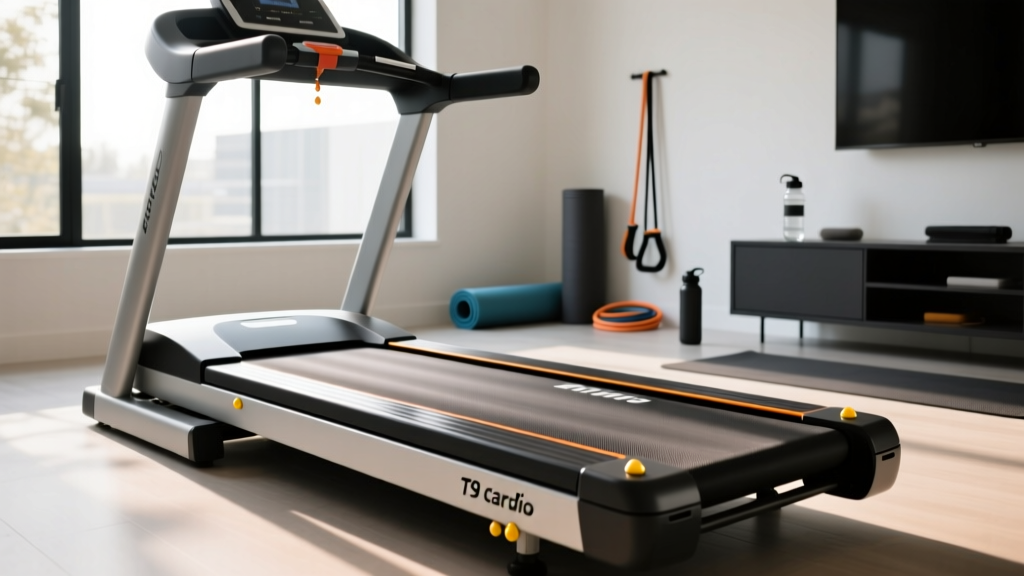
How to Lubricate and Maintain Your T9 Treadmill Belt
Learn how to properly lubricate, align, and maintain your T9 treadmill belt to prevent motor burnout and extend the life of your cardio equipment.

The Science of T9 Treadmill Belt Friction
The T9 treadmill architecture, widely recognized for its folding compact design and 2.0 to 2.5 Continuous Horsepower (CHP) DC motors, relies on a precise coefficient of friction between the running belt and the phenolic-coated deck. When a treadmill belt lacks proper lubrication, the friction coefficient spikes dramatically. According to equipment longevity data highlighted by Consumer Reports, excessive friction is the number one cause of premature motor and control board failure in home cardio machines.
Under normal, well-lubricated conditions, walking at 3.0 mph on a T9 treadmill draws approximately 3 to 5 amps of current. However, when the belt dries out, the motor must work exponentially harder to pull the belt over the deck. This amp draw can easily spike to 12 or 14 amps. Because the T9's Pulse Width Modulation (PWM) motor controller is typically rated for a 15-amp peak, sustained friction spikes will overheat the MOSFETs on the lower control board, eventually tripping the thermal overload switch or permanently frying the circuitry. In 2026, replacing a fried T9 motor control board costs between $145 and $195, a completely avoidable expense with routine maintenance.
CRITICAL WARNING: Never use WD-40, 3-in-One oil, or any petroleum-based lubricants on your T9 treadmill. Petroleum distillates will chemically degrade the PVC and urethane layers of the belt, causing delamination and voiding your manufacturer warranty. Only use 100% pure liquid silicone treadmill lubricant.The 2026 Protocol: Step-by-Step Belt Lubrication
Proper lubrication is not just about squirting oil under the belt; it requires a methodical approach to ensure even distribution without over-saturating the deck. Over-lubrication can cause the belt to slip during heavy foot strikes, which creates a different set of motor amp spikes. Follow this exact procedure for your T9 model.
Tools Required
- 100% pure liquid silicone treadmill lubricant (approx. $9 to $14 per bottle)
- Microfiber cleaning cloths
- Appropriate metric Allen wrench (usually 5mm or 6mm for T9 rear roller bolts)
- Vacuum with a crevice tool
Execution Steps
- Power Down and Clean: Unplug the T9 treadmill from the wall. Use the vacuum crevice tool to remove dust, pet hair, and debris from the edges of the belt and the motor hood vents. Wipe the exposed edges of the belt with a dry microfiber cloth.
- Loosen the Belt (Optional but Recommended): Using your Allen wrench, turn both rear roller adjustment bolts counter-clockwise by exactly two full turns. This creates enough slack to easily slide your hand and the lubricant applicator under the belt.
- Apply the Silicone: Lift the edge of the belt on one side. Insert the lubricant nozzle and apply exactly 0.5 ounces (about half a standard applicator bottle) in a wide 'S' or zig-zag pattern from the front roller to the rear roller. Repeat on the opposite side with another 0.5 ounces. Do not exceed 1 ounce total per side.
- Restore Tension: Turn both rear roller bolts clockwise by exactly two full turns to return the belt to its baseline tension.
- Distribute the Lubricant: Plug the treadmill back in. Stand on the side rails, start the machine at 1.0 mph, and let it run for 2 minutes. Then, walk normally on the belt at 2.5 mph for 3 to 5 minutes. The weight of your body will press the silicone evenly into the microscopic pores of the phenolic deck.
Diagnostic Matrix: Belt Tension vs. Tracking
Lubrication is only half the maintenance equation. A poorly tracked or improperly tensioned belt will wear out unevenly, regardless of how much silicone you apply. The American Council on Exercise (ACE) emphasizes that proper biomechanical alignment of fitness equipment is crucial for both machine longevity and user safety. Use the matrix below to diagnose and fix common T9 belt issues.
| Symptom | Root Cause | Exact Adjustment Required |
|---|---|---|
| Belt slips or hesitates underfoot during running | Belt tension is too loose, or deck is over-lubricated. | Tighten BOTH rear roller bolts clockwise by 1/4 turn. Test. Repeat if necessary. (Ideal tension: belt lifts 2 to 3 inches at the center). |
| Belt drifts steadily to the LEFT during use | The left side of the rear roller is looser than the right. | Turn the LEFT rear bolt clockwise by 1/4 turn. Turn the RIGHT rear bolt counter-clockwise by 1/4 turn to maintain overall tension. |
| Belt drifts steadily to the RIGHT during use | The right side of the rear roller is looser than the left. | Turn the RIGHT rear bolt clockwise by 1/4 turn. Turn the LEFT rear bolt counter-clockwise by 1/4 turn. |
| Loud squeaking or chirping from the front roller | Front roller bearings are drying out or belt is misaligned causing edge friction. | Check tracking first. If centered, apply a single drop of 100% silicone to the front roller bearing housings (do not spray). |
Financial Impact: Maintenance vs. Repair Costs
Understanding the financial reality of treadmill neglect is the best motivation for adhering to a strict maintenance schedule. Based on 2026 parts pricing for standard T9 folding treadmill architectures, here is what you stand to lose by ignoring belt care:
- Routine Maintenance (Annual): $12 (One bottle of 100% silicone lubricant lasts for 2-3 applications).
- Replacement Belt & Deck Kit: $65 to $95. Required when a dry belt generates enough heat to melt the urethane top layer or crack the wooden MDF deck.
- Lower Motor Control Board: $145 to $195. The most common casualty of a dry belt due to amp spikes blowing the capacitors and MOSFETs.
- Drive Motor Replacement: $220 to $280. Occurs when sustained high-amp draw burns out the internal copper windings or strips the nylon drive gears.
Expert Insight: "Many users assume a slipping belt means they need to tighten it. However, if the belt is dry, tightening it will only increase the friction and guarantee a motor board failure. Always lubricate first, run the machine, and only adjust tension if the slippage persists."
Frequently Asked Questions (FAQ)
How often should I lubricate my T9 treadmill belt?
The general rule of thumb is every 150 miles of use or every 3 to 6 months, whichever comes first. If you are a heavy runner (over 150 lbs) or use the treadmill at high inclines frequently, the friction generates more heat, which evaporates the silicone faster. In these cases, check the lubrication levels every 2 months by feeling under the belt; it should feel slightly slick, not dry or tacky.
My T9 manual says the belt is 'pre-lubricated.' Do I still need to add silicone?
Many modern T9 models ship with a wax or silicone-impregnated layer baked into the underside of the belt. While this extends the initial maintenance-free period, it is not permanent. After the first 100 to 150 miles, this factory coating wears off. Once you notice the belt feeling dry to the touch underneath, you must transition to manual liquid silicone lubrication to protect the deck.
What happens if I accidentally over-lubricate the belt?
Over-lubrication causes the silicone to seep out the edges of the belt, creating a slipping hazard on your floor and causing the belt to hydroplane over the deck during sprints. If you apply too much, turn the treadmill off, loosen the belt slightly, and use dry microfiber towels to wipe away the excess liquid from the deck and the underside of the belt until it is just barely slick.
More gear to consider
All reviews
Bowflex T7 Treadmill & Stationary Bike Types: Space Layout Guide

Curved vs Motorized Treadmills: Setup & Treadmill Fitness App Guide

Treadmill Keeps Shocking Me? Air Bike vs Assault Bike Value Guide
ProForm 14.0 Treadmill vs Ellipticals: Home Space Layout Guide

Can A Plane Take Off From A Treadmill? Curved vs Motorized
