Curved vs Motorized Treadmills for a Treadmill and Abs Workout
Compare curved manual and motorized treadmills to find the best fit for your cardio and core routine. Expert insights for a treadmill and abs workout.

The Biomechanics of Core Engagement on a Treadmill
When fitness enthusiasts search for ways to maximize their gym time, combining cardiovascular conditioning with core stabilization is a top priority. However, not all cardio machines are created equal when it comes to abdominal recruitment. If your goal is to design an effective treadmill and abs workout, the fundamental mechanics of the machine you choose—specifically, curved manual treadmills versus traditional motorized treadmills—will dictate your results.
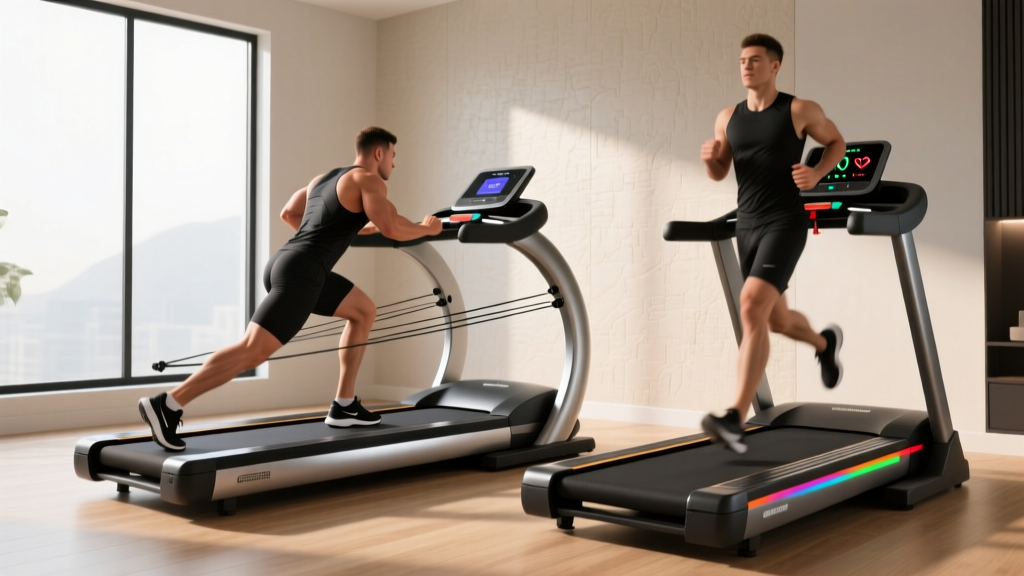
According to biomechanical analyses published by the American Council on Exercise (ACE), core activation during locomotion is heavily dependent on pelvic stabilization and the demand placed on the posterior chain. A motorized treadmill pulls your foot backward, artificially assisting the hip extension phase of your gait. Conversely, a curved manual treadmill requires your muscles to generate 100% of the force required to move the belt. This distinction drastically alters how your rectus abdominis, transversus abdominis, and obliques fire during a workout.
Why Curved Treadmills Demand More From Your Abs
Curved manual treadmills feature a slat belt that rests on a concave track. Because there is no motor, the user must act as the engine. To accelerate the belt, you must push off the ground with greater force, engaging the glutes and hamstrings. To decelerate or stabilize, your core must act as an anti-rotation and anti-extension brace.
- Pelvic Stabilization: Without a motor dictating the pace, any asymmetry in your stride forces your obliques and quadratus lumborum to work overtime to keep your pelvis level.
- Upright Posture Enforcement: The curved geometry naturally encourages a slight forward lean from the ankles, not the waist. This aligns the spine and forces the deep core stabilizers (transversus abdominis) to maintain a neutral spine, as detailed in kinesiology resources like ExRx.net.
- Deceleration Forces: Stopping or slowing down on a curved treadmill requires immense eccentric core and leg control, mimicking the braking forces of outdoor trail running.
The Motorized Treadmill Core Deficit (and How to Fix It)
Standard motorized treadmills are exceptional for steady-state cardio and precise pace control. However, because the belt pulls your leg back, the hip flexors and quadriceps often dominate, while the core remains relatively passive. To turn a motorized treadmill into a viable platform for a treadmill and abs workout, you must introduce external variables—such as extreme inclines, weighted carries, or off-belt plyometrics—to force the core to engage.
Head-to-Head Comparison: Curved vs. Motorized
Below is a structural and functional comparison to help you decide which machine aligns with your core-training objectives for 2026.
| Feature | Curved Manual Treadmill | Motorized Treadmill |
|---|---|---|
| Core Activation Level | High (Continuous stabilization required) | Low to Moderate (Requires incline/weights) |
| Belt Mechanics | Vulcanized rubber slats on a curved track | Continuous PVC/urethane belt on a flat deck |
| Pace Control | User-generated (Instant acceleration/deceleration) | Motor-generated (Gradual speed changes) |
| Average Price Range (2026) | $3,200 - $5,500 | $800 - $2,500 |
| Best For | HIIT, sprint intervals, functional core stability | |
| Maintenance | Low (No motor or electronics to fail) | High (Motor lubrication, belt tensioning, board repairs) |
Top 2026 Equipment Picks for Core-Intensive Cardio
If you are investing in a machine specifically to enhance your abdominal conditioning alongside cardio, here are the top-performing models currently dominating the market.
The Curved Elite: TrueForm Runner ($4,295)
The TrueForm Runner remains the gold standard for manual treadmills. Its low-profile slat belt offers minimal friction, meaning the core must work incredibly hard to initiate movement from a dead stop. The lack of side handrails on the base model forces users to rely entirely on their own balance and core proprioception, making it an unparalleled tool for functional abdominal training.
The Budget Manual: AssaultRunner Elite ($3,499)
While slightly more expensive than its predecessor, the 2026 Elite model features an upgraded resistance curve and a digital display that tracks wattage. The steeper curve at the front of the deck requires a more aggressive forward lean, heavily recruiting the lower abdominals to prevent the lumbar spine from overarching during sprints.
The Motorized Workhorse: Sole F80 ($999)
If a manual treadmill is out of your budget, the Sole F80 is the best motorized alternative for core work. Why? Its robust 3.5 CHP motor can sustain a 15% incline at low speeds without stuttering. This allows you to perform heavy incline walking with kettlebells or medicine balls, transforming the treadmill into an anti-extension core device.
Actionable Treadmill and Abs Workout Protocols
Owning the right equipment is only half the battle. Below are two highly specific, expert-designed protocols tailored to the unique mechanics of both machine types.
Protocol A: The Slat-Belt Stabilizer (For Curved Treadmills)
Objective: Maximize oblique and transversus abdominis engagement through multi-planar movements.
- Warm-up (5 mins): Brisk walk, focusing on driving the knees up and pulling the belt with the hamstrings.
- Sprint Intervals (10 mins): 20 seconds of max-effort sprinting (RPE 9) followed by 40 seconds of active recovery walking. The rapid acceleration forces the core to brace aggressively to transfer power from the lower body.
- Lateral Shuffles (5 mins): Turn sideways. Perform lateral shuffles for 30 seconds per side. Expert Tip: Because the belt is dead-weight, shuffling laterally forces the hips and obliques to stabilize the pelvis against the heavy, dragging slat belt.
- Cooldown (5 mins): Slow backward walking. This heavily targets the anterior tibialis and forces the rectus abdominis to maintain an upright posture against the backward pull.
Protocol B: The Incline Anti-Extension (For Motorized Treadmills)
Objective: Utilize the motorized belt's constant pull and steep incline to create an anti-extension core stimulus.
- Setup: Set the incline to 12% - 15%. Set the speed to a slow 2.0 - 2.5 mph. Do not hold the handrails.
- Goblet March (10 mins): Hold a 15 lb to 25 lb kettlebell or medicine ball tight against your chest. The combination of the steep incline pulling you backward and the front-loaded weight forces your upper abs to work isometrically to keep your ribs pulled down and spine neutral.
- Overhead Carry (5 mins): Reduce incline to 8%. Press a 10 lb weight plate or light dumbbell straight overhead. Walk at 2.5 mph. This challenges the deep core stabilizers to prevent lumbar hyperextension while the belt disrupts your base of support.
- Off-Belt Planks (3 sets): Turn the treadmill completely OFF. Place your hands on the stationary side rails and your feet on the floor, or place your hands on the floor and feet on the belt (if the belt is locked). Perform 45-second plank holds. The slight give of the machine's frame adds a micro-instability factor that fires up the core.
Common Form Mistakes That Kill Core Activation
Regardless of whether you are using a $4,000 curved manual or a budget motorized model, poor form will render your treadmill and abs workout useless. Watch out for these critical errors:
- The Handrail Death Grip: Holding onto the console or side rails on a motorized treadmill completely bypasses the core's need to stabilize the torso. If you must hold on, the speed or incline is too high.
- Over-striding on Curved Models: Reaching too far forward with your lead foot on a curved treadmill shifts your center of gravity backward, disengaging the abs and placing dangerous shear force on the lumbar spine. Keep your steps quick and directly under your hips.
- Ignoring the Transversus Abdominis: Many users focus on 'crunching' their abs while running. Instead, focus on 'bracing'—imagine preparing for a punch to the stomach. This engages the deep corset muscles that actually stabilize the spine during dynamic cardio.
Final Verdict: Which Should You Buy?
If your primary goal is to seamlessly integrate high-intensity cardio with functional core stabilization, the curved manual treadmill is the undisputed champion. The sheer physical demand of moving the belt guarantees that your abs, obliques, and lower back are engaged with every single stride. However, the $3,500+ entry price is a significant barrier.
For those on a stricter budget, a high-quality motorized treadmill with a reliable incline motor (like the Sole F80) is a highly effective alternative. By leveraging steep inclines, weighted carries, and creative off-belt exercises, you can engineer a highly effective treadmill and abs workout that yields exceptional core strength and cardiovascular endurance without breaking the bank.
More gear to consider
All reviews
Vibration Plate vs Treadmill: Why Spin & Recumbent Bikes Win
Elliptical vs Treadmill for Home Cardio: Treadmill vs Treadclimber

Orangetheory Fitness Treadmill Workout: Walking Pad vs Compact Treadmill

Best Equip Cardio For Sports: High-Performance Training Tools Built for Athletes

Under Desk Treadmills vs Sole Fitness Treadmills: Office Review