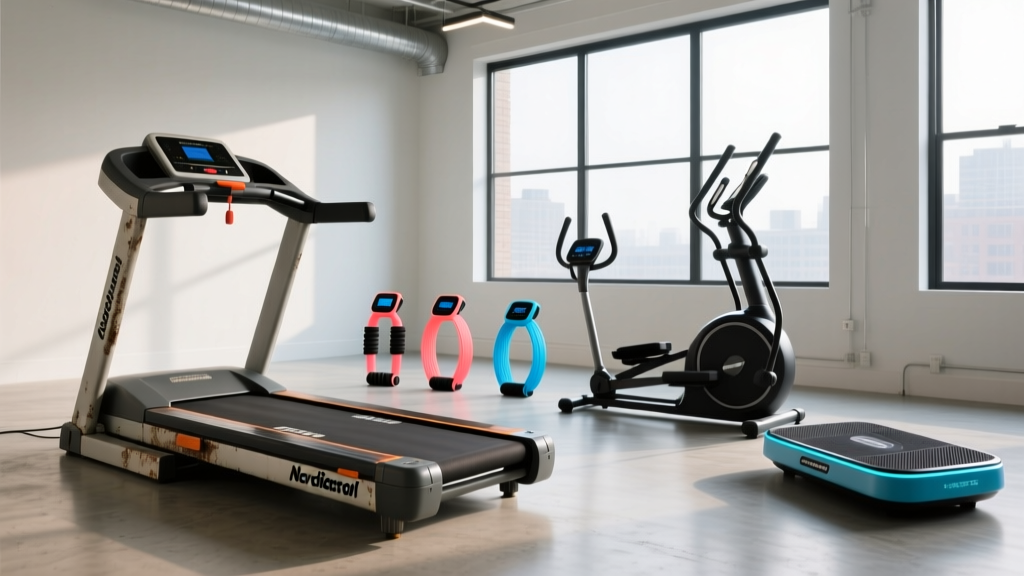
Older NordicTrack Treadmill vs Compact Portable Cardio: 2026 Trends
Analyzing the 2026 market shift from an older NordicTrack treadmill to compact portable cardio equipment options. Compare footprints, costs, and trends.

The 2026 Micro-Fitness Shift: Why Bulky is Out
The home fitness landscape has undergone a radical transformation over the last few years. As urban living spaces shrink and remote work solidifies its place in the 2026 economy, the demand for massive, dedicated home gyms has plummeted. In its place, a new market segment has exploded: compact portable cardio equipment options. For many households, this macroeconomic shift forces a difficult conversation about the giant piece of machinery gathering dust in the guest room or garage. If you are currently holding onto an older NordicTrack treadmill, you are participating in a broader consumer trend. Legacy models from the mid-2010s to early 2020s were built for a different era of home fitness—one that prioritized commercial-gym mimicry over spatial efficiency and daily friction.
Today, the market heavily favors agility. Consumers are trading heavy, stationary cardio machines for modular, foldable, and lightweight alternatives that integrate seamlessly into multi-use living spaces. This trend report and market analysis breaks down the spatial, financial, and psychological factors driving the migration away from legacy treadmills toward modern portable cardio solutions.
The Legacy Footprint: Analyzing the Older NordicTrack Treadmill
To understand the market shift, we must first quantify the physical and financial burden of legacy equipment. When consumers search for an older nordictrack treadmill on secondary markets, they are typically looking at models like the NordicTrack T 6.5 S, the C990, or early generations of the Commercial 1750. These machines are engineering marvels of their time, featuring 2.5 to 3.0 Continuous Horsepower (CHP) motors, heavy-gauge steel frames, and expansive running belts.
Engineering and Spatial Realities
However, that durability comes with a massive spatial tax. Take the popular NordicTrack T 6.5 S as a baseline. Its active footprint measures roughly 73 inches long by 30 inches wide, consuming over 15 square feet of floor space. Weighing in at nearly 150 pounds, it is not easily moved for cleaning or room reconfiguration. Furthermore, the industry's answer to space constraints—the folding deck—is largely a compromise. Even when folded vertically, the machine's base remains on the floor, occupying a 10-square-foot footprint and often blocking baseboard heaters, floor vents, or window sills.
Market Insight: The 'Last Mile' ProblemIn 2026, the secondary market for heavy fitness equipment is severely bottlenecked by logistics. Buyers are increasingly unwilling to rent cargo vans or hire movers for a $200 used treadmill. This 'last mile' friction drastically depresses the resale value of older, heavier cardio machines compared to their portable counterparts.
Market Data: Legacy Treadmills vs. Compact Portable Cardio Equipment Options
The transition from legacy treadmills to compact portable cardio equipment options is driven by measurable advantages in spatial efficiency and setup friction. The following market comparison matrix highlights the stark differences between maintaining a legacy machine and upgrading to modern portable alternatives.
| Equipment Category | Active Footprint | Storage Footprint | Avg. 2026 Cost | Setup Friction |
|---|---|---|---|---|
| Older NordicTrack Treadmill (e.g., T 6.5 S) | 15.2 sq ft | 10.5 sq ft (Folded) | $150 - $300 (Resale) | High (Stationary) |
| Smart Walking Pad (e.g., WalkingPad R2) | 8.5 sq ft | 2.1 sq ft (Under-bed) | $250 - $450 (New) | Low (Roll-away) |
| Compact Magnetic Rower (e.g., Xebex Foldable) | 12.0 sq ft | 3.5 sq ft (Vertical) | $400 - $700 (New) | Medium (Hinge-fold) |
| Under-Desk Elliptical / Bike | 2.5 sq ft | 2.5 sq ft (Closet) | $150 - $350 (New) | Very Low (Plug & Play) |
The Psychology of Friction and Daily Usage
Market trends are not just about square footage; they are deeply tied to behavioral psychology. The American Heart Association emphasizes that consistency in physical activity is far more critical than occasional high-intensity sessions. Legacy treadmills introduce high 'activation friction.' To use an older NordicTrack treadmill, you must walk to a dedicated room, plug in the safety key, wait for the console to boot, and endure the loud hum of a massive motor.
Conversely, compact portable cardio equipment options are designed for zero-friction integration into daily life. A walking pad can be slid out from under a sofa and activated via a remote control in under 10 seconds, allowing users to accumulate steps while attending virtual meetings. According to data from the Centers for Disease Control and Prevention, breaking up sedentary time with short, frequent bouts of movement yields significant cardiovascular benefits. Portable equipment directly facilitates this 'exercise snacking' behavior, making it a superior fit for the modern work-from-home lifestyle.
Financial Breakdown: The Hidden Costs of Holding On
Many owners hesitate to part with their older NordicTrack treadmills due to the sunk cost fallacy, remembering the $600 to $1,200 they originally paid. However, holding onto depreciating, space-dominating assets carries hidden costs. In major metropolitan areas, the cost per square foot of residential real estate is at a premium. Dedicating 15 square feet to an unused machine is a poor allocation of valuable space.
Furthermore, the maintenance costs for out-of-warranty legacy treadmills are rising in 2026. Replacement parts for older motor control boards, drive belts, and deck cushions are becoming harder to source as manufacturers pivot their supply chains to newer, compact models. A single motor failure on a legacy unit can cost upwards of $250 in parts and labor, often exceeding the machine's current secondary market value.
Top Compact Portable Cardio Categories Dominating 2026
If you are ready to reclaim your floor space, the current market offers highly engineered alternatives that do not sacrifice cardiovascular efficacy. Here are the dominant categories in the compact portable cardio equipment space:
1. Smart Walking Pads and Under-Desk Treadmills
Brands like WalkingPad, UREVO, and Horizon have perfected the 180-degree foldable treadmill. These units utilize brushless motors that operate at under 45 decibels, making them quiet enough for office environments. While they lack the incline and sprint capabilities of a legacy treadmill, they excel at maintaining a steady 3.0 to 4.0 MPH walking pace, which is ideal for zone-2 cardio and daily step accumulation.
2. Vertical-Storing Magnetic Rowers
For those who miss the full-body engagement and higher heart-rate ceilings of a traditional treadmill, compact rowers are the answer. Modern magnetic resistance rowers can be folded at the rail and stored vertically, taking up no more floor space than a dining chair. They offer a high-calorie-burn workout without the heavy impact on joints associated with running on older, stiffer treadmill decks.
3. Foldable Air Bikes and Spin Bikes
The air bike market has seen a surge in 'apartment-friendly' models. By utilizing magnetic resistance instead of massive fan wheels, and incorporating hinged frames, companies are delivering high-intensity interval training (HIIT) capabilities in machines that weigh under 60 pounds and can be rolled into a closet when not in use.
Decision Framework: Keep, Sell, or Replace?
Deciding what to do with your legacy equipment requires an honest assessment of your spatial needs and fitness habits. Use this framework to guide your next move:
- Keep It If: You have a dedicated, climate-controlled garage or basement gym, you regularly run at speeds above 7.0 MPH, and you utilize the incline features for specific training blocks.
- Sell and Replace If: The machine is in a multi-use room (like a bedroom or living room), you primarily use it for walking or light jogging, and you find yourself skipping workouts due to the setup friction or noise levels.
- Donate If: The machine requires repairs that exceed $150, or if local marketplace demand is too low to justify the effort of hosting buyers and helping them load the 150-pound machine into a truck.
Conclusion: The Future of Home Cardio
The era of the massive, immovable home treadmill is fading, replaced by an emphasis on spatial harmony and behavioral integration. While an older NordicTrack treadmill may hold sentimental value or represent a significant past investment, the 2026 fitness market clearly rewards agility. By transitioning to compact portable cardio equipment options, consumers are not just freeing up square footage—they are removing the physical and psychological barriers to daily movement. As real estate costs rise and living spaces evolve, the most valuable piece of fitness equipment is no longer the heaviest; it is the one that seamlessly fits into your life.
For more insights on optimizing your home gym footprint, consult the Mayo Clinic's guide to home fitness and stay tuned to FitGearPulse for our upcoming reviews on the latest ultra-compact cardio releases.
More gear to consider
All reviews
Treadmill Tail Mofos: 2026 Small Space Folding Reviews & Trends

2026 Under Desk Treadmill Review vs Life Fitness Treadmill FlexDeck
Stationary Bike Types Maintenance vs. 5 Incline on Treadmill Wear
Elliptical vs Treadmill: Bowflex T9 Review & Value

Curved vs Motorized: NordicTrack Runners Flex Treadmill Tested
