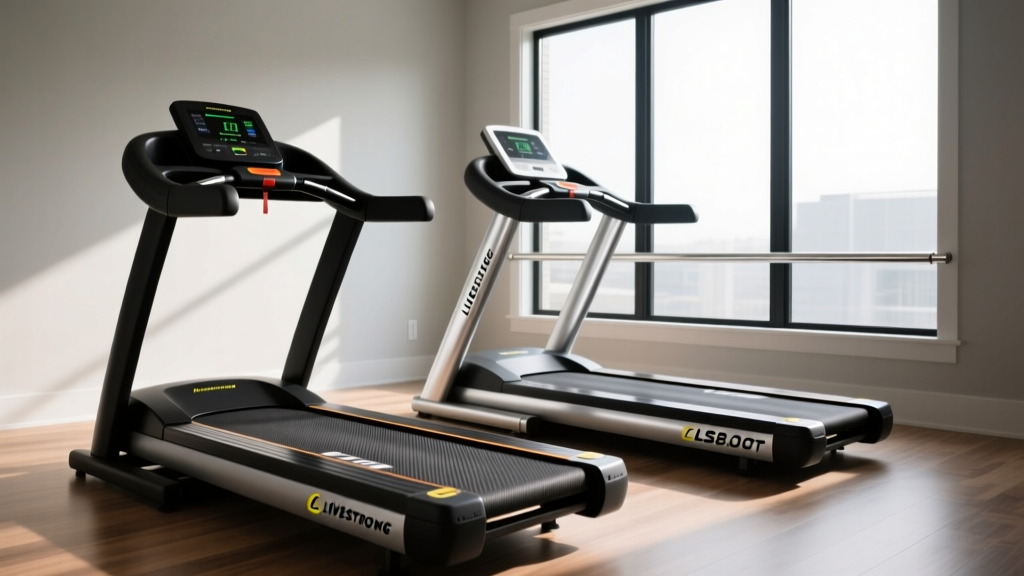
Curved vs Motorized Treadmills: NordicTrack T10 Treadmill Review
Compare curved manual treadmills and motorized models like the NordicTrack T10 treadmill. Discover hidden costs, biomechanics, and the best fit for 2026.

The Biomechanical Divide: Curved Manual vs. Motorized Treadmills
The home fitness equipment market has undergone a massive shift over the last decade. While traditional motorized treadmills have long been the staple of residential cardio, curved manual treadmills have surged in popularity, promising elite biomechanics and zero electricity consumption. But does a $4,000 slatted-belt machine truly outperform a budget-friendly motorized workhorse? To answer this, we must compare the fundamental mechanics of curved manual running against the benchmark of entry-level motorized cardio: the NordicTrack T10 treadmill.
According to the Centers for Disease Control and Prevention (CDC), adults need at least 150 minutes of moderate-intensity aerobic activity weekly. Whether you achieve this on a self-powered curved deck or a motorized belt, consistency is key. However, the way these machines facilitate that consistency—and the hidden costs they carry over a five-year lifespan—differ drastically.
Understanding Curved Manual Treadmills
Curved treadmills (like the TrueForm Trainer or AssaultRunner Elite) feature a concave, slatted running surface. Because there is no motor, the user dictates the pace entirely through their own biomechanics. Striking the front of the curve accelerates the belt, while striking the center or back decelerates it.
The Pros and Cons of Self-Powered Running
- Biomechanical Advantage: The curve naturally encourages a forefoot or midfoot strike, reducing the harsh heel-strike impact forces associated with flat, motorized decks.
- Caloric Expenditure: Studies indicate that running on a curved manual treadmill can increase heart rate and caloric burn by up to 30% compared to a motorized treadmill at the same perceived speed, largely due to the lack of motor assistance in propelling the belt backward.
- Speed Limitations: There are no artificial speed caps. If you can sprint at 18 MPH, the machine will keep up.
- The Drawback: The steep learning curve. Many beginners experience severe calf and Achilles fatigue during their first few weeks, and the fixed curve makes casual, low-incline walking feel biomechanically awkward compared to a flat deck.
The Motorized Benchmark: Deep Dive into the NordicTrack T10 Treadmill
While curved treadmills dominate high-end boutique studios, the NordicTrack T10 treadmill represents the reality for 80% of home gym owners: the need for a reliable, space-efficient, and affordable motorized machine. Retailing between $449 and $499 in 2026, the T10 is part of NordicTrack’s highly successful T-Series, designed specifically for walking, jogging, and light interval training.
NordicTrack T10 Treadmill: Core Specifications
- Motor: 2.75 CHP (Continuous Duty Horsepower)
- Speed Range: 0 – 10 MPH
- Incline: 0% – 10% (Motorized)
- Tread Belt: 20" x 55"
- Footprint: 73" L x 29" W (Folds to 46" L)
- User Capacity: 300 lbs
Real-World Performance and Limitations
The 2.75 CHP motor is the critical metric here. As noted in Consumer Reports' treadmill buying guide, consumers must look for Continuous Duty Horsepower (CHP) rather than Peak Horsepower. A 2.75 CHP motor is robust enough for daily walking and jogging up to 8 MPH. However, if a 250 lb user attempts to sustain a 10 MPH sprint for extended intervals, the motor will draw excessive amperage, potentially triggering the machine's thermal safety shutoff.
Furthermore, the 55-inch belt length is a vital consideration. For users under 6'0", the 55-inch deck provides ample room for a natural stride. For taller runners, the belt is too short, forcing an unnatural, clipped stride that can lead to hip flexor strain over time. The T10 is, therefore, an exceptional machine for walkers, power-walkers, and joggers of average height, but falls short for elite marathon training.
Head-to-Head Comparison Matrix
To visualize the stark differences between the curved manual category and the budget motorized category represented by the NordicTrack T10, review the comparison table below.
| Feature | Curved Manual (e.g., TrueForm Trainer) | Motorized (NordicTrack T10 Treadmill) |
|---|---|---|
| Price Point | $3,499 - $3,995 | $449 - $499 |
| Power Source | 100% Human-Powered | 120V Standard Wall Outlet |
| Running Surface | ~62" x 17" (Urethane Slats) | 20" x 55" (Continuous PVC Belt) |
| Incline Capability | Fixed Curve (Simulates ~4-8% grade) | Adjustable 0% - 10% |
| Interactive Tech | Basic LCD / Bluetooth FTMS | Basic LCD (iFIT requires separate tablet) |
| Ideal User Profile | Sprinters, CrossFitters, Forefoot runners | Walkers, Joggers, Seniors, Rehab patients |
Hidden Maintenance and Failure Modes
When investing in cardio equipment, the initial purchase price is only half the equation. Maintenance requirements and component failure modes vary wildly between these two machine types.
Curved Treadmill Wear and Tear
Curved treadmills are often marketed as "maintenance-free," which is a gross oversimplification. The running surface consists of dozens of individual rubber or urethane slats, each riding on sealed ball bearings. Over 1,000+ miles, the center slats will compress and wear down faster than the edges. Replacing a slat kit on a premium curved treadmill can cost between $300 and $500. Additionally, the drive cables that keep the belt tensioned can stretch, requiring manual recalibration with a tension wrench to prevent the belt from slipping during explosive sprints.
NordicTrack T10 Motorized Maintenance
The NordicTrack T10 requires traditional motorized treadmill upkeep. The most common failure mode for budget motorized treadmills is a fried motor controller board. This rarely happens spontaneously; it is almost always caused by excessive friction between the deck and the belt. If you fail to apply 100% silicone lubricant under the belt every 130 miles (or roughly every three months), the friction causes the motor to draw excessive amps, eventually melting the controller board. Replacing the deck and belt on the T10 costs around $80, and the lubricant is $10—a fraction of curved treadmill maintenance, provided you adhere to the schedule.
Another minor but common T10 failure mode involves the folding hinge mechanism. The gas shock that assists in folding the deck can lose pressure after 3-4 years, and the pivot bolts may squeak if not treated with white lithium grease annually.
Decision Framework: Which Machine Earns Your Floor Space?
Choosing between a curved manual treadmill and the NordicTrack T10 treadmill ultimately comes down to your budget, your biomechanics, and your fitness goals. The American Heart Association emphasizes that the best cardio machine is the one you will use consistently. Use this framework to decide:
- Buy a Curved Manual Treadmill If: You are an athlete focused on HIIT, sprint mechanics, and CrossFit-style conditioning. You have a budget exceeding $3,000, you prefer forefoot running, and you want a machine that will outlast a decade of heavy abuse without requiring electrical diagnostics.
- Buy the NordicTrack T10 Treadmill If: You are a walker, power-walker, or casual jogger under 6'0" tall. You want the ability to adjust your incline from 0 to 10% to simulate outdoor hills. You need a machine that folds up to save space in a multi-use room, and you want to keep your initial investment under $500.
Frequently Asked Questions
Can I use the NordicTrack T10 treadmill without an iFIT subscription?
Yes. The T10 features a built-in LCD screen that displays your time, speed, distance, calories, and pulse via grip sensors. You can manually adjust the speed and incline using the console buttons without any internet connection or subscription. However, the automatic screen that displays interactive mapping and trainer-led workouts requires an active iFIT subscription and a secondary smart device (tablet or phone) placed on the console shelf.
Do curved treadmills really burn more calories?
Yes, but with a caveat. Because you must physically pull the slatted belt backward with every stride—without the assistance of a motor—your posterior chain (glutes and hamstrings) works significantly harder. This increased muscle recruitment elevates your heart rate, leading to a higher caloric burn per minute compared to walking or jogging at the exact same speed on a motorized treadmill like the T10.
Is the 20-inch belt width on the T10 too narrow?
For walking and light jogging, a 20-inch width is the industry standard and provides plenty of lateral room. However, if you are a highly active runner who tends to sway laterally when fatigued, you may prefer a 22-inch belt width, which is typically found on mid-tier to premium motorized treadmills (usually in the $800+ price range).
More gear to consider
All reviews
Peloton Treadmill Motor Size Guide: HP & CHP Explained

How to Start ProForm Treadmill & Maintain All Stationary Bike Types

Rowing Guide: Real Ergs vs Dandy's World Treadmill Machine

Horizon Fitness 101 Treadmill Maintenance: Belt Lubrication Guide
Elliptical vs Treadmill: Preserving Advantages of Treadmill Exercise