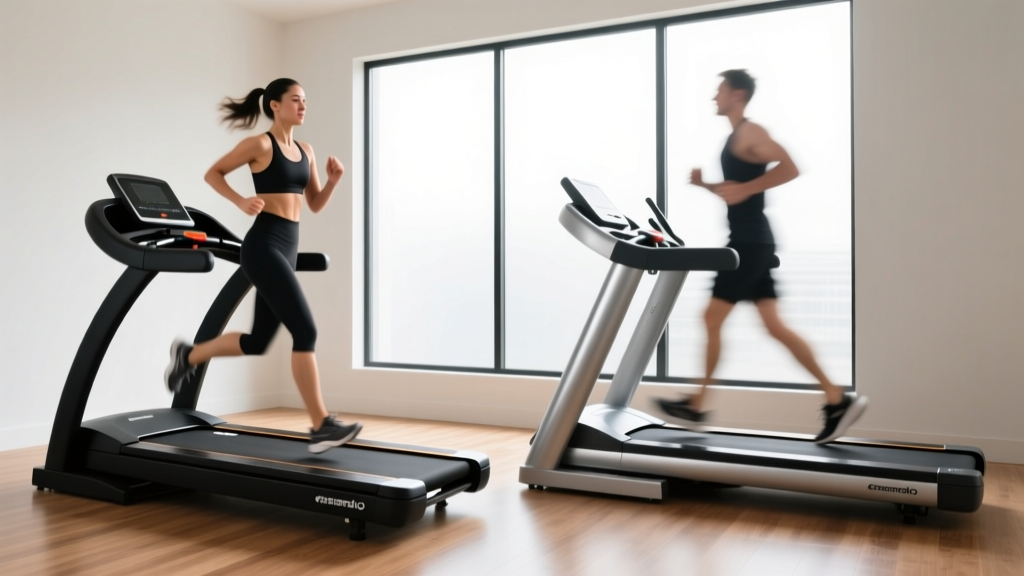
Curved vs Motorized Treadmills: Fixing Jane Fonda Treadmill Mistakes
Troubleshoot common biomechanical and maintenance mistakes when comparing curved manual treadmills to motorized models for your Jane Fonda treadmill routines.

The Biomechanical Divide: Why Your Form Fails on a Curve
Jane Fonda’s longevity-focused fitness campaigns have sparked a massive resurgence in low-impact, steady-state walking. When users search for a 'Jane Fonda treadmill' routine, they are typically looking for her signature protocol: walking at 3.0 to 3.5 mph on a motorized belt, set to a 1% incline, with strict upright posture and arm swings. This method is phenomenal for joint health and cardiovascular baseline building. However, a major trend in the 2026 home gym landscape is transitioning from traditional motorized decks to curved manual treadmills. This is where the mistakes begin.
The fundamental error users make is assuming a curved manual treadmill operates with the same biomechanics as a motorized one. On a motorized treadmill (like the NordicTrack Commercial 1750 or Peloton Tread), the motor pulls your foot backward. Your hamstrings and hip flexors work primarily to stabilize and lift the leg. On a curved manual treadmill (like the AssaultRunner Elite or Technogym Skillmill), there is no motor. You must generate the forward propulsion entirely through your posterior chain—driving the belt backward with your glutes and hamstrings.
WARNING: The 'Lean and Drag' MistakeApplying the relaxed, upright 'Jane Fonda treadmill' walking posture to a curved manual treadmill will result in immediate belt stalling. If you stand too upright on a curve, your center of gravity shifts behind the apex of the curve, forcing you to drag your feet rather than push the slats. You must adopt a slight forward lean (roughly 5 to 8 degrees) from the ankles, not the waist, to engage the curve's propulsion zone.
Troubleshooting Matrix: Motorized vs. Curved Manual Errors
Below is a diagnostic matrix to help you identify whether your fatigue or machine issues stem from motorized or manual treadmill misuse.
| Common Mistake | Motorized Treadmill Symptom | Curved Manual Symptom | The Fix |
|---|---|---|---|
| Over-striding | Heel striking; lower back pain; motor surging. | Belt jerks violently; sudden deceleration; calf strain. | Shorten stride; aim for mid-foot strike directly under your hips. |
| Handrail Gripping | Reduced caloric burn; hunched shoulders. | Inability to reach top speed; severe shoulder tension. | Let go. Pump arms to generate momentum, especially on curves. |
| Pacing Mismatch | Boredom; insufficient heart rate elevation. | Rapid exhaustion; inability to hold a 3.5 mph pace. | Drop curved treadmill speed expectations by 15-20%. |
Pacing and RPE: Why Your 3.5 MPH Walk Feels Like a Sprint
A core pillar of the Jane Fonda treadmill routine is maintaining a conversational pace, typically around 3.0 to 3.5 mph, keeping the Rate of Perceived Exertion (RPE) at a manageable 4 or 5 out of 10. When users transition to a curved manual treadmill, they often attempt to replicate this exact speed. This is a critical error.
Because a curved treadmill requires you to move the belt's physical mass (often over 150 lbs of rubber and steel slats) and overcome the magnetic or friction resistance of the curve, the caloric expenditure and muscular demand are significantly higher. According to research published in the Journal of Strength and Conditioning Research, curved treadmills can elicit a 15% to 20% higher heart rate and caloric burn at the exact same perceived speed compared to motorized models.
Expert Insight: If your Jane Fonda treadmill protocol calls for 45 minutes at 3.5 mph on a motorized deck, do not attempt 3.5 mph on an AssaultRunner Elite. You will burn out in 15 minutes. Instead, target your heart rate zone (roughly 110-125 BPM for steady-state longevity walking) rather than the digital speed readout. On a curve, this will likely equate to a 2.5 to 2.8 mph walking pace.
The Handrail Death Grip: Ruining Your Posterior Chain
Jane Fonda’s walking tutorials heavily emphasize an open chest and relaxed shoulders. Yet, when faced with the self-propelled nature of a curved treadmill, many users develop a 'handrail death grip' out of fear of falling backward. Gripping the side rails of a curved treadmill shifts your center of gravity backward, entirely neutralizing the propulsion mechanics of the curve. You end up dragging your feet, which causes severe friction burns on the polyurethane slats and premature wear on the guide wheels.
Troubleshooting Steps for Balance Issues:
- Start at the Apex: Stand in the very center (the lowest point) of the curve. If you stand too far forward on the curve, the belt will accelerate out from under you.
- Use the Front Handles (Temporarily): If you must hold on, use the front horizontal handles to pull your chest slightly forward, mimicking the required lean, rather than gripping the side rails which pulls you backward.
- Engage the Core: A braced core stabilizes the pelvis, allowing your legs to drive the slats without your upper body compensating.
Machine Maintenance: Troubleshooting Belt Slippage and Motor Overheating
Mistakes aren't just biomechanical; they are mechanical. Failing to maintain your equipment based on its specific drive system will lead to costly repairs. As of 2026, replacing a curved treadmill slat belt can cost upwards of $600, while a motorized deck replacement averages $250.
Motorized Treadmill Maintenance (The Jane Fonda Standard)
Motorized treadmills rely on a continuous PVC or polyurethane belt sliding over a wooden or composite deck. The most common mistake is ignoring deck lubrication, which causes the motor to overheat and the control board to throw an 'E1' or 'E2' error code.
- The Fix: Every 3 to 6 months (or every 150 miles), lift the belt and apply 100% silicone treadmill lubricant in a zig-zag pattern. Never use WD-40 or petroleum-based products.
- Tension Troubleshooting: If the belt slips when you step on it, locate the rear roller adjustment bolts. Turn both the left and right bolts exactly one-quarter (1/4) turn clockwise. Re-test. Over-tightening will destroy the motor bearings.
Curved Manual Treadmill Maintenance
Curved treadmills do not have decks to lubricate, but they have complex guide wheel and tension systems. The most common mistake is ignoring the slat tension, leading to a 'jerky' feeling during the push-off phase.
- The Fix: Inspect the polyurethane guide wheels located under the running track. If they are coated in dust, wipe them with a damp microfiber cloth. Dust acts as an abrasive and causes the slats to track sideways.
- Tension Troubleshooting: If the belt feels loose or slips under heavy foot strikes, locate the tensioning mechanism (usually at the front or rear axle). Consult your specific manual (e.g., Technogym Skillmill requires a specific torque wrench setting, while the AssaultRunner uses standard hex bolts). Adjust in micro-increments to avoid snapping the Kevlar-reinforced guide cables.
Expert Verdict: Which Machine Matches Your Routine?
Choosing between a curved manual and a motorized treadmill depends entirely on your physiological goals and adherence to the American Heart Association's physical activity guidelines, which recommend 150 minutes of moderate-intensity aerobic activity per week.
If your goal is strict adherence to the Jane Fonda treadmill method—long duration, low-impact, steady-state walking for joint longevity and mental health—a high-quality motorized treadmill is the superior choice. The motor does the work of pulling the belt, allowing you to focus entirely on posture, breathing, and duration without muscular fatigue in your hamstrings.
Conversely, if you are an athlete looking to maximize caloric burn, improve sprint mechanics, and build posterior chain power in shorter 20-to-30-minute windows, the curved manual treadmill is unmatched. Just remember to abandon your motorized pacing expectations and let your heart rate, not the digital console, dictate your effort.
Frequently Asked Questions
Can I do the Jane Fonda treadmill walking routine on a curved treadmill?
Yes, but you must adjust your expectations. A 3.5 mph walk on a motorized treadmill is a moderate effort. A 3.5 mph walk on a curved treadmill is a vigorous, high-intensity effort. Adjust your speed downward to maintain the intended low-impact heart rate zone.
Do curved manual treadmills require electricity?
No. True curved manual treadmills (like the AssaultRunner or TrueForm) are 100% human-powered and require no electrical outlet, making them highly versatile for garage gyms or off-grid spaces. However, some magnetic-resistance curved hybrids do require power for their digital consoles and resistance magnets.
Which treadmill is safer for older adults?
According to Mayo Clinic fitness guidelines, consistency and joint safety are paramount for older adults. Motorized treadmills with long handrails, automatic emergency stop clips, and adjustable 1% cushioning are generally safer and more appropriate for seniors than curved manual treadmills, which require greater balance and posterior chain strength to initiate movement.
More gear to consider
All reviews
Elliptical vs Treadmill Value & 30 Minute Beginner Treadmill Workout

Curved vs Motorized Treadmill: How Long to Walk 10000 Steps?
Sole F63 Treadmill Disassembly: Motor Size & HP Guide

Treadmill Weight Loss Before and After: 2026 Models Compared

Weslo Cadence 5.9 Treadmill Manual & Motor Size Guide for Beginners
