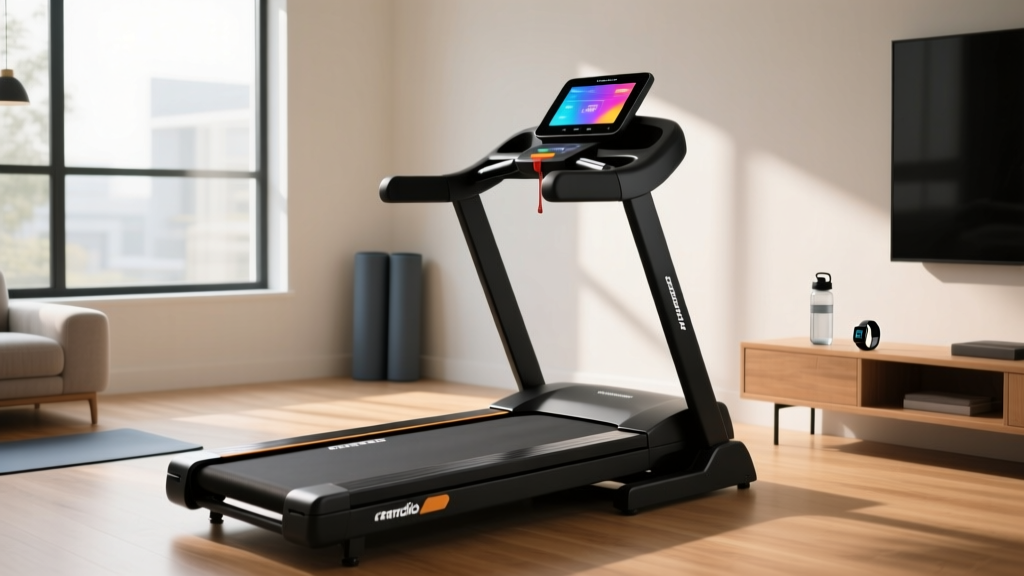
Curved vs. Motorized: Which Powers Your HIIT Treadmill Workout?
Discover whether a curved manual or motorized treadmill is best for your HIIT Treadmill Workout. We compare biomechanics, ramp-up times, and top models.

The Biomechanics of Sprinting: Push vs. Pull
When designing a high-intensity interval training (HIIT) protocol, the mechanics of your equipment dictate the physiological response. The fundamental difference between a curved manual treadmill and a traditional motorized treadmill lies in how the belt moves. On a motorized treadmill, the belt pulls your foot backward, which heavily engages the hip flexors and quadriceps. Conversely, a curved non-motorized treadmill requires you to push the belt backward with every strike. This 'push' mechanic forces deep engagement of the posterior chain—specifically the glutes, hamstrings, and calves.
According to research highlighted by the American College of Sports Medicine (ACSM), maximizing muscle fiber recruitment is essential for the metabolic spikes required in interval training. Because curved treadmills demand up to 30% more energy expenditure at the exact same perceived speed, they inherently turn a standard sprint into a full-body, posterior-chain-dominant power movement.
The 'Ramp-Up' Penalty: Where Motorized Treadmills Fail HIIT
The most critical, yet frequently overlooked, variable in a HIIT treadmill workout is acceleration time. True Tabata or sprint intervals often feature work periods of just 15 to 20 seconds.
⚠️ The 6-Second Ramp-Up Penalty
Even premium motorized treadmills with 4.0 Continuous Horsepower (CHP) motors take between 4 to 8 seconds to accelerate from a jogging pace (3.0 mph) to a full sprint (12.0 mph). In a 20-second all-out sprint interval, you are spending up to 40% of your work phase simply waiting for the machine to reach your target speed. Curved treadmills have zero ramp-up time; your speed is entirely dictated by your leg turnover, allowing you to hit peak velocity in a single stride.
While the Mayo Clinic notes that interval training is highly effective for improving VO2 max and cardiovascular health, the efficacy of micro-sprints is severely blunted if the equipment cannot match your neuromuscular output instantly.
Head-to-Head Feature Matrix
| Feature | Curved Manual (e.g., TrueForm) | Motorized (e.g., NordicTrack) |
|---|---|---|
| Acceleration Time | Instant (0.0 seconds) | 4.0 - 8.0 seconds |
| Caloric Burn Rate | +20% to 30% higher | Standard baseline |
| Max Speed | Unlimited (User-dependent) | Capped (Usually 12-14 mph) |
| Incline / Decline | Fixed curve (Simulates ~8%) | Adjustable (-3% to 15%) |
| Guided Programming | Limited / External apps | Native HD touchscreens |
| Maintenance | Belt tensioning, no motor | Deck lubrication, motor care |
Top Curved Contenders for 2026
AssaultRunner Pro ($3,499)
The AssaultRunner Pro remains the gold standard for CrossFit boxes and elite sprinters. It features a Kevlar-reinforced rubber slat belt that absorbs impact while providing aggressive traction. Weighing in at 350 lbs, it does not shift during explosive accelerations. The primary drawback is the console; while it displays basic metrics and connects to heart rate monitors, it lacks the immersive, guided programming of motorized counterparts. You must bring your own workout plan.
TrueForm Runner ($4,295)
TrueForm takes a slightly different approach with a lower-profile deck and a vulcanized rubber surface that is remarkably forgiving on the joints. The TrueForm Runner is exceptionally popular among physical therapists and barefoot/minimalist runners. Its low center of gravity makes mounting and dismounting during rapid 15-second on/off intervals significantly safer than the higher-deck AssaultRunner.
Top Motorized Contenders for 2026
NordicTrack Commercial 2450 ($2,299)
If your version of a HIIT treadmill workout relies heavily on incline intervals (like the viral 12-3-30 method or steep hill sprints), motorized is the only way to go. The Commercial 2450 boasts a massive -3% to 12% incline range powered by a robust 4.0 CHP motor. While it suffers from the aforementioned ramp-up penalty on flat sprints, its ability to instantly change the deck angle while maintaining a steady belt speed allows for brutal, gravity-based interval spikes that curved treadmills simply cannot replicate.
Peloton Tread ($2,495)
The Peloton Tread shines in guided, instructor-led HIIT classes. Its unique speed dial allows for 0.1 mph micro-adjustments, letting you find your exact 'all-out' pace without mashing buttons. The 32-inch HD screen provides real-time output metrics, fostering the competitive edge that many users need to push through the final 10 seconds of a grueling interval. However, the top speed is capped at 12.5 mph, which advanced sprinters may find limiting.
Programming Your HIIT Treadmill Workout
Because the machines operate differently, your programming must adapt to the hardware. Here are two distinct protocols optimized for each machine type.
Protocol A: The 'Zero-Ramp' Curved Sprint
Best for: TrueForm / AssaultRunner. Focus: Neuromuscular power and posterior chain.
- Warm-up: 5 minutes of progressive jogging, focusing on driving the knees up and pushing the belt back.
- The Work: 20 seconds of absolute maximum effort. Do not pace yourself. Because there is no ramp-up, stride 1 should be at 80% velocity, and stride 3 should be at 100%.
- The Rest: 40 seconds of complete rest. Step off the belt onto the side rails (practice this safely first) or stand completely still on the curve.
- Volume: Repeat 8 to 10 times.
Protocol B: The Incline/Speed Motorized Ladder
Best for: NordicTrack / Peloton. Focus: Sustained cardiovascular threshold and muscular endurance.
- Warm-up: 5 minutes at 3.0 mph, 0% incline.
- The Work: 60 seconds at 8.0 mph, 4% incline. (The longer interval accounts for the 5-second ramp-up time).
- The Active Recovery: 60 seconds at 3.5 mph, 0% incline. Do not stop completely; keep the belt moving to prepare for the next acceleration.
- The Escalation: Every 3rd interval, increase the incline by 2% while dropping the speed by 0.5 mph to maintain the same perceived exertion.
- Volume: Complete 6 to 8 total rounds.
Maintenance and Long-Term Durability
Curved treadmills are mechanical beasts. Without a motor, motherboard, or wiring harness to fail, their lifespan is exceptionally long. However, the slat belts require periodic tensioning and the bearings need annual inspection. Motorized treadmills, while offering superior tech integration, require strict adherence to deck lubrication (every 150 miles) and eventual motor brush replacements. If you are sweating heavily during daily HIIT sessions, the moisture exposure on a motorized console and internal wiring poses a higher long-term failure risk than a purely mechanical curved deck.
Final Verdict: Which Should You Buy?
The choice ultimately hinges on your definition of interval training. If your goal is raw, unadulterated speed work, biomechanical posterior-chain development, and zero-lag sprint intervals, a curved manual treadmill like the AssaultRunner Pro is the undisputed champion. It forces you to do the work, and it matches your output instantly.
However, if your ideal HIIT treadmill workout involves guided studio classes, dynamic incline changes, and long-form interval endurance rather than micro-sprints, a premium motorized treadmill like the NordicTrack Commercial 2450 provides a vastly superior, more engaging user experience. Assess your training goals, respect the ramp-up penalty, and choose the deck that aligns with your physiological targets.
More gear to consider
All reviews
Elliptical vs Treadmill: 2026 Trends & Treadmill Pickup Near Me

Treadmill Fartlek Training: Belt Maintenance for Compact Home Gyms

Cardio Noise Comparison: Do Treadmill Side Rails Help?

NordicTrack Commercial 2450 Treadmill NTL19125.2 vs Portable Cardio

Are Elliptical Machines Better Than Treadmills? Motor Size Guide