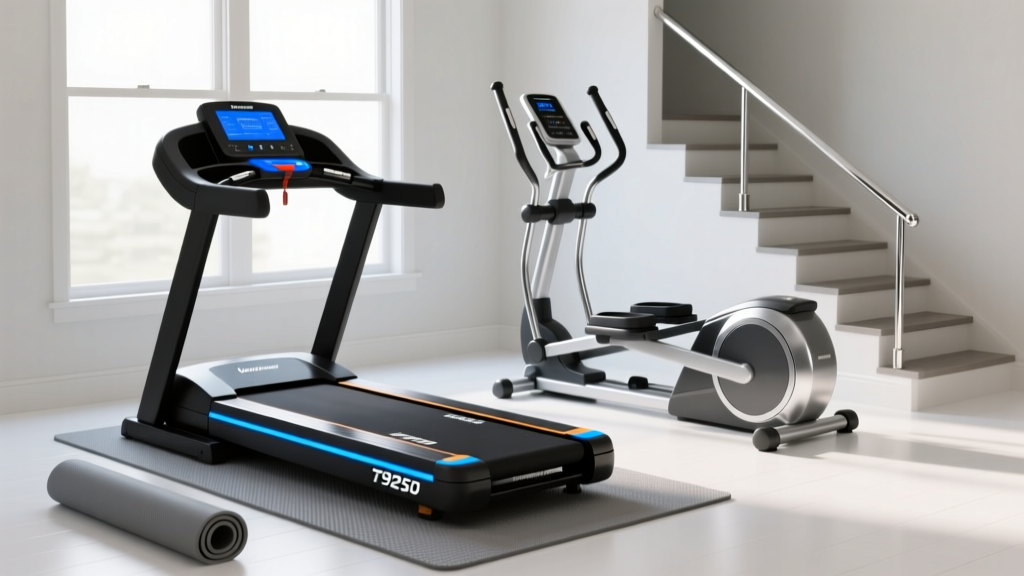
Vision Fitness Treadmill T9250 vs Stair Climbers: Home Mistakes
Discover common home gym mistakes comparing the Vision Fitness Treadmill T9250 and stair climbers, plus expert troubleshooting and space planning guides.

The Home Cardio Dilemma: Premium Treadmills vs. Vertical Climbers
In the 2026 home fitness landscape, enthusiasts frequently face a critical crossroads: investing in a high-end traditional treadmill or pivoting to the intense, low-impact glute activation of a stair climber. Many homeowners start with a premium workhorse like the Vision Fitness Treadmill T9250 (retailing around $2,499), drawn by its 4.0 HP motor and 20' x 60' running surface. However, as training goals shift toward posterior chain development and joint preservation, the stair climber emerges as a compelling alternative.
Yet, transitioning between or maintaining these two distinct machine architectures introduces a host of spatial, biomechanical, and mechanical challenges. This guide dissects the most common mistakes home gym owners make when integrating stair climbers alongside or instead of the Vision Fitness T9250, complete with expert troubleshooting protocols.
Expert Insight: The Vision Fitness T9250 and popular home stair climbers (like the Horizon CLIMBER or Bowflex Max SE7) are both manufactured under the Johnson Health Tech umbrella. While their console ecosystems share similarities, their mechanical failure points and spatial requirements are vastly different.Mistake #1: Miscalculating Overhead Clearance and Footprint
The most frequent error in home gym design is treating a stair climber's footprint as identical to a folding treadmill. The Vision Fitness T9250 features a folding deck that drops to an 8-inch step-up height, making it viable for rooms with standard 8-foot (96-inch) ceilings. Stair climbers, however, demand rigorous vertical math.
The Ceiling Height Formula
When installing a machine like the Horizon CLIMBER ($1,499) or a commercial-grade StepMill in a residential space, you must account for the pedal height at its maximum vertical apex, plus the user's headspace and arm swing.
- Machine Step-Up Height: Typically 10 to 15 inches at the highest pedal extension.
- Arm Clearance: Minimum 12 to 15 inches above the user's head to prevent drywall strikes during high-cadence pumping.
- The Math: User Height + 15" (Machine) + 15" (Clearance) = Minimum Ceiling Height.
Real-World Scenario: A 6'0" (72") user needs a minimum ceiling height of 102 inches (8.5 feet) to safely use a stair climber without altering their natural biomechanics. If your room has standard 8-foot ceilings, the Vision Fitness T9250 remains the only viable option unless you opt for a low-profile mini-stepper, which sacrifices the full kinetic chain engagement of a true climber.
Mistake #2: Biomechanical Leaning and 'Ghost' Calorie Burns
Whether you are walking at a 15% incline on the Vision T9250 or climbing on a stair machine, the temptation to drape your body weight over the handrails is a pervasive mistake. This error fundamentally alters the physiological demand of the workout.
'Holding onto the handrails of a treadmill or stair climber reduces the metabolic cost of the exercise by up to 20% to 30%, effectively tricking the console into displaying an inflated calorie burn that does not reflect actual energy expenditure.' — American Council on Exercise (ACE) Research Division
Correcting the Posture
On the Vision Fitness T9250, utilize the orthopedic handrails only for balance checks or heart-rate monitoring via the integrated digital sensors. On a stair climber, maintain a 'hover' grip. Your fingers should rest lightly on the rails to stabilize your core, but your forearms must remain parallel to the floor. If your triceps are bearing your body weight, you are offloading the gluteus maximus and hamstrings, negating the primary benefit of the stair climber.
Troubleshooting Matrix: T9250 vs. Home Stair Climbers
Mechanical troubleshooting requires an understanding of the specific drive systems. The T9250 relies on a high-torque belt and roller system, while stair climbers utilize chain drives, magnetic resistance, and complex pivot arms. Below is a diagnostic matrix for the most common 2026 home gym failure modes.
| Symptom / Error Code | Machine Type | Root Cause | Expert Fix / Action Plan |
|---|---|---|---|
| E1 Error Code | Vision T9250 Treadmill | Speed sensor misalignment or debris blocking the optical reader near the motor flywheel. | Unplug the unit. Remove the motor hood (6 Phillips screws). Wipe the optical sensor with isopropyl alcohol. Ensure the sensor is exactly 1/8" from the magnet on the pulley. |
| Rhythmic Squeaking | Stair Climber (e.g., Horizon CLIMBER) | Friction in the lower pedal pivot arms or dry chain drive. | Do NOT use standard WD-40, which attracts dust. Apply a 100% PTFE (Teflon) dry lubricant to the pivot bushings and the internal chain every 6 months. |
| Belt Slippage | Vision T9250 Treadmill | Walking belt tension has degraded after 100+ miles of use. | Locate the two rear tension bolts. Turn both bolts exactly 1/4 turn clockwise. Test at 3.0 MPH. Repeat only if slippage persists. Over-tightening will destroy the 4.0 HP motor bearings. |
| E2 / Resistance Failure | Stair Climber (Magnetic) | Servo motor controlling the magnetic brake has lost calibration or the wiring harness is pinched. | Perform a hard reset by holding the 'Start' and 'Increase' buttons for 5 seconds to enter engineering mode and recalibrate the resistance sweep. |
Maintenance Realities: Belt Tension vs. Chain Drive Longevity
When deciding which machine to keep in a high-humidity environment (like a garage gym or a basement without climate control), understanding the degradation of components is vital.
The Treadmill Belt Factor
The Vision Fitness T9250 utilizes a multi-ply urethane-coated belt. In high humidity, the MDF (medium-density fiberboard) deck beneath the belt can absorb moisture, increasing friction. According to Johnson Health Tech's maintenance guidelines, failing to apply 100% silicone lubricant between the belt and deck every 150 miles will cause the motor to draw excess amperage, eventually tripping the thermal breaker. Pro Tip: Lift the edge of the belt; if it feels dry to the touch, it is time for a 1-ounce silicone application.
The Stair Climber Pivot Factor
Stair climbers do not have belts, but they suffer from 'pivot wear.' The repetitive vertical shearing force on the pedal arms requires heavy-duty bushings. If a home user frequently steps onto the pedals with muddy or sweaty shoes, moisture drips directly into the lower pivot joints, causing rust and the dreaded 'clunking' sound. Always keep a microfiber towel on the console to wipe down the pedals post-workout.
Decision Framework: Which Machine Survives Your Routine?
If you are auditing your home gym and must choose between keeping the Vision Fitness T9250 or upgrading to a dedicated stair climber, use this clinical framework endorsed by physical therapists and detailed in Mayo Clinic's aerobic exercise guidelines:
- Choose the Vision T9250 if: You are training for endurance events (marathons, triathlons), require a machine that accommodates multiple users of varying heights without ceiling constraints, or need a stable platform for walking pad-style low-intensity steady-state (LISS) cardio while working at a standing desk.
- Choose a Stair Climber if: You suffer from patellofemoral pain syndrome (runner's knee) exacerbated by the heel-strike impact of treadmills, you have a dedicated room with 9+ foot ceilings, and your primary goal is hypertrophy and muscular endurance in the glutes, quadriceps, and calves.
Frequently Asked Questions
Can I fold the Vision Fitness T9250 to save space when not in use?
Yes, the T9250 features a hydraulic folding mechanism. However, when folded, the deck extends upward at an angle. Ensure you have at least 30 inches of horizontal clearance from the wall to the base of the folded unit to allow the safety latch to engage properly.
Do stair climbers require electrical outlets like the T9250?
High-end home stair climbers with digital consoles and magnetic resistance (like the Bowflex Max series or Horizon CLIMBER) require a standard 120V outlet. However, unlike the T9250's 4.0 HP motor which draws significant current during heavy sprints, stair climbers use minimal electricity, primarily to power the servo-brake and the LCD display.
How often should I replace the walking belt on the T9250?
With proper silicone lubrication and routine tensioning, the OEM walking belt on a premium Vision Fitness treadmill should last between 5 to 7 years of moderate home use (approx. 10-15 miles per week). If the edges begin to fray or the belt develops a permanent 'crease,' immediate replacement is required to prevent motor burnout.
More gear to consider
All reviews
Xebex Treadmill vs Rowing Machine: Buying Guide & Technique
Nordic Track T6 5S Treadmill Setup: Motorized vs Curved Guide
Treadmill Incline Challenge Fatigue: 2026 Stationary Bike Trends

Pronounce Treadmill Workouts Obsolete: Air Bike vs Assault Bike Maintenance Guide

Under Desk Treadmill Review vs NordicTrack Commercial 1750 Treadmill
