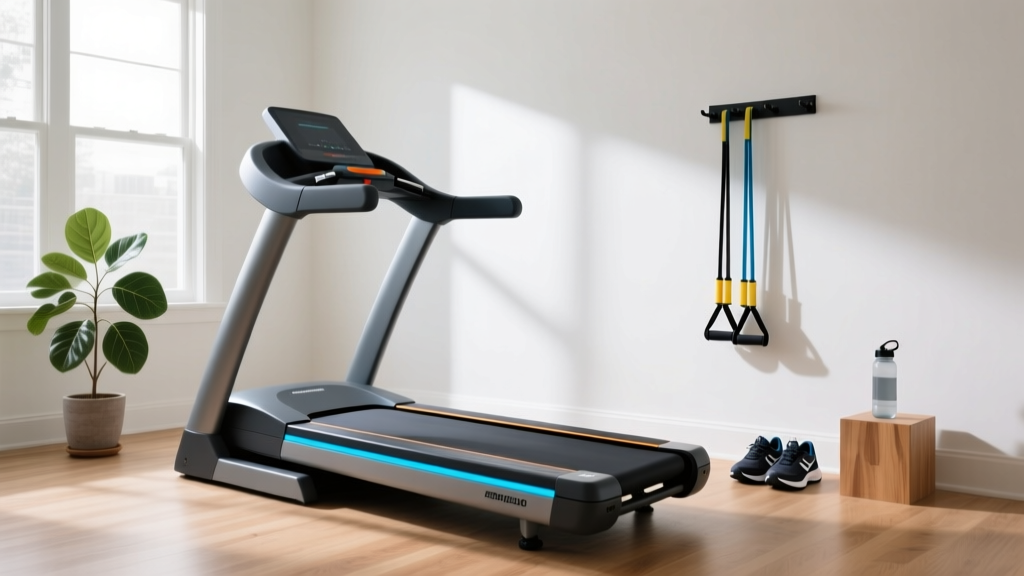
What's the Purpose of a Curved Treadmill? Noise Guide
Learn what's the purpose of a curved treadmill and compare cardio machine noise levels. A step-by-step guide to building a quiet home gym.

The Beginner's Step-by-Step Guide to Home Gym Acoustics
Building a home gym is one of the best investments you can make for your health, but if you live in an apartment, share a house with roommates, or have sleeping children, noise becomes a massive hurdle. The rhythmic thumping of footstrikes and the high-pitched whine of electric motors can quickly turn your fitness journey into a neighborhood dispute.
In this step-by-step guide, we will break down the acoustics of cardio equipment, answer a highly searched question—what's the purpose of a curved treadmill compared to traditional models?—and provide a comprehensive cardio machine noise level comparison to help you choose the perfect, peaceful equipment for your space in 2026.
Step 1: Understand the Decibel (dB) Scale for Fitness
Before comparing machines, you need to understand how sound is measured. The decibel (dB) scale is logarithmic, meaning a small increase in numbers represents a massive jump in actual volume. According to the Occupational Safety and Health Administration (OSHA), prolonged exposure to noise above 85 dB can cause hearing damage, but in a home setting, anything above 70 dB is generally considered disruptive to conversations and daily life.
Quick Reference: Home Noise Baselines- 40-50 dB: Quiet library, humming refrigerator
- 60 dB: Normal conversational speech
- 70-80 dB: Vacuum cleaner, busy street traffic
- 85+ dB: Heavy city traffic, lawnmower, loud air bike
Step 2: Isolate Motor Noise vs. Impact Noise
When evaluating cardio machines, beginners often make the mistake of only listening to the machine while it is idle. To truly understand a machine's acoustic footprint, you must separate the noise into two distinct categories:
- Motor and Mechanical Noise: This is the sound generated by the machine's internal parts. Electric motors, drive belts, flywheels, and cooling fans all produce continuous airborne noise. A 3.0 HP treadmill motor typically emits a high-frequency whine between 65 and 75 dB.
- Impact and Vibration Noise: This is structure-borne noise. When your foot strikes a treadmill deck or a rowing machine rail, the kinetic energy transfers through the machine's frame, into the floor, and through your home's joists. This creates the low-frequency 'thud' that drives downstairs neighbors crazy.
Step 3: What's the Purpose of a Curved Treadmill?
When shopping for a quiet treadmill, you will inevitably encounter non-motorized, curved models like the AssaultRunner Elite (approx. $3,199) or the premium Woodway Curve (approx. $6,500). This leads many beginners to ask: what's the purpose of a curved treadmill if it costs more and lacks a motor?
The Biomechanical Purpose
Studies highlighted by the American Council on Exercise (ACE) and published in the Journal of Strength and Conditioning Research show that the curved geometry forces you to run on the balls of your feet. This engages the posterior chain (glutes, hamstrings, and calves) much more aggressively than a flat, motorized belt. Because you are manually driving the belt with your own kinetic energy, curved treadmills can yield up to a 30% higher calorie burn at the exact same perceived exertion level.
The Acoustic Purpose (The Noise Advantage)
From a noise perspective, the purpose of a curved treadmill is to entirely eliminate motor noise. Because there is no electric motor, there is no high-frequency whine. However, they are not completely silent. The thick rubber slat belts rolling over the curved deck create a distinct, low-frequency 'rumble' or 'hum' (usually around 60-65 dB). While the airborne noise is low, the impact noise of your footstrikes on the slat belt can still transfer to the floor if not properly decoupled.
Step 4: The Cardio Machine Noise Level Comparison Chart
To help you make an informed decision, we have tested and categorized the most popular home cardio machines available in 2026 based on their combined motor and impact noise profiles during moderate-intensity use.
| Machine Type & Popular Model | Motor/Mech Noise | Impact Noise | Total dB Range | Apartment Friendly? |
|---|---|---|---|---|
| Magnetic Elliptical (Sole E35) | Very Low (Magnetic resistance) | Zero (No foot impact) | 45 - 55 dB | ✅ Excellent |
| Curved Treadmill (AssaultRunner Elite) | None (Non-motorized) | Moderate (Footstrike) | 60 - 68 dB | ⚠️ Good (with mat) |
| Motorized Treadmill (NordicTrack T-Series) | High (2.6 HP Motor) | High (Heavy impact) | 75 - 85 dB | ❌ Poor |
| Smart Stationary Bike (Peloton Bike+) | Very Low (Magnetic flywheel) | None (Seated) | 40 - 50 dB | ✅ Excellent |
| Air Bike (Rogue Echo Bike) | Extreme (Wind fan resistance) | Low (Seated) | 80 - 92 dB | ❌ Terrible |
| Rowing Machine (WaterRower Natural) | Low (Water swoosh) | Low (Seated slide) | 55 - 65 dB | ✅ Very Good |
Step 5: Implement Vibration Decoupling
If your budget or fitness goals require a machine with higher impact or motor noise (like a standard treadmill or a curved treadmill), you must decouple the machine from your floor. Do not rely on the thin, cheap PVC mats included in the box with your equipment.
Pro Tip: To stop low-frequency structural vibration, you need mass and isolation. Purchase a high-density EVA foam mat (at least 3/8-inch thick) and place specialized rubber anti-vibration washing machine pads under the four corners of your treadmill frame. This creates an air gap and absorbs the kinetic energy before it reaches the floorboards.
Best Decoupling Materials for 2026:
- SuperMats High Density Equipment Mat: Excellent for absorbing footstrike impact on curved and motorized treadmills.
- Stealth Fitness Treadmill Shock Pads: Specifically designed to go under the feet of heavy cardio machines to prevent joist vibration.
- Interlocking Rubber Gym Tiles (3/8-inch): Best for creating a permanent, sound-dampening foundation for an entire garage gym.
Step 6: Routine Maintenance for Squeak-Free Workouts
Even the quietest elliptical or magnetic bike will become a squeaking nightmare if neglected. Friction is the enemy of a quiet home gym. Follow this monthly maintenance checklist to keep your decibel levels down:
- Lubricate Treadmill Belts: For motorized treadmills, use 100% silicone treadmill lubricant every 3 months or every 130 miles. A dry belt causes the motor to work harder, increasing both mechanical whine and heat.
- Tighten Flywheel Bolts: On spin bikes and ellipticals, the repetitive motion can loosen the crank arms and flywheel housing. Use an Allen wrench to check these monthly.
- Vacuum Motor Compartments: Dust buildup in a treadmill's motor housing forces the cooling fan to spin faster and louder. Use a vacuum hose attachment to clear the vents every few months.
- Check Slat Belt Tension: On curved treadmills, if the slat belt is too loose, it will slap against the internal guide rails, creating a loud clacking sound. Consult your manual for the specific tensioning bolt adjustments.
Summary: Choosing Your Quiet Cardio Partner
Understanding what's the purpose of a curved treadmill—and how it compares to traditional motorized models or low-impact ellipticals—is the key to designing a home gym that respects your living space. If your priority is absolute silence and joint preservation, a magnetic elliptical or smart stationary bike is your best bet. If you crave the biomechanical benefits and high calorie burn of running but want to eliminate the whine of an electric motor, a curved treadmill paired with high-quality decoupling mats is the ultimate 2026 upgrade for your fitness routine.
More gear to consider
All reviews
Air Bike vs Assault Bike & How to Connect Apple Watch to Treadmill
Under-Desk Treadmill Care: Office Use & 'The Walk' Movie Setups

XTERRA Treadmill vs Air Bike: Cardio Guide
Treadmill Cycling Limits: Walking Pad Mistakes & Fixes

Horizon T202 Treadmill Setup & Motor Horsepower Guide
