Costway SuperFit Treadmill vs Stationary Bike Types: Space Guide
Optimize your home gym layout. Compare the Costway SuperFit treadmill footprint against upright, recumbent, and spin bikes for small spaces.

Designing a functional home cardio zone in a compact apartment or multi-purpose spare room requires a ruthless approach to spatial geometry. As urban living spaces shrink and remote work remains a permanent fixture in 2026, the days of dedicating a sprawling 300-square-foot basement exclusively to fitness equipment are over. Today's home gym design is about micro-footprints, multi-modal equipment, and strict adherence to safety clearances.
In this comprehensive layout guide, we are tackling a highly specific spatial challenge: evaluating the ultra-compact Costway SuperFit treadmill against the three primary stationary bike types (upright, recumbent, and spin). By analyzing exact dimensions, mandatory safety buffers, and real-world ingress/egress requirements, you will learn exactly how to map out a high-performance cardio layout without turning your living space into an obstacle course.
The Costway SuperFit Treadmill: A Masterclass in Micro-Footprints
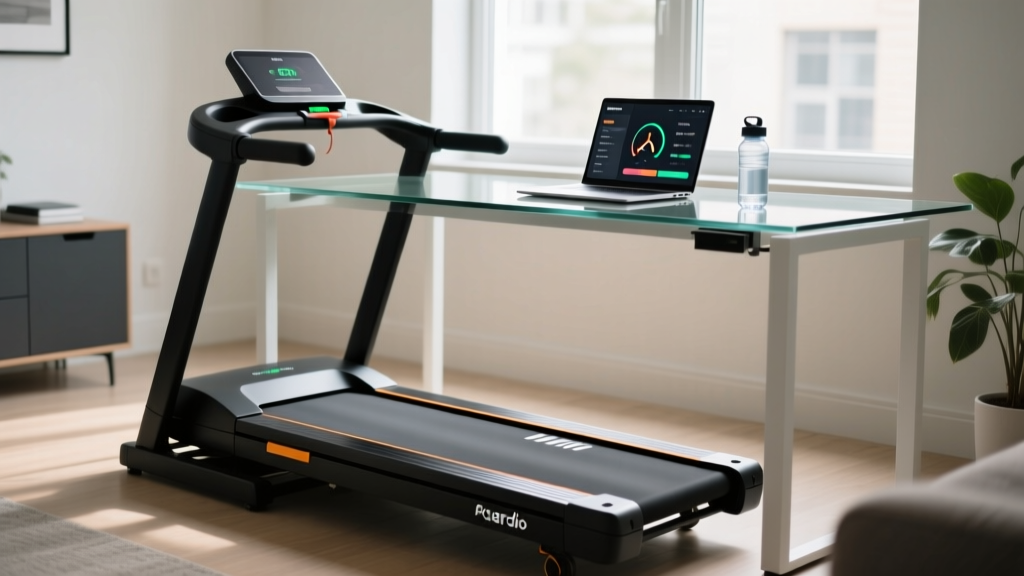
The Costway SuperFit 2-in-1 folding treadmill has become a staple in small-space fitness due to its dual-mode chassis. Unlike traditional folding treadmills that still demand a massive 30-inch by 60-inch operational footprint when upright, the SuperFit is engineered for dual-deployment.
Dimensional Breakdown
- Flat Mode (Under-Desk): 50.5 inches (L) x 20.5 inches (W) x 4.5 inches (H). In this mode, it slides beneath a standard 28-inch standing desk or a 14-inch bed frame clearance.
- Raised Mode (Standard Walking): 50.5 inches (L) x 20.5 inches (W) x 46 inches (H). The handrail locks into place, increasing the vertical profile but maintaining the exact same floor footprint.
- Weight: Approximately 62 lbs, allowing a single user to pivot it on its transport wheels and store it vertically against a wall (requiring only a 50.5" x 4.5" wall footprint).
From a layout perspective, the SuperFit's primary advantage is its 2.25 HP motor housed in a low-profile deck. However, because the running belt is limited to roughly 40 inches in length, it is strictly a walking and light-jogging machine (max speed 7.6 mph). It eliminates the need for the 30-inch rear safety clearance required by larger treadmills, provided it is used exclusively in flat mode beneath a desk.
Decoding Stationary Bike Types: Upright, Recumbent, and Spin
When comparing the Costway SuperFit to stationary bikes, we must segment the bike category into three distinct mechanical archetypes. Each type interacts with your floor plan differently, dictating everything from ceiling height requirements to lateral transfer space.
1. Upright Bikes: The Vertical Compromise
Upright bikes (like the Schwinn IC4 or NordicTrack S15i) mimic the geometry of a traditional road bike but with a slightly more relaxed seat tube angle.
Average Footprint: 45" L x 20" W.
Spatial Profile: Upright bikes have the smallest total volume of any cardio machine. Because the user's center of gravity is directly over the bottom bracket, the base only needs to be wide enough to prevent lateral tipping during out-of-the-saddle sprints. They are ideal for narrow galley-style rooms or bedroom corners, requiring only 10 inches of side clearance for mounting.
2. Recumbent Bikes: The Horizontal Sprawl
Recumbent bikes (such as the Sole R92 or Exerpeutic 400XL) feature a bucket seat with a backrest and a forward-extended pedal crank.
Average Footprint: 62" L x 27" W.
Spatial Profile: Recumbents are the most space-inefficient cardio machines on the market. Their elongated wheelbase is necessary to support the user's extended legs and prevent forward tip-overs. Furthermore, physical therapists and the Mayo Clinic's home fitness guidelines note that recumbent users often require mobility aids. Therefore, you must allocate an additional 24-inch lateral transfer zone on at least one side of the bike for wheelchair or walker maneuvering, effectively doubling its spatial footprint.
3. Spin / Indoor Cycling Bikes: The Fixed-Position Anchor
Spin bikes (like the Keiser M3i or Peloton Bike+) utilize a heavy front or rear flywheel (often 30 to 45 lbs) and a rigid, fixed-gear drivetrain.
Average Footprint: 55" L x 22" W.
Spatial Profile: While longer than an upright bike, spin bikes are incredibly dense and heavy. They do not fold, and their transport wheels are designed for short pivots, not long-distance repositioning. In a layout design, a spin bike should be treated as a permanent architectural fixture. They require a minimum of 15 inches of side clearance to accommodate the user's knee-tracking and out-of-saddle lateral sway.
Spatial Matrix: Footprints and Mandatory Safety Clearances
According to the U.S. Consumer Product Safety Commission (CPSC), failure to maintain adequate clearance zones is a leading cause of home gym friction burns and impact injuries. Below is the 2026 operational matrix comparing the Costway SuperFit against the three bike types.
| Equipment Type | Base Footprint (L x W) | Required Rear Clearance | Required Side Clearance | Total Operational Zone |
|---|---|---|---|---|
| Costway SuperFit (Flat Mode) | 50.5" x 20.5" | 12" (Desk Chair Buffer) | 10" (Each Side) | 74.5" x 40.5" |
| Costway SuperFit (Raised Mode) | 50.5" x 20.5" | 36" (ASTM Fall Zone) | 15" (Each Side) | 86.5" x 50.5" |
| Upright Stationary Bike | 45" x 20" | 12" (Wall Buffer) | 10" (Mounting Side) | 57" x 30" |
| Recumbent Bike | 62" x 27" | 12" (Wall Buffer) | 24" (Transfer Zone) | 74" x 51" |
| Spin / Indoor Cycle | 55" x 22" | 18" (Dismount Buffer) | 15" (Sway Zone) | 73" x 52" |
Layout Frameworks: Fitting Cardio into Sub-200 Sq Ft Rooms
When integrating the Costway SuperFit treadmill alongside a stationary bike in a single room, you must move beyond simple footprint math and consider volumetric space and human biomechanics. Follow this step-by-step framework to draft your floor plan:
- Map the Ingress/Egress Corridors: Before placing any machine, draw a 30-inch wide pathway from the door to the window. This is your primary egress route. Never place a recumbent bike across this path, as its low profile creates a severe tripping hazard.
- Assign the Costway SuperFit to the Perimeter: Utilize the space beneath a south-facing window or a dedicated standing desk. If using it in raised mode, anchor it against a load-bearing wall to minimize vibration transfer to neighboring rooms.
- Position Bikes Based on Ceiling Height: Spin bikes and upright bikes require vertical clearance. A standard 8-foot ceiling is sufficient, but if you have sloped ceilings or attic spaces, ensure a minimum of 78 inches of clearance above the highest pedal point to prevent head strikes during standing climbs.
- Optimize HVAC and Ventilation: Cardio machines generate significant localized heat and humidity. Position your spin or upright bike directly in the line of sight of your HVAC supply vent or a wall-mounted fan. The Costway SuperFit, being a low-intensity walking pad, can be placed in dead-air corners without causing user overheating.
Edge Cases: Floor Joists, Vibration, and Real-World Failures
Space optimization is not just about X and Y axes; the Z-axis (floor loading and acoustic transfer) is where most small-space gym layouts fail.
Pro-Tip on Floor Loading: A 180 lb user on a spin bike generating 400 watts of output concentrates immense dynamic point-load on the front stabilizer. If your home gym is on a second-floor timber-framed structure, place a 3/4-inch high-density EVA foam mat beneath all equipment to disperse the load across multiple floor joists and dampen low-frequency acoustic vibrations.
Another common failure mode involves the Costway SuperFit's power cord management. Because it is designed to slide under desks, users frequently run over the power cable with their office chairs, eventually fraying the 120V wire. When designing your layout, route the SuperFit's power cable along the baseboard using adhesive cable channels, keeping the floor entirely clear for the treadmill's sliding mechanism.
Finally, consider the visual weight of the equipment. Recumbent bikes, due to their sprawling 62-inch length, can make a small room feel psychologically claustrophobic. If spatial perception is a concern, prioritize the Costway SuperFit (which can be hidden under furniture) and an upright bike (which draws the eye vertically rather than horizontally), keeping the room's sightlines open and preserving the illusion of square footage.
Final Verdict on Small-Space Cardio
Choosing between the Costway SuperFit treadmill and the various stationary bike types ultimately depends on your room's specific geometric constraints. The SuperFit dominates in multi-use rooms where floor space must be reclaimed for daily living or working. However, if your goal is high-intensity interval training (HIIT) and you have a dedicated 5x5 foot corner, a spin or upright bike offers a superior cardiovascular stimulus with a remarkably manageable footprint. By respecting the safety clearances outlined by organizations like Harvard Health and the CPSC, you can build a safe, highly optimized cardio sanctuary in even the most restrictive floor plans.
More gear to consider
All reviews
How Much Is 10k Steps on a Treadmill? Small-Space Cardio Guide

Is Walking on the Treadmill Cardio? Home Stair Climber Guide

Beyond Treadmill Abuse Murder: Air Bike vs Assault Bike Layouts
Maintaining Compact Treadmills for HIIT Treadmill Workouts

SendNudesX Treadmill Noise Troubleshooting: How It Compares to Top Brands