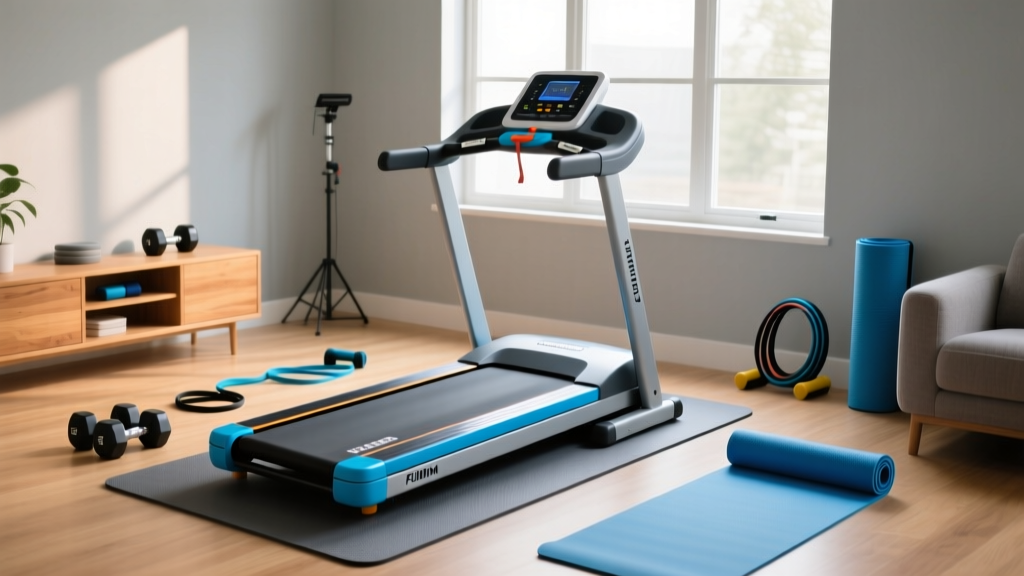
Compact Layouts: Belt Care for a Beginners Treadmill Running Program
Optimize your compact home gym layout with proper treadmill belt maintenance. Ensure a smooth, quiet beginners treadmill running program with our expert guide.

The Spatial Reality of Compact Home Gyms
When designing a home gym in a small apartment, spare bedroom, or converted closet, spatial optimization usually takes priority over mechanical accessibility. You measure the footprint, ensure the folding mechanism clears the ceiling, and tuck the machine neatly against a wall. However, this aggressive space-saving approach often creates a hidden enemy for your equipment: restricted airflow and concentrated dust. For anyone embarking on a beginners treadmill running program, a poorly ventilated, tightly wedged treadmill is a recipe for premature belt degradation, motor overheating, and disruptive friction noise.
According to the American Heart Association, consistency is the most critical factor in a new fitness routine. Nothing derails a novice's momentum faster than a squeaking deck or a burnt-out motor controller caused by excessive belt friction. In 2026, modern treadmill decks are largely constructed from high-density MDF coated with phenolic resin or dual-sided wax, but they still rely on a microscopic layer of 100% silicone to maintain a friction coefficient below 0.15. When your layout traps heat and lint, that silicone breaks down rapidly. This guide bridges the gap between interior layout design and essential mechanical maintenance, ensuring your compact space supports rather than sabotages your fitness goals.
Designing Clearances for Maintenance Access
The most common mistake in small-space gym design is pushing the treadmill flush against walls or into tight alcoves. While a treadmill might physically fit in a 30-inch deep alcove, this layout makes routine belt lubrication and tension alignment nearly impossible without completely dismantling the room's layout. To maintain your machine without moving 180 pounds of steel, your spatial blueprint must include dedicated 'service voids'.
| Zone | Minimum Clearance | Purpose & Maintenance Impact |
|---|---|---|
| Left/Right Sides | 18 inches | Allows arm extension for belt lifting, silicone application, and hex-key access to rear roller alignment bolts. |
| Rear (Motor End) | 36 inches | Required for vacuuming motor compartment dust, accessing the drive belt, and ensuring exhaust heat dissipation. |
| Top (Ceiling) | 12 inches above user | Prevents claustrophobia during incline running and allows heat to rise away from the console electronics. |
| Front (Incline Base) | 4 inches | Accommodates the physical downward arc of the deck when the incline motor lowers to a 0% grade. |
The Micro-Climate Effect: Heat, Dust, and Friction
Small rooms and enclosed spaces have distinct micro-climates that directly impact treadmill tribology (the science of friction and wear). When you run, the kinetic energy not transferred into forward motion is converted into heat at the belt-deck interface. In a spacious room, ambient air circulation dissipates this heat. In a tight corner layout, the heat pools around the lower chassis.
The 'Closet Gym' Lint Problem
If your space optimization involves placing the treadmill in a bedroom closet or near open shelving, you are introducing textile lint into the equation. Cotton and synthetic fibers shed continuously. When lint settles on a treadmill deck, it mixes with the wet silicone lubricant to form a highly abrasive, paste-like compound. This paste acts like liquid sandpaper, scouring the phenolic coating off the deck and increasing the amperage draw on the drive motor. For a beginners treadmill running program, where the user may not yet recognize the subtle sound of a struggling motor, this can lead to a blown control board within the first 90 days.
To combat this in tight layouts, you must integrate a specialized cleaning protocol. The Mayo Clinic emphasizes that a safe, clean environment is foundational to sustaining any new exercise habit. In a compact layout, this means using a microfiber mop with a mild, non-ammonia degreaser on the floor surrounding the machine twice a week to capture airborne lint before it reaches the deck.
Step-by-Step: Lubricating in Confined Layouts
When your spatial design leaves you with the bare minimum 18-inch side clearances, applying lubricant requires a specific technique to avoid making a mess on your walls or flooring. Always use 100% silicone liquid (never aerosol sprays, which contain petroleum distillates that destroy PVC belts). A 4-ounce bottle of premium liquid silicone costs roughly $12 to $15 and will last a home user 2 to 3 years.
- Power Down and Unplug: In a tight space, a stray foot hitting the console could start the belt. Always sever the power connection.
- The 'Reach-and-Lift' Technique: Kneel at the midpoint of the side rail. Reach your dominant hand under the belt, pulling it upward just enough to clear the deck (about 1.5 inches).
- Target the Centerline: Squeeze exactly 0.5 ounces (about half the provided squeeze bottle) of silicone in a zig-zag pattern directly down the center of the deck, reaching as far toward the middle of the belt as your arm allows.
- Repeat on the Opposite Side: Utilize your 18-inch side clearance to access the other side, applying the remaining 0.5 ounces.
- Manual Distribution: Without turning the machine on, reach in and manually drag the belt side-to-side to spread the silicone. Then, plug the machine in and run it at 2.0 MPH for three minutes to evenly distribute the fluid via the rollers.
Acoustic Optimization for Shared Walls
Space optimization often means utilizing rooms with shared walls—apartments, condos, or bedrooms adjacent to living spaces. A dry treadmill belt generates high-frequency acoustic vibrations that travel directly through the deck, down the steel uprights, and into the floor joists. This structure-borne noise is incredibly disruptive.
Proper lubrication reduces the friction coefficient, which in turn drops the acoustic output of the machine by 4 to 8 decibels. However, in a compact layout, you must also decouple the machine from the architecture. If your layout forces the treadmill onto hardwood or tile, you must place a 3/8-inch thick, high-density vulcanized rubber mat underneath. This mat not only catches stray silicone drips during your maintenance routine but also absorbs the low-frequency thud of foot strikes, ensuring your early morning runs don't disturb the household.
Troubleshooting Edge Cases in Tight Spaces
Even with perfect spatial planning, small-room environments present unique mechanical edge cases. Here is how to diagnose and fix them:
- Edge Case: Belt Slipping on Incline
Cause: Over-lubrication in a humid, unventilated room. If your compact gym lacks a dehumidifier, ambient moisture can prevent the silicone from bonding to the deck, creating a hydroplaning effect.
Fix: Wipe the underside of the belt with a dry, lint-free cloth and run the machine at 5 MPH for 10 minutes to burn off excess moisture. - Edge Case: Asymmetrical Belt Drift
Cause: Uneven flooring in a converted closet or alcove. If the treadmill sits on a sloped floor (common in older homes), gravity pulls the belt to the lower side, causing it to rub against the side rail.
Fix: Use a digital level across the deck. Place rigid, non-compressible shims under the lower side's front and rear leveling feet before attempting to adjust the rear roller tension bolts. - Edge Case: Static Shock
Cause: Dry winter air in a small, sealed room combined with a nylon-blend running shirt and a slightly dry belt.
Fix: Apply a fresh coat of silicone and ensure your rubber isolation mat is grounded or treated with an anti-static spray.
The FitGearPulse Verdict: A successful beginners treadmill running program relies as much on your room's blueprint as it does on your cardiovascular effort. By designing your compact layout with maintenance clearances, managing the micro-climate of your space, and adhering to a strict 0.5oz silicone regimen every 150 miles, you transform a tight corner into a professional-grade, whisper-quiet training zone.
More gear to consider
All reviews
Under Desk Treadmill Benefits: Office Reviews & Care

ProForm Sport TL Treadmill Noise Test vs. Top Quiet Rivals

Beginner Treadmill Intervals: Walking Pad vs Treadmill Guide

ProForm Carbon T10 Treadmill & Stationary Bikes: Space Layout Guide
Echanfit Treadmill vs Elliptical: Maintenance & Longevity Guide
