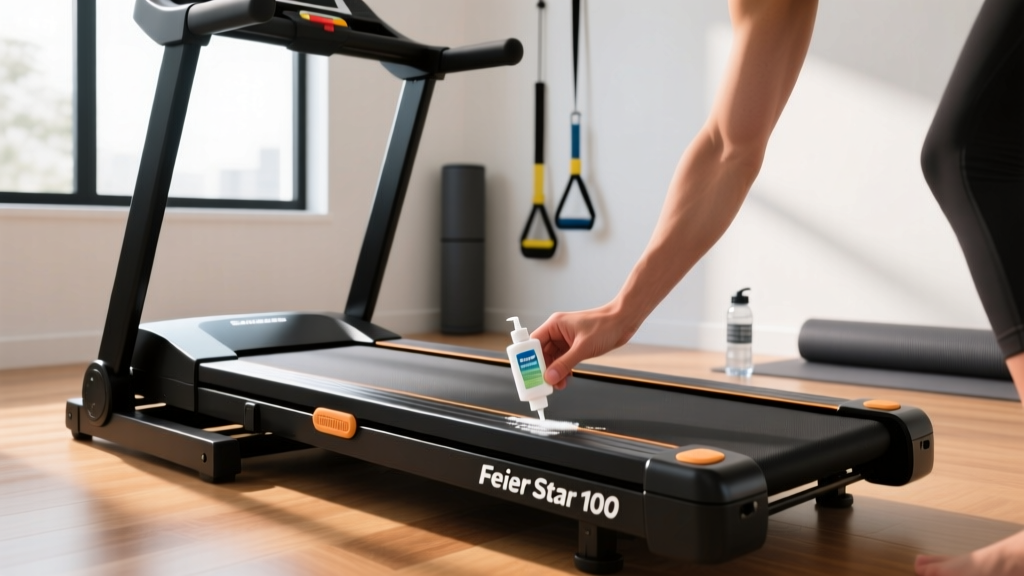
Feier Star 100 Folding Treadmill Belt Maintenance Guide
Master your Feier Star 100 folding treadmill belt maintenance. Learn exact silicone lubrication steps, tension adjustments, and motor-saving tips.

The Hidden Cost of Belt Friction on Compact Motors
The Feier Star 100 folding treadmill is a popular choice for apartment dwellers and home gyms due to its compact footprint and accessible price point. However, like most budget-friendly treadmills in the 2.0 to 2.5 HP category, its primary vulnerability lies in the relationship between the running belt, the deck, and the motor's thermal limits. When a treadmill belt dries out, friction increases exponentially. According to equipment repair specialists, a well-lubricated belt draws between 3 to 6 amps of current during a standard 6.0 MPH run. A dry, neglected belt can spike that amp draw to 12 or even 15 amps.
Because the Feier Star 100 folding treadmill utilizes a compact motor housing with limited active cooling, sustained high-amp draw will inevitably trigger the thermal overload switch or, worse, permanently fry the lower control board. As of 2026, replacing a proprietary lower control board on this tier of machine costs between $65 and $95, entirely negating the budget-friendly appeal of the unit. Proper belt maintenance is not just about a smoother run; it is the single most critical factor in extending the lifespan of your machine's electronic and mechanical components.
⚠️ CRITICAL WARNING: The Petroleum TrapNever use WD-40, silicone-blend sprays, or any petroleum-based lubricants on your treadmill belt. Petroleum products degrade the PVC and rubber compounds of the belt, causing it to stretch, delaminate, and ultimately destroy the phenolic coating on the MDF deck. You must use 100% pure silicone liquid or spray specifically formulated for fitness equipment.
Essential Tools for Feier Star 100 Maintenance
Before beginning your maintenance routine, gather the following items. You likely already have most of these on hand:
- 100% Silicone Treadmill Lubricant: Brands like Spot On, Godora, or generic 100% silicone ($8–$14). Liquid with a wand applicator is often easier to control than aerosol sprays.
- 5mm Allen Wrench (Hex Key): Usually included in the original Feier Star 100 assembly kit. This is required for rear roller tension adjustments.
- Microfiber Cloths: For wiping away excess silicone and dust.
- Vacuum with Brush Attachment: Essential for cleaning the motor shroud and folding hinge.
- Smart Plug with Energy Monitoring (Optional): Devices like the Kill A Watt or modern smart plugs allow you to monitor the treadmill's real-time amp draw, taking the guesswork out of belt friction diagnostics.
Step-by-Step 100% Silicone Lubrication Protocol
Industry experts and publications like Runner's World recommend lubricating your treadmill belt every 130 miles or every three months, whichever comes first. If you are a heavier user or run at high inclines, lean toward the 90-day mark.
- Power Down and Unplug: Always remove the safety key and unplug the Feier Star 100 from the wall to prevent accidental startup while your hands are near the rollers.
- Locate the Application Zone: Reach under the side edge of the belt near the middle of the deck. You do not need to completely loosen the belt for routine maintenance; lifting the edge 2 to 3 inches is sufficient.
- Apply the Silicone: Insert the applicator wand under the belt and apply approximately 0.5 ounces (about half a standard squeeze bottle) in a zig-zag pattern from the center outward toward the edge. Repeat on the opposite side.
- Manual Distribution: Before turning the machine on, press down on the belt and use your hands to massage the silicone across the width of the deck. This ensures the lubricant reaches the center of the deck where your foot strike occurs.
- The 5-Minute Spread Cycle: Plug the treadmill back in, insert the safety key, and start the belt at a slow 3.0 MPH. Walk on the treadmill for 5 minutes. The combination of your body weight and the belt movement will perfectly distribute the silicone across the entire deck surface.
- Wipe the Edges: Stop the machine and use a microfiber cloth to wipe away any excess silicone that has squeezed out onto the side rails. Leftover silicone on the rails creates a slipping hazard for your feet.
Diagnosing Belt Tension and Alignment Issues
Lubrication is only half the battle. Over time, the belt on the Feier Star 100 folding treadmill will stretch and may drift to one side. The New York Times Wirecutter notes that improper belt tension is a leading cause of premature motor failure. Use the troubleshooting matrix below to diagnose and fix belt issues using the 5mm Allen wrench on the rear roller end caps.
| Symptom | Root Cause | Adjustment Protocol |
|---|---|---|
| Belt hesitates or slips when foot strikes | Belt tension is too loose; motor is spinning but belt is not gripping the front roller. | Turn BOTH left and right rear roller bolts clockwise by exactly 1/4 turn. Test and repeat if necessary. Do not over-tighten. |
| Belt drifts to the LEFT side | Left side tension is looser than the right side. | Turn LEFT bolt clockwise 1/4 turn, OR turn RIGHT bolt counter-clockwise 1/4 turn. Run at 3 MPH to observe tracking. |
| Belt drifts to the RIGHT side | Right side tension is looser than the left side. | Turn RIGHT bolt clockwise 1/4 turn, OR turn LEFT bolt counter-clockwise 1/4 turn. Run at 3 MPH to observe tracking. |
| High-pitched squealing from rear | Belt is over-tensioned, putting excessive strain on roller bearings. | Turn BOTH bolts counter-clockwise 1/4 turn until the squeal stops and the belt grips without slipping. |
The Folding Hinge: A Hidden Dust Trap
One unique maintenance challenge specific to the Feier Star 100 folding treadmill is its folding mechanism. When the deck is folded upright for storage, the front motor shroud and the folding hinge act as a shelf, catching dust, pet hair, and debris. According to the Consumer Product Safety Commission (CPSC), dust accumulation inside motor housings acts as an insulator, trapping heat and drastically reducing the lifespan of electronic components.
Quarterly Motor Hood Cleaning:
- Unplug the machine and fold it down to the running position.
- Use a Phillips head screwdriver to remove the 4 to 6 screws securing the plastic motor hood at the front of the deck.
- Lift the hood carefully, noting the routing of the power cable.
- Use a vacuum with a soft brush attachment to gently remove dust bunnies from the motor fins, the lower control board heat sink, and the front roller pulley.
- Wipe the inside of the plastic hood with a damp cloth before reattaching.
Sizing and Installing a Replacement Belt
Even with meticulous lubrication, treadmill belts eventually wear out. If you notice fraying on the edges, visible white weave showing through the black PVC surface, or a glazed, hardened texture that no longer absorbs silicone, it is time for a replacement. Generic replacement belts for this class of treadmill typically cost between $25 and $45.
How to measure for a replacement: Do not rely solely on the manufacturer's stated dimensions, as production runs can vary slightly. Use a flexible tailor's measuring tape to measure the width of the belt (usually around 16.5 inches for the Feier Star 100) and the total length of the belt loop. To measure the length, mark a line on the belt with chalk, measure to the end of the deck, rotate the belt by hand, and continue measuring until you reach the chalk mark again. Order a belt and deck combo if your current deck feels rough or gouged to the touch.
Frequently Asked Questions
Q: Can I use a silicone spray meant for automotive weather stripping?
A: While it may be 100% silicone, automotive sprays often contain propellants and solvents that can degrade the treadmill belt's adhesive layers. Always use a lubricant explicitly labeled for fitness equipment.
Q: My Feier Star 100 suddenly stopped working and won't turn back on. Did I kill the motor?
A: Not necessarily. You likely tripped the thermal overload switch due to high friction. Unplug the machine, ensure the belt is lubricated and properly tensioned, and wait 45 minutes for the internal breaker to reset. If it still fails, the lower control board or the safety key reed switch may have failed.
Q: How tight should the belt be after adjustment?
A: You should be able to lift the side edge of the belt about 2 to 3 inches off the deck with moderate resistance. If you can lift it 5 inches, it is too loose and will slip. If you cannot lift it more than an inch, it is too tight and will destroy the motor bearings.
More gear to consider
All reviews
Disassembling NordicTrack Treadmill? Why Spin & Upright Bikes Win
Sunny Health & Fitness Manual Walking Treadmill vs Motorized: HP Guide

Curved vs Motorized: Is a Horizon Evolve SG Treadmill Right?

SpaceWalker Treadmill vs. Stair Climber: Home Use Guide

Elliptical vs Treadmill: Space Design & Kelsey Kane Treadmill Trail
