Compact Cardio: Bike Types & Interval Training on Treadmill for Beginners
Discover how to optimize small home gyms with the right stationary bike types and space-saving layouts for interval training on treadmill for beginners.

The Spatial Challenge of Modern Home Cardio
Designing a functional home gym in 2026 requires a ruthless approach to space optimization. With urban living spaces shrinking and the demand for high-quality fitness equipment rising, homeowners and renters alike are forced to make critical decisions about which cardio machines earn their precious floor space. The two most common contenders for the primary cardio slot are stationary bikes and treadmills. However, comparing them isn't just about calorie burn; it is a complex equation involving spatial footprints, ceiling clearances, acoustic transfer, and safety zones.
This guide breaks down the spatial realities of different stationary bike types (upright, recumbent, and spin) and contrasts them with the unique layout requirements needed for safe interval training on treadmill for beginners. By the end, you will have a concrete framework for designing a compact, high-performance cardio zone that doesn't compromise your living area.
The Spatial Footprint of Stationary Bike Types
Stationary bikes are generally the darlings of small-space home gyms, but not all bikes are created equal when it comes to square footage. Understanding the exact dimensions and clearance requirements of each type is the first step in layout design.
1. Spin Bikes / Indoor Cycles
Spin bikes mimic the geometry of outdoor road bikes. They are inherently compact, making them ideal for tight corners, bedrooms, or multi-use living spaces. Models like the Schwinn IC4 (retailing around $799) or the Bowflex C6 feature a footprint of roughly 48 inches long by 21 inches wide. Because the user is leaned forward, the vertical clearance requirement is minimal, easily fitting under standard 8-foot ceilings or even in basement gyms with low-hanging ductwork.
2. Upright Bikes
Upright bikes offer a more relaxed, traditional seating position. They often come with larger consoles and wider bases for stability. The NordicTrack Commercial S22i (approximately $1,999 in 2026) requires a footprint of 55 x 22 inches. While slightly longer than a spin bike, the primary spatial advantage is the ability to easily drape a towel over the handlebars and step off laterally without navigating a long frame.
3. Recumbent Bikes
Recumbent bikes are the most spatially demanding. Designed with a bucket seat and extended leg position, they are ideal for rehabilitation and lower-back support but are notorious space-hogs. The Sole R92 (priced near $1,399) commands a massive 63 x 28 inches of floor space. In a small apartment, a recumbent bike often dictates the entire room's layout, forcing furniture to be arranged around its elongated frame.
| Bike Type | Example Model (2026) | Footprint (L x W) | Weight | Best Spatial Use Case |
|---|---|---|---|---|
| Spin / Indoor Cycle | Schwinn IC4 | 48" x 21" | 112 lbs | Bedrooms, tight corners, closets |
| Upright Bike | NordicTrack S22i | 55" x 22" | 140 lbs | Dedicated gym nooks, home offices |
| Recumbent Bike | Sole R92 | 63" x 28" | 145 lbs | Spacious living areas, rehab zones |
Accommodating Interval Training on Treadmill for Beginners
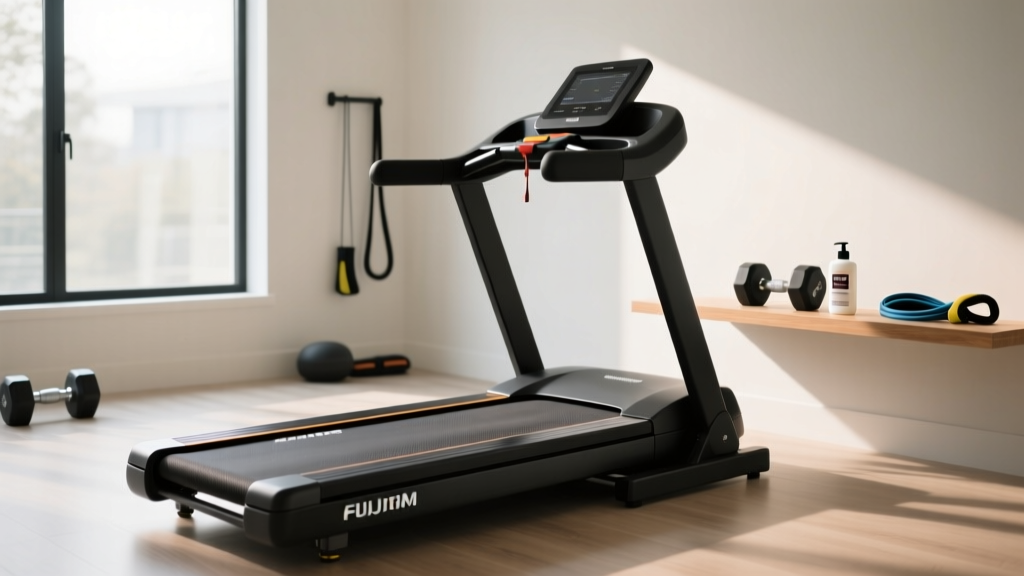
While bikes excel in compact footprints, many users ultimately desire the weight-bearing, high-calorie-burn benefits of running. If your fitness roadmap includes interval training on treadmill for beginners, spatial planning shifts dramatically. Interval training involves rapid transitions between high-intensity sprinting and low-intensity recovery. For beginners, this introduces a significant safety variable: fatigue-induced stumbling.
The Rear-Clearance Danger Zone: According to the U.S. Consumer Product Safety Commission (CPSC), treadmills require a minimum of 2 feet of clear space behind the machine. However, for beginners performing high-intensity intervals, we strongly recommend extending this to 3 to 4 feet. If a user loses balance during a sprint interval and falls off the back, they must not strike a wall, glass window, or furniture edge.
Selecting the Right Treadmill for Small Spaces
For compact layouts, folding treadmills are mandatory. The Sole F63 (approx. $1,199) and the Horizon T202 (approx. $999) are industry staples. When deployed, the Sole F63 requires 82 x 35 inches of floor space. When folded, it reduces to 48 x 35 inches. However, a folded treadmill still protrudes nearly three feet into the room and stands over 6 feet tall, which can visually dominate a small space and block natural light from windows.
Calculating Ceiling Clearance for Intervals
Beginners often underestimate the vertical space needed for treadmill intervals. As speed increases, a runner's vertical bounce (flight time) increases.
- Deck Height: Most standard treadmills have a deck height of 8 to 10 inches.
- User Height: Add the tallest user's height in the home.
- Bounce Buffer: Add a minimum of 4 inches for interval running bounce.
Formula: Deck Height + User Height + 4 inches = Minimum Ceiling Height. If you have 8-foot (96-inch) ceilings and a 6-foot (72-inch) user, the math (10 + 72 + 4 = 86 inches) leaves only a 10-inch margin. In rooms with low ceilings, interval training on a treadmill becomes physically hazardous, making a spin bike the superior spatial choice.
Decision Framework: Bikes vs. Treadmills in Compact Layouts
How do you choose which machine anchors your small-space gym? Use this practical decision matrix based on your specific spatial constraints and fitness goals.
The Space-Constraint Checklist
- Do you have less than 20 square feet of dedicated floor space?
Verdict: Choose a Spin Bike. Treadmills require a minimum of 35 sq ft (including safety clearances) to operate safely. - Is your ceiling height under 8 feet (e.g., a basement)?
Verdict: Choose an Upright or Spin Bike. Treadmill interval training will result in head strikes. - Do you live in an upstairs apartment with noise-sensitive neighbors?
Verdict: Choose a Magnetic Resistance Spin Bike (like the IC4). The foot-strike impact of beginner treadmill intervals generates severe low-frequency acoustic transfer through floor joists, even with dampening mats. - Is your primary goal weight-bearing bone density improvement?
Verdict: Choose a Folding Treadmill. As noted by the Mayo Clinic, high-intensity interval training improves cardiovascular health, but the impact of running is necessary for bone density, which stationary cycling cannot provide.
Real-World Layout Configurations
When integrating these machines into your home, the layout must account for both active use and passive storage. Here are two optimized configurations for 2026 home designs.
Configuration A: The 'Closet-to-Cardio' Nook (Spin Bike Focus)
Utilizing a 4x6 foot alcove or large walk-in closet.
- Equipment: Schwinn IC4 Spin Bike.
- Layout: Position the bike facing outward or toward a wall-mounted mirror to monitor form. Leave 18 inches of lateral clearance on the drive-side (right side) for maintenance access and emergency dismounts.
- Flooring: Use a 3/8-inch thick, high-density vulcanized rubber mat (approx. $60). This protects hardwood from sweat corrosion and prevents the bike's leveling feet from indenting laminate flooring.
Configuration B: The Multi-Use Living Area (Folding Treadmill Focus)
For a spare bedroom or living room corner where the machine must be hidden when not in use.
- Equipment: Horizon T202 Folding Treadmill.
- Layout: Place the treadmill in a corner, but never push the rear directly against a wall. Maintain the 3-foot rear safety corridor. Angle the machine slightly (15 degrees) off the wall if the room is narrow, allowing the user to step off the side safely.
- Visual Trick: When folded, drape a structured, tailored equipment cover over the treadmill. In 2026, many fitness brands offer covers that mimic the look of modern upholstered furniture or acoustic panels, blending the machine into the room's decor.
Acoustic and Vibration Dampening Strategies
Space optimization isn't just about physical dimensions; it's about managing the 'acoustic space' of your home. Interval training on a treadmill generates rhythmic, high-impact thuds (often between 140-160 steps per minute during sprints).
To optimize a small space without driving household members or neighbors insane, implement a layered flooring approach:
- Base Layer: 1/2-inch interlocking EVA foam tiles (absorbs shock).
- Barrier Layer: A sheet of 6-mil polyethylene plastic (prevents sweat from reaching the subfloor and stops the rubber from staining hardwood).
- Top Layer: A 3/8-inch horse-stall mat or specialized treadmill isolation pad (provides a firm, non-slip surface that disperses kinetic energy laterally rather than vertically).
This 1-inch total stack will raise your treadmill deck height slightly, so recalculate your ceiling clearance accordingly.
Final Thoughts on Compact Cardio Design
Optimizing a home gym for cardio requires balancing your fitness ambitions with the physical realities of your living space. While stationary bike types like spin and upright models offer unparalleled spatial efficiency and acoustic discretion, they cannot fully replicate the biomechanics of running. Conversely, designing a safe zone for interval training on treadmill for beginners demands a strict adherence to rear-clearance safety protocols and vertical bounce calculations. By measuring your space accurately, respecting safety corridors, and choosing the right equipment class for your specific architectural constraints, you can build a world-class cardio zone in even the most compact of environments.
More gear to consider
All reviews
Deer Run Treadmill Z10 & Motor Size Guide: What HP Do You Need?
Air Bike vs Assault Bike: Ditch the Treadmill Game for HIIT

Horizon 7.4 AT Folding Treadmill vs. Walking Pads: 2026 Comparison

ProForm 6.0 Treadmill vs Home Stair Climbers: 2026 Guide

Air Bike vs Assault Bike & 3G Cardio Elite Runner Treadmill Care