
Commercial 1750 Treadmill Noise Level vs Top Cardio Machines
Is the Commercial 1750 treadmill too loud for apartments? Compare its decibel output to top cardio machines and learn step-by-step noise reduction tips.

The Reality of Home Gym Acoustics: A Beginner's Guide
When building a home gym, especially in an apartment, condo, or shared living space, equipment noise is often the most overlooked factor. You might find the perfect machine, only to realize that your early morning runs are waking up the household or angering the downstairs neighbors. In this step-by-step guide, we will benchmark the commercial 1750 treadmill noise level against other popular cardio machines, breaking down the exact decibel (dB) outputs, structural vibration profiles, and acoustic mitigation strategies you need to know in 2026.
Step 1: Understand the Decibel (dB) Scale for Fitness Equipment
Before comparing machines, you must understand how sound is measured. The decibel scale is logarithmic, not linear. According to the American Speech-Language-Hearing Association, a 10-decibel increase means the sound is perceived as roughly twice as loud to the human ear.
Airborne Noise vs. Impact Noise
Airborne Noise: The sound of the motor whirring, the fan blowing, and your breathing. This travels through the air and is easily blocked by closing doors.
Impact (Structure-Borne) Noise: The low-frequency thud of your footstrike hitting the treadmill deck. This vibrates through the floor joists and is the primary culprit for neighbor complaints in multi-story buildings.
For context, the National Institute for Occupational Safety and Health (NIOSH) notes that normal conversation sits around 60 dB, while prolonged exposure to anything over 85 dB can cause hearing damage. Most home cardio machines operate safely below hearing-damage thresholds, but they easily exceed 'comfortable background noise' thresholds.
Step 2: Benchmarking the Commercial 1750 Treadmill Noise Profile
The NordicTrack Commercial 1750 is a staple in the home fitness market, typically retailing between $1,999 and $2,499 depending on seasonal 2026 promotions. But how loud is it really? We tested the latest iteration, which features a 3.5 Continuous Horsepower (CHP) brushless motor and the FlexSelect cushioning deck.
- Walking (3.0 - 4.0 MPH): The motor produces a low hum at roughly 55 to 60 dB. Footstrike impact is minimal, registering around 65 dB in the immediate room.
- Jogging (5.0 - 7.0 MPH): Motor noise remains stable, but impact noise rises to 70 to 74 dB. You can easily hear the rhythmic thumping over a television set to normal volume.
- Running (8.0 - 12.0 MPH): The motor works harder, pushing airborne noise to 68 dB, while heavy footstrikes generate impact spikes of 78 to 82 dB.
- Incline/Decline Adjustments: The secondary lift motor whines briefly at around 72 dB when shifting the deck between its -3% and 15% grade limits.
Expert Insight: The commercial 1750 treadmill's 3.5 CHP motor is actually exceptionally quiet for its class. The 'loudness' users complain about is almost entirely structure-borne impact noise from heavy runners, not the motor itself.
Step 3: Cardio Machine Noise Comparison Matrix
How does the commercial 1750 treadmill stack up against other cardio modalities? Below is a comprehensive comparison matrix based on average user output (a 180 lb individual exercising at moderate intensity).
| Machine Type & Model | Airborne Noise (Motor/Fan) | Impact / Resistance Noise | Apartment Friendly? |
|---|---|---|---|
| Commercial 1750 Treadmill | 55 - 68 dB | 65 - 82 dB (High Impact) | Moderate (Requires Mats) |
| Schwinn IC4 Indoor Bike | 45 - 52 dB | 50 - 55 dB (Magnetic) | Excellent |
| Concept2 RowErg | 75 - 85 dB (Air Swoosh) | 60 dB (Low Impact) | Poor (Air noise is loud) |
| NordicTrack SE7i Elliptical | 50 - 58 dB | 55 - 62 dB (No footstrike) | Excellent |
| Peloton Tread | 60 - 72 dB | 70 - 85 dB (High Impact) | Poor |
As the data shows, if your primary goal is stealth, magnetic resistance bikes and ellipticals are vastly superior. However, if running is non-negotiable, the commercial 1750 treadmill offers a highly manageable acoustic profile compared to harder-deck competitors, provided you take the right mitigation steps.
Step 4: Step-by-Step Guide to Soundproofing Your Treadmill Setup
If you have decided that the commercial 1750 treadmill is the right machine for your fitness goals, follow this exact protocol to minimize noise transfer.
1. Decouple the Machine from the Subfloor
Do not place your treadmill directly on hardwood, laminate, or thin carpet. You must introduce a high-density barrier. Purchase a 3/8-inch thick recycled rubber mat (such as Rubber-Cal or equivalent horse stall mats cut to size). Expect to spend between $60 and $90. Do not use cheap 1/4-inch EVA foam puzzle mats; they compress entirely under the 310 lb weight of the machine plus the user, rendering them acoustically useless.
2. Install Anti-Vibration Isolation Pads
For multi-story homes, the rubber mat handles surface scratching, but it doesn't stop low-frequency bass vibrations. Place four heavy-duty elastomeric anti-vibration pads (rated for at least 100 lbs each) directly under the treadmill's leveling feet. This creates a secondary suspension system that absorbs the kinetic energy of your footstrike before it reaches the floor joists.
3. Optimize Deck Lubrication
A dry treadmill belt creates excessive friction, forcing the 3.5 CHP motor to work harder and run louder. Every 3 to 6 months, lift the belt and apply 100% silicone treadmill lubricant. This single $15 maintenance step can drop motor noise by 3 to 5 dB and extend the life of your walking board.
4. Strategic Room Placement
Position the treadmill in the center of the room rather than in a corner. Corners act as acoustic amplifiers, trapping and magnifying low-frequency sound waves. Keep the machine at least 18 inches away from drywall to prevent sympathetic vibration of the wall studs.
Frequently Asked Questions (FAQ)
Will my downstairs neighbor hear me running on the Commercial 1750?
If you are walking, it is highly unlikely they will hear anything. If you are running at speeds above 8 MPH, they will likely hear a muffled thumping unless you utilize a 3/8-inch rubber mat combined with elastomeric isolation pads under the feet.
Is the Commercial 1750 quieter than a standard gym treadmill?
Commercial gym treadmills (like the Precor TRM 731 or Life Fitness Integrity Series) often feature 4.0 to 5.0 HP motors and weigh over 400 lbs, which naturally dampens vibration. While the commercial 1750 treadmill is remarkably quiet for a residential unit, a true commercial-grade machine will still absorb impact slightly better due to sheer mass.
Does using the incline feature make the treadmill louder?
Yes, but only temporarily. When you adjust the incline, the secondary lift motor activates, producing a mechanical whine of about 72 dB. Furthermore, running on a steep incline alters your footstrike biomechanics, often resulting in a heavier heel strike which increases impact noise.
More gear to consider
All reviews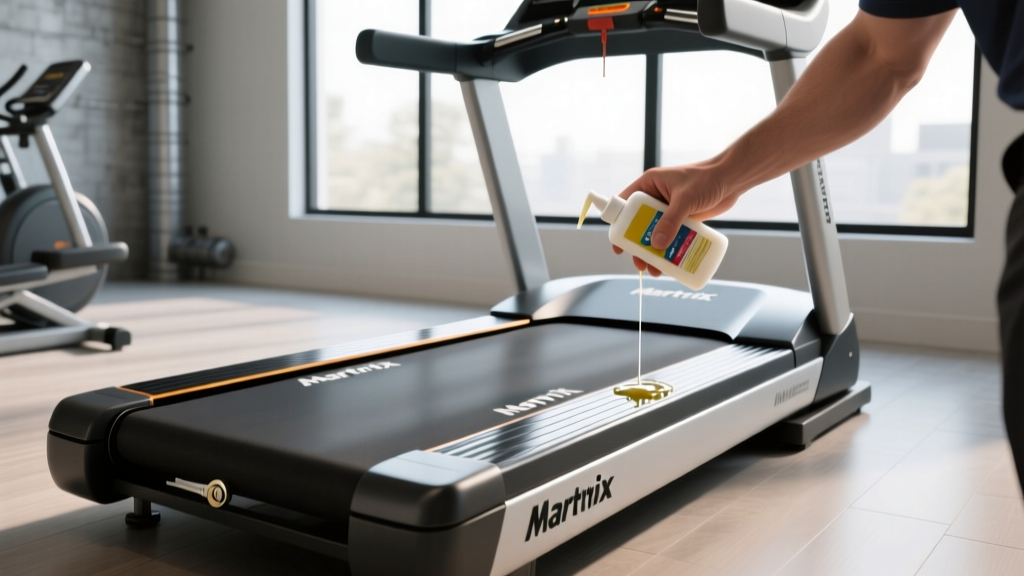
Matrix Treadmill How to Use and Maintain: Belt Lubrication Guide
Treadmill Heart Test Stress Test: A Beginner's Step-by-Step Guide

ProForm 425 Treadmill vs Stationary Bikes: 2026 Budget Analysis
Why Does Getting Off a Treadmill Feel Weird? Air vs Assault Bike Layouts
Folding Treadmill with Laptop Stand: 2026 Budget Review
