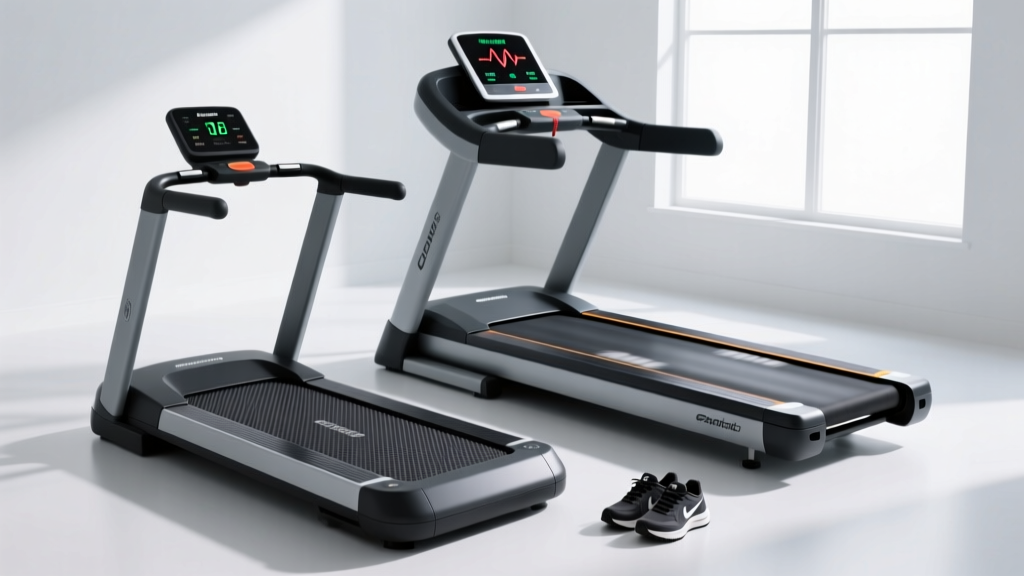
Walking Pad vs Treadmill: Fixing Treadmill Running Pace Mistakes
Discover the truth about walking pad vs treadmill performance. Learn to fix treadmill running pace mistakes, prevent motor burnout, and choose the right gear.

The Core Mistake: Misunderstanding Pace Thresholds
The work-from-home fitness boom popularized under-desk walking pads, but as users transition from casual strolls to serious cardio, a critical mechanical clash occurs. Many attempt to maintain their standard outdoor treadmill running pace on hardware fundamentally not engineered for the biomechanical forces of running. According to the American Council on Exercise (ACE), a standard running stride at a 7:00/mile pace requires a belt length of at least 55 inches to accommodate the flight phase and foot strike without altering natural kinematics. Most walking pads cap out at 40 to 45 inches, forcing an unnatural, choppy stride that alters biomechanics and increases joint impact.
Beyond biomechanics, the electrical limitations are severe. Pushing a 1.25 CHP (Continuous Horsepower) DC motor—like the one found in the base WalkingPad models—to sustain a 6 MPH treadmill running pace under a 160-lb load causes amperage spikes from a nominal 4A to over 10A. This triggers thermal overload switches or, worse, fries the MOSFETs on the lower control board. Understanding these limitations is the first step in our walking pad treadmill comparison and review troubleshooting guide.
Walking Pad vs. Treadmill: 2026 Hardware Comparison
To understand where your equipment fails, we must compare the hardware specifications of popular 2026 models. The Consumer Reports Treadmill Buying Guide consistently emphasizes that continuous duty motors below 2.5 CHP are unsuitable for sustained running. Below is a direct comparison of leading walking pads and traditional treadmills to illustrate the mechanical gaps.
| Feature | UREVO Strol 2E (Pad) | KingSmith WalkingPad R2 (Pad) | Sole F63 (Treadmill) | Horizon 7.0 AT (Treadmill) |
|---|---|---|---|---|
| 2026 Retail Price | $299 | $499 | $1,199 | $999 |
| Motor Size (CHP) | 1.25 CHP | 1.25 CHP | 3.0 CHP | 3.0 CHP |
| Belt Dimensions | 44' x 17' | 47' x 17' | 60' x 20' | 58' x 20' |
| Max Speed | 7.6 MPH | 7.5 MPH | 12.0 MPH | 12.0 MPH |
| Max User Weight | 240 lbs | 265 lbs | 325 lbs | 350 lbs |
| Ideal Pace Zone | Walking / Light Jog | Walking / Light Jog | Sprint / Marathon | Interval / Tempo |
Deck Shock Absorption: The Hidden Pace Killer
When analyzing a walking pad treadmill comparison and review, most consumers fixate on motor size and belt length, entirely ignoring deck construction. The deck is where the kinetic energy of your treadmill running pace is absorbed. Full-sized treadmills like the Sole F63 utilize a multi-zone elastomer cushioning system. The strike zone (front) is firm for push-off efficiency, while the landing zone (rear) features softer durometer rubber to absorb up to 40% more impact than asphalt.
Conversely, walking pads use a rigid, low-profile MDF or thin steel deck sitting mere millimeters from the floor. When you attempt a 7:00/mile treadmill running pace on a rigid walking pad, the ground reaction forces (GRF) travel directly up your tibia to your knees and hips. Over a 30-minute session, this micro-trauma accumulates, leading to shin splints and patellar tendonitis. If your primary goal is sustained running, the lack of deck suspension on a walking pad is a non-negotiable dealbreaker.
Troubleshooting Guide: Fixing Pace-Induced Equipment Failures
1. Belt Hesitation and Slipping at High Speeds
The Mistake: Users pushing a walking pad to its absolute maximum speed experience sudden belt hesitation, causing a dangerous stuttering effect mid-stride.
The Fix: This is rarely a motor issue; it is a friction and tension failure. High-speed foot strikes generate immense downward force, breaking the static friction between the belt and the front roller.
- Locate the rear roller adjustment bolts on the left and right back caps.
- Using a 3/16-inch Allen wrench, turn both bolts clockwise by exactly one quarter-turn.
- Apply 15ml of 100% silicone treadmill lubricant directly to the deck under the belt.
- Run the machine at 3 MPH for 5 minutes to distribute the lubricant, then test at your target pace.
2. Motor Shroud Overheating and Thermal Shutoffs
The Mistake: Treating a walking pad like a commercial gym treadmill by running 45-minute intervals at a high treadmill running pace without cooldowns.
The Fix: Walking pads utilize compact, low-profile motor shrouds with minimal airflow. You must respect the 20% duty cycle limit of these machines. For every 15 minutes of running, allow a 5-minute idle cooldown. Additionally, use a vacuum with a brush attachment to clear dust from the motor compartment's ventilation grilles every 30 days. Accumulated dust acts as an insulator, trapping heat around the DC motor windings and triggering premature thermal shutoffs.
3. Console Speed Surging (Calibration Drift)
The Mistake: Ignoring minor speed fluctuations until the console begins surging unpredictably between 5.0 and 6.5 MPH.
The Fix: This indicates a dirty optical speed sensor or a stretched drive belt. Unplug the machine, remove the motor shroud, and locate the small optical sensor near the flywheel. Wipe the sensor eye with isopropyl alcohol. If the drive belt feels loose when pinched (it should have less than 1/2 inch of deflection), loosen the motor mount bolts, slide the motor forward to increase tension, and retighten.
Expert Warning: Never use WD-40 or petroleum-based lubricants on your treadmill belt. These degrade the PVC backing and will permanently ruin the deck, requiring a $150+ replacement.Pace Matching Framework: Which Machine Fits Your Stride?
Choosing the right machine requires honest self-assessment of your target treadmill running pace. Use this framework to match your biomechanical needs with the correct hardware category.
- Zone 1: The Under-Desk Walker (14:00 - 18:00/mile): Target speed 2.0 - 3.5 MPH. A standard 1.0 CHP walking pad (e.g., Xiaomi WalkingPad C2, ~$249) is perfectly adequate. The 40-inch belt is sufficient for your shortened walking stride.
- Zone 2: The Hybrid Jogger (9:00 - 12:00/mile): Target speed 5.0 - 6.5 MPH. You need a 'hybrid' folding pad with a reinforced frame and handrail, such as the UREVO Strol 2E (~$299) or the KingSmith WalkingPad R2 (~$499). Ensure the belt is at least 44 inches long to prevent heel-strike clipping.
- Zone 3: The Serious Runner (Sub-8:00/mile): Target speed 7.5+ MPH. Walking pads are entirely unsafe and mechanically incapable of supporting this treadmill running pace. You must invest in a full-sized treadmill with a 3.0 CHP motor and a 60-inch belt, like the Sole F63 (~$1,199) or Horizon 7.0 AT (~$999).
Frequently Asked Questions
Can I upgrade the motor on my walking pad to run faster?
No. Walking pad control boards (PWM controllers) are hard-coded to the specific voltage and amperage limits of the factory motor. Installing a larger motor will immediately blow the board's capacitors, void your warranty, and create a severe fire hazard.
Why does my treadmill running pace feel harder on a walking pad than outdoors?
Shorter belts force a higher cadence and shorter stride length to avoid stepping on the front motor housing. This altered biomechanics increases the metabolic cost of running, making a 9:00/mile pace feel closer to an 8:00/mile effort. Furthermore, walking pads lack the shock-absorption elastomers found in full-sized treadmill decks, leading to faster muscle fatigue.
How often should I recalibrate the speed sensor?
For walking pads used daily at maximum speeds, check the optical sensor and drive belt tension every 6 months. For full-sized treadmills used for standard running, an annual calibration check is sufficient unless you notice visible surging or console error codes (like E1 or E2).
More gear to consider
All reviews
Treadmill Frame Showdown: Curved Manual vs Motorized Models

Under Desk Treadmills: Value & Treadmill Workout Programs
Under Desk Treadmills 2026: Adapting a Popular Treadmill Workout
Prevent Treadmill Burns on Skin: Compact Portable Cardio Maintenance

Small Space Folding Treadmills 2026: The Ideal Treadmill Dimension
