Curved Manual vs Motorized: How the Cadence 450 Treadmill Compares
Compare curved manual and motorized treadmills. See how the budget-friendly Cadence 450 treadmill stacks up in our in-depth 2026 buying guide.

The Great Treadmill Divide: Curved Manual vs. Motorized Decks
When outfitting a home gym in 2026, the treadmill market presents a stark dichotomy. On one end, you have the high-intensity, self-powered curved manual treadmills that dominate CrossFit boxes and elite athletic facilities. On the other, traditional motorized treadmills offer automated inclines, digital integration, and joint-friendly cushioning. But where do entry-level, budget-friendly motorized models—specifically the Cadence 450 treadmill—fit into this ecosystem?
This in-depth buying guide breaks down the biomechanics, engineering, and real-world failure modes of curved manual decks versus premium motorized machines, while providing a rigorous stress-test analysis of the Cadence 450 to help you determine which deck actually belongs in your home.
Biomechanics of the Curved Manual Treadmill
Curved manual treadmills, such as the AssaultRunner Elite ($3,499) or the TrueForm Runner ($5,995), feature a concave running surface made of individual rubber slats. Because there is no motor, the user must propel the belt by striking the front of the curve and pulling it backward.
The 30% Caloric Premium
According to research published in the Journal of Strength and Conditioning Research, running on a curved manual treadmill increases caloric expenditure by up to 30% compared to a standard motorized treadmill at the same speed. This is due to the increased activation of the posterior chain (hamstrings and glutes) required to pull the belt, alongside the lack of motorized momentum assisting your stride.
Expert Insight: The concave shape naturally encourages a forefoot or midfoot strike. Heel strikers often find curved treadmills uncomfortable initially, as the geometry forces a shorter, higher-cadence stride that reduces braking forces on the knee joint.Edge Cases and Failure Modes
While curved treadmills boast zero electrical components to fail, they are not maintenance-free. The most common failure mode is slat belt stretching. Over 2 to 3 years of heavy use, the Kevlar-reinforced rubber slats can lose tension, causing the belt to slip under heavy sprinting loads. Replacing a curved slat belt typically costs between $400 and $600, and requires significant mechanical labor to recalibrate the side tensioners.
Premium Motorized Treadmills: Tech, Cushioning, and Incline
Motorized treadmills in the $1,000 to $3,000 range (like the Sole F80 or NordicTrack Commercial 1750) rely on a Continuous Duty Horsepower (CHP) motor to drive a flat, continuous loop belt.
Understanding CHP vs. Peak HP
The most critical specification in motorized treadmill buying is understanding motor ratings. Premium models advertise Continuous Horsepower (CHP), which measures the motor's ability to sustain power output under a continuous load without overheating. A 3.0 CHP motor can comfortably support a 250 lb runner at 8 mph for an hour.
Furthermore, premium motorized decks feature multi-zone elastomer cushioning. The American Council on Exercise (ACE) notes that high-quality deck cushioning can reduce impact forces on the tibia and femur by up to 30% compared to running on asphalt, making motorized treadmills the superior choice for runners recovering from joint injuries or those logging high weekly mileage.
Where the Cadence 450 Treadmill Fits in the Spectrum
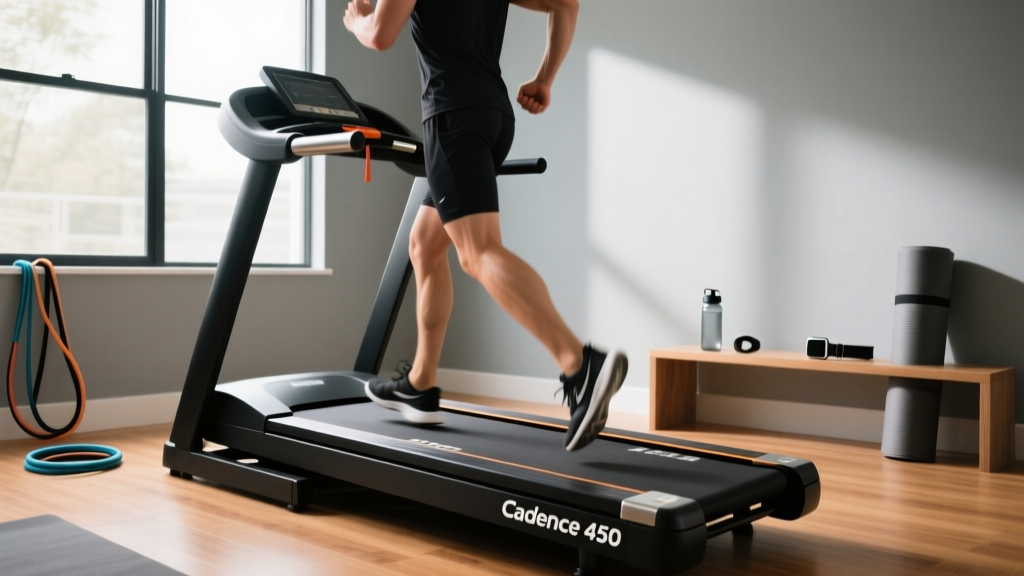
The Cadence 450 treadmill represents the ultra-budget, entry-level motorized segment, typically retailing between $299 and $399. It is vital to understand its engineering limitations to use it effectively without destroying the machine.
Motor and Deck Specifications
- Motor: 1.5 Peak HP (Note: This translates to roughly 0.75 CHP. It is strictly a walking and light-jogging motor).
- Running Surface: 40 inches long by 14 inches wide. This is significantly narrower and shorter than the industry-standard 20" x 55" running surface.
- Weight Capacity: 220 lbs.
- Top Speed: 5.0 mph.
The Cadence 450 utilizes a 1.5 Peak HP motor. If a user weighing over 180 lbs attempts to jog at 5.0 mph for more than 20 minutes, the motor will draw excessive amperage. This will inevitably trip the internal thermal overload breaker, shutting the machine down mid-stride to prevent a fire hazard. The Cadence 450 is engineered exclusively for brisk walking (2.0 to 3.5 mph) and should not be used for sustained running.
Head-to-Head Comparison Matrix
Use the table below to compare the high-end curved manual, the premium flat motorized, and the budget Cadence 450 treadmill to find the right fit for your specific training goals and budget.
| Feature | Curved Manual (e.g., AssaultRunner) | Premium Motorized (e.g., Sole F80) | Budget Motorized (Cadence 450) |
|---|---|---|---|
| Price Range | $2,999 - $5,999 | $999 - $1,999 | $299 - $399 |
| Power Source | 100% Human-Powered | 3.0 to 4.0 CHP Motor | 1.5 Peak HP (~0.75 CHP) |
| Max Speed | Unlimited (User dependent) | 12.0 mph | 5.0 mph |
| Incline Capability | Fixed Curve (Simulates ~8% grade) | 0% to 15% Automated | Fixed Flat (0%) |
| Caloric Burn | +30% higher than flat running | Standard baseline | Lower (Walking only) |
| Primary Use Case | HIIT, Sprinting, Athletic Conditioning | Distance Running, Joint Rehab, Tech | Daily Walking, Small Spaces, Budget |
Decision Framework: Which Deck Should You Buy?
Choosing between these three distinct categories requires an honest assessment of your biomechanics, budget, and training intent. Use the following frameworks to make your final decision.
Choose a Curved Manual Treadmill If:
- You train for power and speed: The ability to instantly transition from a walk to an all-out sprint without waiting for a motor to spool up makes curved decks unmatched for High-Intensity Interval Training (HIIT).
- You want zero electrical dependency: If your home gym is in a garage, shed, or off-grid location where running heavy 15-amp dedicated circuits is impossible, a manual curve requires only your sweat.
- You are a midfoot/forefoot striker: Your natural running mechanics will seamlessly translate to the slatted curve.
Choose a Premium Motorized Treadmill If:
- You log high mileage: If you are training for a marathon and need to run 5 to 10 miles at a steady state, the automated pacing and joint-saving elastomer cushions of a premium motorized deck are non-negotiable.
- You require incline variability: Simulating hill climbs via automated 15% inclines is vital for endurance athletes, a feature completely absent in manual models.
- You need digital integration: Bluetooth FTMS connectivity to apps like Zwift or Peloton Digital requires the automated speed control only found in motorized units.
Choose the Cadence 450 Treadmill If:
- Your goal is strictly daily walking: If you want a dedicated under-desk or living room walking pad to hit 10,000 steps a day while watching television, the 5.0 mph top speed is perfectly adequate.
- You have strict spatial and financial limits: The Cadence 450 folds down to a remarkably small footprint and costs a fraction of a premium deck, making it ideal for apartment dwellers.
- You weigh under 180 lbs: Staying well below the 220 lb max capacity ensures the 0.75 CHP motor operates within its safe thermal limits, vastly extending the lifespan of the drive belt and control board.
Maintenance Protocols and Longevity
Regardless of the machine you choose, neglecting maintenance is the fastest route to a bricked treadmill. Here are the specific maintenance protocols for each category, as recommended by Consumer Reports treadmill durability guidelines.
- Curved Manual Slat Belts: Do not use liquid silicone lubricants on curved slat belts; it will cause the rubber to degrade and slip. Instead, use a dry PTFE (Teflon) spray on the side guide rails every 6 months to reduce friction on the bearing wheels.
- Premium Motorized Decks: Apply 100% pure silicone treadmill lubricant under the belt every 3 months or every 150 miles. To test if your belt needs lube, slide your hand under the center of the belt; if it feels completely dry rather than slightly slick, it is time to lubricate. Failure to do so will cause the motor to draw excess amps and burn out the lower control board.
- Cadence 450 Motor Housing: Budget treadmills like the Cadence 450 often lack advanced internal cooling fans. Every month, use a vacuum with a brush attachment to clear dust, pet hair, and lint from the motor hood at the front of the deck. Clogged air intakes are the number one cause of thermal breaker trips in entry-level models.
Final Verdict
The treadmill you buy must align with your physiological output and your wallet. The curved manual treadmill remains the undisputed king of high-intensity, athletic conditioning, demanding a premium price but delivering unmatched biomechanical engagement. Premium motorized treadmills offer the best blend of joint protection, tech integration, and steady-state endurance training.
Meanwhile, the Cadence 450 treadmill carves out a highly specific, utilitarian niche. It is not a runner's machine, nor is it a HIIT tool. It is a dedicated, budget-conscious walking station. If you respect its 5.0 mph speed limit and keep the motor housing free of dust, the Cadence 450 provides exceptional value for daily step-counting and low-impact cardiovascular health in small spaces.
More gear to consider
All reviews
Budget Folding Treadmills: Treadmill Stress Test Target Heart Rate

Elliptical vs Treadmill: NordicTrack Commercial 2450 Treadmill Manual
Stair Climber Setup: Elliptical vs Treadmill for Weight Loss

Beyond Images of a Treadmill: Curved vs Motorized Setup

Beyond the Muscles: What Does Treadmill Work Out Cost in Belt Care?