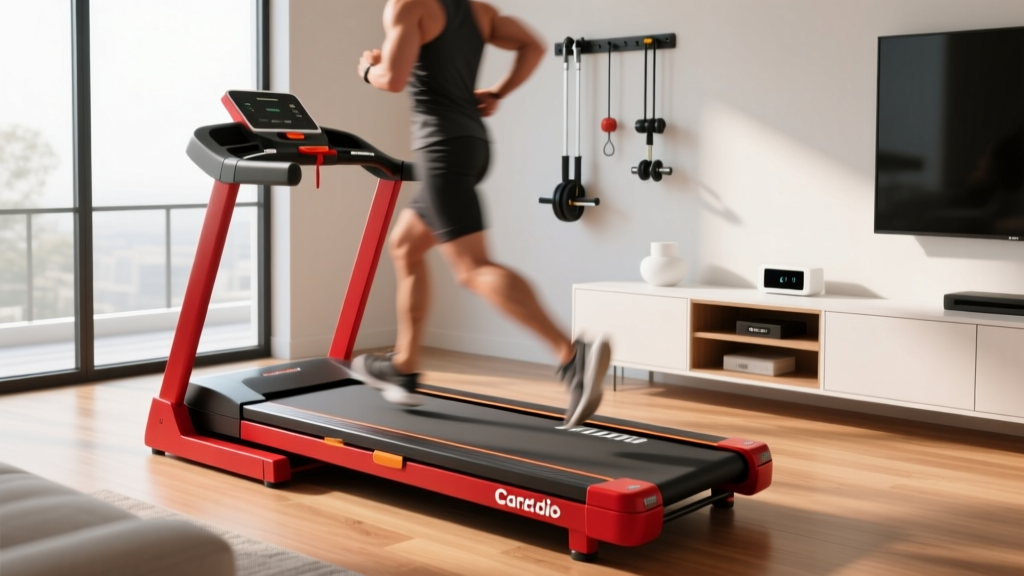
Elliptical Cross Trainer vs Treadmill vs Stair Climber: Home Guide
We break down the elliptical cross trainer vs treadmill debate and add the stair climber to find the best home cardio machine for your joints and goals.

The 2026 Cardio Triad: Redefining the Home Gym Standard
For decades, the fitness community has been locked in a binary debate: the elliptical cross trainer vs treadmill. However, as home gym real estate becomes more premium and biomechanical science advances, a third contender has forcefully entered the conversation. The modern stair climber—specifically hybrid stepper-climbers and compact step-mills—has disrupted the traditional cardio hierarchy. In this comprehensive 2026 guide, we move beyond generic calorie counters to analyze the mechanical realities, joint-loading vectors, and long-term ownership costs of these three cardio titans.
Quick Navigation: This guide evaluates the Sole F85 Treadmill, the NordicTrack Commercial 14.9 Elliptical, and the Bowflex Max Trainer M9 Stair Climber to provide concrete, data-driven purchasing advice for home users.Biomechanics and Caloric Expenditure: The Raw Data
When evaluating cardio equipment, marketing materials often inflate caloric expenditure. According to Harvard Health Publishing, actual energy expenditure is heavily dependent on user weight, machine resistance, and biomechanical efficiency. Below is a comparative matrix based on a 185-pound user performing 30 minutes of vigorous effort.
| Machine Type | Calories Burned (30 min) | Joint Impact Force | Primary Muscle Activation | Avg. Footprint (L x W) |
|---|---|---|---|---|
| Treadmill (Sole F85) | 350 - 450 kcal | 2.0x - 3.0x Body Weight | Calves, Hamstrings, Core | 82" x 35" |
| Elliptical (NordicTrack 14.9) | 300 - 400 kcal | < 0.5x Body Weight | Quads, Glutes, Lats/Biceps | 76" x 35" |
| Stair Climber (Bowflex Max M9) | 400 - 500+ kcal | 1.2x - 1.5x Body Weight | Gluteus Maximus, Quads | 49" x 30" |
The Classic Showdown: Elliptical Cross Trainer vs Treadmill
The decision between an elliptical and a treadmill usually hinges on two factors: joint preservation and sport-specificity. If you are training for a marathon, the treadmill is non-negotiable. If you are managing osteoarthritis, the elliptical is your safest bet.
Joint Loading and Osteoarthritis Prevention
The Mayo Clinic consistently recommends low-impact aerobic exercise for individuals with joint degradation. When your foot strikes a treadmill belt—even one with advanced cushioning like the Sole F85's Cushion Flex Whisper Deck—the ground reaction force (GRF) travels directly up the kinetic chain, impacting the meniscus and lumbar spine. Conversely, the elliptical cross trainer eliminates the strike phase entirely. The NordicTrack Commercial 14.9 utilizes a 10kg front-drive flywheel and a 20-inch adjustable stride, keeping the foot planted and reducing GRF to near-zero. For users over 50 or those recovering from lower-extremity surgeries, the elliptical is the undisputed champion of longevity.
Real-World Pricing and Spatial Realities
In 2026, premium home treadmills require a significant financial and spatial commitment. The Sole F85 retails around $2,299, requires a dedicated 20-amp electrical circuit to handle its 4.0 HP continuous-duty motor, and demands a ceiling clearance of at least 8 feet to accommodate the user's height plus the 8-inch deck step-up. Ellipticals like the NordicTrack 14.9 ($1,799) operate on standard 15-amp circuits, draw less peak amperage, and generally produce fewer low-frequency vibrations, making them vastly superior for second-floor home gyms or shared-wall townhouses.
The Vertical Disruptor: Stair Climber Machine for Home Use
While the elliptical cross trainer vs treadmill debate focuses on horizontal movement, the stair climber exploits vertical force vectors. Historically, true step-mills (like the StairMaster Gauntlet) were too massive and expensive for residential use. Today, hybrid stair climbers like the Bowflex Max Trainer M9 ($1,999) bridge the gap, combining the upper-body engagement of an elliptical with the vertical stepping motion of a stair climber.
"The stair climber forces the user to overcome gravity with every single repetition, resulting in a significantly higher heart rate response and greater gluteal hypertrophy compared to level-ground locomotion. It is the most time-efficient cardio machine for metabolic conditioning."
The Glute Activation Advantage
Electromyography (EMG) studies consistently show that stair climbing elicits up to 40% greater activation in the gluteus maximus and hamstrings compared to walking on a treadmill at a moderate incline. For home users prioritizing posterior chain development alongside cardiovascular health, the stair climber offers a dual-purpose solution that negates the need for separate weighted hip-thrust machines in smaller home gyms.
Mechanical Failure Modes & Long-Term Maintenance
Consumer reviews rarely discuss what happens in year four of ownership. As fitness equipment experts, we evaluate machines based on their most common mechanical failure modes. Understanding these will save you hundreds in out-of-warranty repair costs.
- Treadmill Deck Delamination: The most common catastrophic failure in home treadmills is the warping and delamination of the Medium Density Fiberboard (MDF) deck. If a user exceeds 250 lbs and fails to lubricate the silicone belt every 150 miles, friction generates heat, melting the phenolic resin coating. Prevention: Buy machines with reversible wax-phenolic decks and strictly adhere to lubrication schedules.
- Elliptical Rail Pitting: On rear-drive ellipticals, the polyurethane wheels tracking along aluminum rails can develop flat spots or cause 'pitting' if dust and pet hair accumulate. Over time, this creates a grinding sensation. Prevention: Wipe rails with isopropyl alcohol weekly; never use petroleum-based lubricants on elliptical tracks.
- Stair Climber Alternator & Chain Slip: Hybrid climbers use complex internal alternators to generate magnetic resistance. The drive chains connecting the pedals to the alternator can stretch under high-torque, low-cadence stepping. Prevention: Maintain a cadence above 60 SPM to reduce torque load on the internal drivetrain, and schedule professional chain-tensioning every 18 months.
The Final Verdict: Matching Machine to Biomechanical Need
There is no universal 'best' machine; there is only the right tool for your specific physiological profile and spatial constraints.
- Choose the Treadmill (Sole F85) if you are an active runner training for outdoor events, require sport-specific gait mechanics, and have a dedicated, ground-floor room with ample clearance and robust electrical infrastructure.
- Choose the Elliptical (NordicTrack 14.9) if joint preservation is your primary medical concern, you want to engage both the upper and lower body simultaneously, and you need a quieter machine for multi-story living environments.
- Choose the Stair Climber (Bowflex Max M9) if you have a severely restricted footprint (under 15 square feet), prioritize time-efficient metabolic conditioning (HIIT), and want to maximize glute and quad hypertrophy without lifting heavy free weights.
By looking past the traditional elliptical cross trainer vs treadmill binary and objectively evaluating the spatial and biomechanical realities of the modern stair climber, you can make a highly informed, long-term investment in your 2026 home gym.
More gear to consider
All reviews
Curved vs Motorized: ProForm 480 Pi Treadmill Guide
Exerpeutic Treadmill Manual Guide & Under Desk Office Review

Is It Okay to Run Barefoot on a Treadmill? Curved vs Motorized

Top Compact Portable Picks for a Virtual Treadmill in 2026

High Intensity Treadmill Workout for Beginners: Motor HP Fixes