2026 Market Analysis: Bike Types vs NordicTrack X9i Treadmill
Our 2026 market analysis compares upright, recumbent, and spin bikes against the NordicTrack X9i treadmill to help you choose the best home cardio.

The 2026 Home Cardio Paradigm Shift
As we navigate the 2026 fitness equipment landscape, consumer purchasing behavior has shifted dramatically from blanket 'smart-gym' subscriptions toward biomechanical specificity and spatial efficiency. According to recent data from Grand View Research, the home fitness equipment market continues to expand, but buyers are increasingly scrutinizing the return on investment (ROI) per square foot. This has sparked a fascinating market debate: should consumers invest in specialized stationary bike types (upright, recumbent, and spin) or commit to flagship incline trainers like the NordicTrack X9i treadmill?
This trend report deconstructs the current market positioning of the stationary bike triad against the heavy-duty treadmill sector, providing a data-driven framework for home gym architects and fitness enthusiasts.
Market Insight: The 'Subscription Fatigue' Factor
In 2026, hardware durability and offline functionality are outperforming screen-centric models. Buyers are prioritizing machines with standard Bluetooth FTMS (Fitness Machine Service) protocols that allow third-party app integration (like Zwift or Kinomap) without mandatory proprietary monthly fees.
Deconstructing the Stationary Bike Triad
The stationary bike market is not a monolith; it is segmented into three distinct biomechanical categories, each serving a unique physiological demographic and spatial requirement.
1. Spin Bikes: The High-Intensity Contenders
Spin bikes (indoor cycles) dominate the high-intensity interval training (HIIT) segment. The market leader in biomechanical accuracy remains the Keiser M3i (MSRP $2,195). Unlike friction-based budget models, premium spin bikes utilize rear-mounted magnetic resistance and aluminum flywheels.
- Q-Factor: Premium models maintain a Q-factor (distance between pedals) of 160mm-180mm, mimicking outdoor road bikes and preventing lateral knee strain.
- Footprint: Average 45' x 26' (8.1 sq ft).
- Target Demographic: Athletes, HIIT practitioners, and users requiring zero-impact, high-cadence (100+ RPM) cardiovascular conditioning.
2. Upright Bikes: The Traditionalists
Upright bikes offer a middle ground between spin bikes and recumbents. Models like the Schwinn 170 (MSRP $699) feature a smaller footprint and a traditional saddle, but with a slightly more relaxed geometry. They utilize heavier front flywheels (often 15-20 lbs) and belt-drive systems for quiet operation in multi-family dwellings.
- Biomechanics: Engages the core and upper body more than recumbents, but lacks the aggressive aero-posture of a spin bike.
- Footprint: Average 42' x 24' (7.0 sq ft).
- Target Demographic: General fitness users seeking moderate-intensity steady-state (MISS) cardio without the saddle discomfort of aggressive spin geometry.
3. Recumbent Bikes: The Rehabilitation & Comfort Standard
Recumbent bikes, such as the Sole LCR900 (MSRP $1,399), feature a step-through design and a bucket seat with lumbar support. This closed-chain kinetic movement eliminates axial loading on the spine.
According to the CDC Physical Activity Guidelines, adults need at least 150 minutes of moderate-intensity aerobic activity weekly. Recumbent bikes provide the highest compliance rates for aging populations and those with lumbar radiculopathy due to their zero-impact, supported posture.
- Drive System: Typically features a heavy 30-40 lb flywheel positioned at the front, driven by a poly-v belt.
- Footprint: Average 63' x 27' (11.8 sq ft) — notably longer than uprights.
- Target Demographic: Seniors, physical therapy patients, and users with lower back or joint pathologies.
The Heavyweight Challenger: NordicTrack X9i Treadmill Market Position
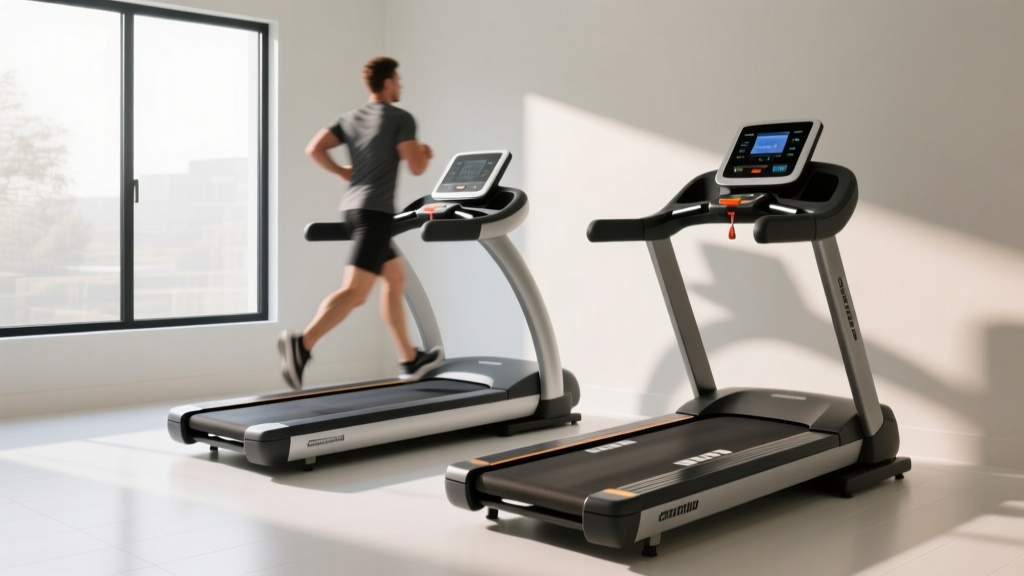
While the bike market fractures into specialized niches, the premium treadmill market consolidates around incline capabilities. The NordicTrack X9i (MSRP $1,799) represents the 'incline trainer' category, diverging from standard folding treadmills by offering a 0-15% incline grade and a robust 3.0 CHP Mach Z motor.
From a market analysis perspective, the X9i competes on caloric expenditure density. Walking at a 15% incline at 3.0 MPH elicits a metabolic equivalent (MET) response similar to running on a flat surface, but with significantly reduced ground reaction forces (GRF). However, the X9i demands a massive spatial commitment: its footprint is 76' x 30' (15.8 sq ft), and it requires an additional 36 inches of rear clearance for safe dismounting, plus vertical ceiling clearance to account for the 15% deck elevation.
Head-to-Head Market Comparison Matrix
To contextualize the 2026 buying landscape, we mapped the leading representatives of each category against critical home-gym metrics.
| Equipment Type | Flagship Model (2026) | MSRP | Spatial Volume | Impact Force (GRF) |
|---|---|---|---|---|
| Spin Bike | Keiser M3i | $2,195 | 8.1 sq ft | 0x Bodyweight |
| Upright Bike | Schwinn 170 | $699 | 7.0 sq ft | 0x Bodyweight |
| Recumbent Bike | Sole LCR900 | $1,399 | 11.8 sq ft | 0x Bodyweight |
| Incline Trainer | NordicTrack X9i Treadmill | $1,799 | 15.8+ sq ft | 1.5x - 3x Bodyweight |
Consumer Buying Framework: Space, Cost, and Biomechanics
When deciding between the stationary bike spectrum and the NordicTrack X9i treadmill, 2026 consumers should apply the following decision matrix based on physiological needs and architectural constraints.
1. The Joint-Health & Rehabilitation Route
If a user presents with plantar fasciitis, meniscal tears, or lumbar herniations, treadmills—even with advanced cushioning decks like NordicTrack's Runners Flex—are contraindicated. The American Heart Association emphasizes consistency over intensity for cardiovascular health; a recumbent bike guarantees daily compliance by removing the pain barrier associated with weight-bearing impact.
2. The Caloric Density & Space-Restricted Route
For apartment dwellers or users with sub-100 square foot dedicated gym spaces, the NordicTrack X9i treadmill is mathematically unfeasible. A premium spin bike offers superior caloric burn per minute (up to 12-15 kcal/min during all-out sprints) compared to steady-state incline walking (6-8 kcal/min), while occupying half the floor space and generating zero acoustic vibration transfer to downstairs neighbors.
3. The Bone-Density & Athletic Conditioning Route
Conversely, if the primary goal includes maintaining bone mineral density (BMD) through osteogenic loading, or training for alpine hiking and marathon events, the bike triad falls short. The NordicTrack X9i's 15% incline capability specifically targets the posterior chain (glutes, hamstrings, and calves) in a way that seated cycling cannot replicate, making it the superior choice for functional, weight-bearing athletic prep.
Final Verdict for 2026 Buyers
The 2026 cardio market is no longer about buying the 'best' machine in a vacuum; it is about biomechanical alignment and spatial economics. The stationary bike types—upright, recumbent, and spin—offer unparalleled joint preservation, acoustic discretion, and spatial efficiency. However, for users with the square footage to accommodate its 76-inch deck and the physiological requirement for weighted incline training, the NordicTrack X9i treadmill remains a dominant, high-ROI investment in functional longevity.
More gear to consider
All reviews
How Many Miles is 10k Steps on Treadmill? Curved vs Motorized Guide

Stair Climber Setup Guide & Benefits of Incline Treadmill Workout
Walking Pad vs Treadmill: Setup & Free Treadmill Removal Near Me

Cardio Noise Setup: ProForm Treadmill Maintenance Lubrication
Curved U Treadmill vs Motorized: Mistakes & Fixes