Bike Types vs Treadmill Workout with Dumbbells: Space Guide
Compare upright, recumbent, and spin bike footprints against the space needed for a treadmill workout with dumbbells to optimize your home gym layout.

The Home Gym Spatial Dilemma: Footprint vs. Function
Designing a functional home gym in 2026 requires a ruthless approach to spatial geometry. With the average dedicated home fitness space shrinking to roughly 80 to 120 square feet, enthusiasts are forced to make critical compromises between equipment versatility and floor plan reality. One of the most common layout debates centers on choosing between stationary bike types (upright, recumbent, and spin) versus accommodating the dynamic clearance required for a treadmill workout with dumbbells. While CDC physical activity recommendations emphasize mixing aerobic and muscle-strengthening activities, executing both in a single compact room demands precise layout planning. This guide deconstructs the exact dimensions, safety buffers, and spatial ROI of these cardio modalities to help you engineer the ultimate space-optimized home gym.
Deconstructing Stationary Bike Types: Upright, Recumbent, and Spin
Not all stationary bikes are created equal, especially when measuring their volumetric footprint. According to Consumer Reports fitness equipment testing, the physical footprint of a bike dictates not just where it sits, but how the surrounding room flows. Let us break down the three primary stationary bike types and their spatial realities.
1. Upright Bikes: The Vertical Compromise
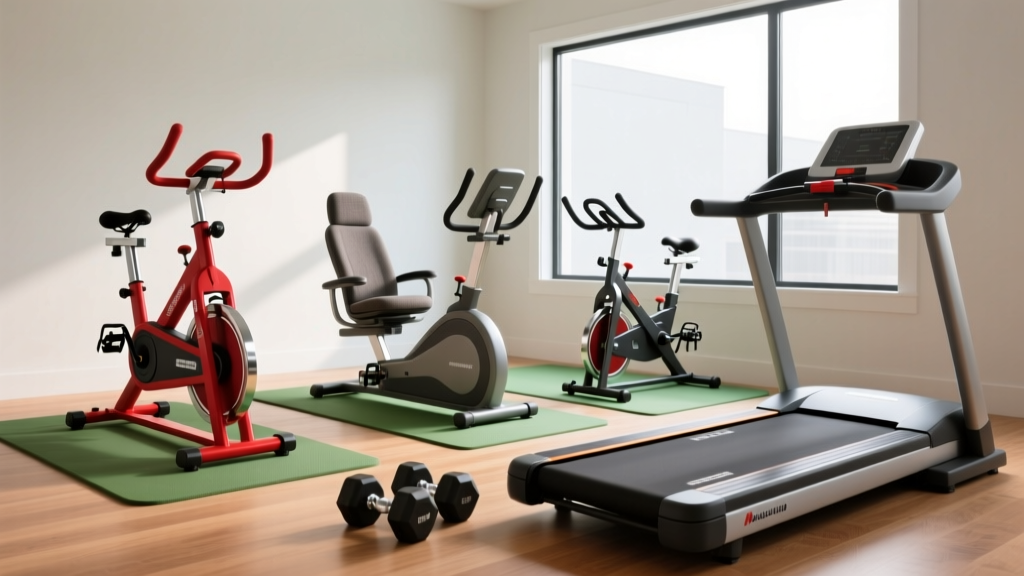
Upright bikes mimic traditional outdoor cycling geometry, positioning the user directly over the pedals. Models like the Schwinn 170 Upright Bike (priced around $699 in 2026) boast a static footprint of approximately 42 inches long by 21 inches wide. Because the user remains relatively stationary and vertical, the required safety perimeter is minimal—usually just 12 inches on all sides. Upright bikes are ideal for tucking into tight corners or placing directly in front of a window where lateral swing space is non-existent.
2. Recumbent Bikes: The Horizontal Space Hog
Recumbent bikes feature a bucket seat with a backrest and forward-placed pedals, prioritizing lumbar support and joint offloading. The Nautilus R618 (approximately $1,499) measures a sprawling 65 inches long by 28 inches wide. While excellent for rehabilitation or low-impact cardio, recumbent bikes dominate linear floor space. They cannot be easily folded or stood on end, making them a poor choice for multi-purpose rooms or narrow galley-style home gyms.
3. Spin / Indoor Cycling Bikes: The Compact Powerhouse
Spin bikes, such as the Keiser M3i (roughly $2,295), are engineered for high-intensity interval training (HIIT) and out-of-saddle climbing. The footprint is roughly 49 inches by 26 inches. However, spatial optimization for a spin bike must account for the rider's movement. When performing standing climbs or lateral handlebar sways, the user requires an additional 18 inches of lateral clearance to avoid striking walls or mirrors.
The Spatial Math of a Treadmill Workout with Dumbbells
Many home gym owners purchase a treadmill assuming it only requires the machine's physical footprint. A standard folding model like the NordicTrack T Series 6.5 Si measures 70 inches long by 29 inches wide. However, integrating a treadmill workout with dumbbells fundamentally alters the spatial mathematics of your room.
⚠️ ASTM Safety & Clearance Warning: According to FDA treadmill safety guidelines and ASTM F2278 standards, treadmills require a minimum of 20 inches of clearance on each side and 78 inches of unobstructed space directly behind the machine to prevent severe injury in the event of a fall.When you add dumbbells to the equation—whether you are performing lateral raises while walking at 2.5 mph, executing farmer's carries, or stepping off the belt for goblet squats—the spatial requirements expand dramatically. You must calculate a Dynamic Movement Zone.
- Lateral Swing Radius: Holding 10 lb to 25 lb hex dumbbells and performing shoulder presses or lateral raises requires a minimum of 36 inches of clearance on both the left and right sides of the treadmill belt.
- Dismount Zone: A safe dismount area for dropping dumbbells or transitioning to floor work requires a 4-foot by 4-foot reinforced rubber matting zone adjacent to the treadmill.
- Vertical Clearance: Overhead dumbbell presses on an incline treadmill (which adds 6 to 12 inches of elevation) demand a ceiling height of at least 9 feet to avoid drywall impacts.
Comparative Footprint Matrix: Bikes vs. Treadmill Zones
To visualize the spatial ROI, we have mapped the static footprint against the total dynamic zone required for safe operation in a 2026 home environment.
| Equipment Configuration | Static Footprint | Required Safety Buffer | Total Dynamic Zone | Layout Flexibility |
|---|---|---|---|---|
| Upright Bike (e.g., Schwinn 170) | 6.1 sq ft | 12" perimeter | 10.5 sq ft | High (Corner-friendly) |
| Recumbent Bike (e.g., Nautilus R618) | 12.6 sq ft | 18" perimeter | 18.2 sq ft | Low (Linear anchor) |
| Spin Bike (e.g., Keiser M3i) | 8.8 sq ft | 24" lateral | 15.0 sq ft | Medium (Wall-adjacent) |
| Treadmill + Dumbbell Zone | 14.0 sq ft | 36" lateral + 78" rear | 52.0+ sq ft | Very Low (Room-dominant) |
Strategic Layout Frameworks for Compact Rooms
If your goal is to incorporate both a stationary bike and a treadmill workout with dumbbells into a single spare bedroom or basement alcove, you must adopt a strategic zoning framework. Here are three expert-approved layout designs for 2026 home gyms:
Framework 1: The 'Active Corner & Folding Anchor' (For 10x12 Rooms)
Place a folding treadmill (like the ProForm City L6) flat against the longest unbroken wall, ensuring the 78-inch rear clearance aligns with the room's entryway or a hallway. Position an upright bike in the opposite corner. Store adjustable dumbbells (e.g., Bowflex SelectTech 552) on a low-profile rack directly beneath the treadmill's handrails when folded. This keeps the center of the room open for yoga or kettlebell flows.
Framework 2: The 'Mirror Illusion' Layout
When executing a treadmill workout with dumbbells, form-checking is critical to prevent shoulder impingement or lower back strain. Mount a large, shatterproof acrylic gym mirror on the wall directly facing the treadmill. This not only allows for safe movement tracking but creates an optical illusion that doubles the perceived depth of the room, mitigating the claustrophobia often associated with heavy cardio equipment in small spaces.
Framework 3: Vertical Storage Integration
"In modern spatial design, floor space is a premium, but wall space is often underutilized. Mounting dumbbell racks at a 45-degree angle on the wall adjacent to your spin bike transforms dead space into an accessible strength zone without encroaching on the bike's lateral sway radius." — FitGearPulse Spatial Analysis Team
Expert Verdict: Maximizing ROI per Square Foot
When evaluating stationary bike types against the spatial demands of a treadmill workout with dumbbells, the decision ultimately hinges on your primary fitness modality. If your programming relies heavily on combined cardio-strength circuits, the treadmill is non-negotiable, but you must dedicate a minimum 6x9 foot zone exclusively for safety and movement. Conversely, if your goal is pure cardiovascular conditioning with a secondary strength component, a high-quality spin bike paired with a set of adjustable dumbbells yields a vastly superior spatial ROI, occupying less than 30% of the square footage required by a treadmill setup. Measure your room, map your dynamic zones, and choose the equipment that serves your physiology without compromising your home's livability.
More gear to consider
All reviews
Air vs Assault Bike Space & How to Unfold a ProForm Treadmill Safely

Power Generating Treadmill Market vs Stationary Bike Types 2026

Stair Climber Home Guide & dogpacer lf 3.1 dogpacer treadmill

How Fast Is 3 Speed On A Treadmill? Air Bike Vs Assault Bike
Spirit XT485 Treadmill vs Sole F85: 2026 Heavy-Duty Comparison
