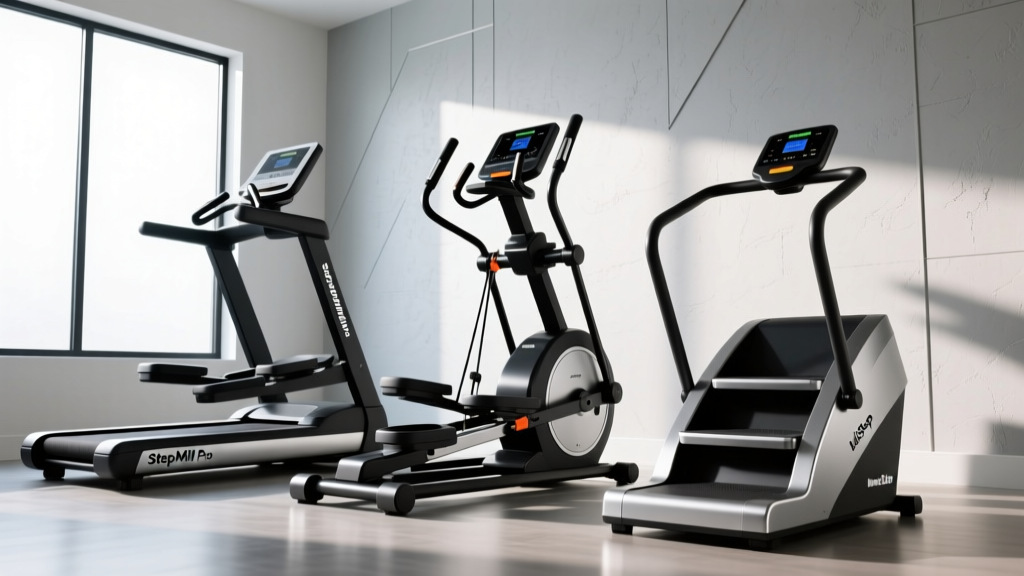
Beyond Treadmill Memes: Stair Climber Home Guide
Escape the boredom of treadmill memes. Our 2026 stair climber buying guide compares StepMills, hybrids, and mini-steppers with exact specs and prices.

The Hamster Wheel vs. The Vertical Climb
We have all seen the treadmill memes—the viral videos of gym-goers staring blankly at walls, the "hamster wheel" jokes, and the universal dread of the 60-minute steady-state slog. While internet culture mocks the monotony of the treadmill, fitness professionals and home-gym enthusiasts in 2026 are quietly pivoting to a more efficient, high-yield alternative: the stair climber.
If your current cardio routine feels like a punchline, transitioning to a stair climber machine for home use offers a biomechanically superior stimulus. Unlike the linear, low-impact glide of a treadmill, stair climbing forces continuous hip extension against gravity. According to research published in the National Center for Biotechnology Information (NCBI), stair ascent requires significantly higher activation of the gluteus maximus and vastus lateralis compared to level walking or jogging, yielding a higher caloric expenditure per minute.
The Meme Reality Check
"Running on a treadmill is just paying a monthly subscription to be a hamster." — A popular fitness meme. While funny, the real issue with treadmills isn't just boredom; it's the lack of posterior chain engagement. Stair climbers eliminate the "hamstring neglect" inherent in flat-surface cardio, turning a passive slog into an active muscle-building session.
The 3 Main Categories of Home Stair Climbers
Before dropping thousands of dollars, you must understand the mechanical differences between the three primary types of stair climbers on the market. Each serves a distinct user profile and spatial constraint.
1. The StepMill (Rotating Staircase)
This is the gold standard—the literal revolving staircase made famous by commercial gyms. It forces a natural, continuous stepping motion without the "cheat" of momentum.
- Pros: Highest caloric burn, truest biomechanical replication of real stairs, unmatched durability.
- Cons: Massive footprint, extreme weight (often 300+ lbs), and strict ceiling height requirements.
2. Elliptical/Climber Hybrids
Machines like the Bowflex Max Trainer series blend the low-impact footpath of an elliptical with the vertical resistance of a climber. They use a pedal-and-handlebar system to engage the upper body simultaneously.
- Pros: Compact footprint, low ceiling clearance needed, upper-body integration.
- Cons: Fixed stride path can feel restrictive; less pure glute isolation than a StepMill.
3. Mini-Steppers (Hydraulic Piston)
These compact, budget-friendly units use two independent footplates driven by hydraulic cylinders.
- Pros: Under $100, easily stored under a bed, zero power outlet required.
- Cons: Hydraulic cylinders overheat during sessions longer than 20 minutes; limited resistance ceiling.
2026 Stair Climber Comparison Matrix
To help you navigate the current market, we have benchmarked three top-tier models across different categories based on 2026 pricing, structural requirements, and warranty coverage.
| Model | Type | 2026 Retail Price | Footprint (L x W) | Min. Ceiling Height | Warranty |
|---|---|---|---|---|---|
| StairMaster Gauntlet | StepMill | $7,499 | 72" x 34" | User Height + 16" | 10 Yr Frame, 3 Yr Parts |
| Bowflex Max Trainer M9 | Hybrid | $2,299 | 49" x 30" | User Height + 15" | 3 Yr Frame & Parts |
| Sunny Health SF-S0978 | Mini-Stepper | $75 | 13" x 16" | N/A (Standard Room) | 1 Yr Frame |
Critical Installation Metrics: Don't Ignore Ceiling Height
The most common reason home gym owners return high-end StepMills is the "head-bump" factor. When you are at the top of the stepping cycle on a machine like the StairMaster Gauntlet, the lowest step is still elevated roughly 10 to 14 inches off the floor.
The "Head-Bump" Clearance Formula
Do not guess your ceiling requirements. Use this exact formula before purchasing a rotating staircase:
Minimum Ceiling Height = Your Height (in inches) + 16 inches (buffer for step elevation and arm reach) + 6 inches (safety margin).
For example, if you are 6'0" (72 inches), your minimum ceiling height must be 94 inches (7 feet, 10 inches). If you have standard 8-foot (96-inch) ceilings, you are safe. If you are outfitting a basement gym with dropped ceilings or HVAC ductwork, measure from the floor to the lowest hanging obstruction, not the drywall.
Common Failure Modes & Maintenance Realities
According to the Mayo Clinic, consistency is the primary driver of aerobic fitness. If your machine breaks down, your consistency drops to zero. Here are the real-world failure modes you must watch for based on machine type:
Hydraulic Cylinder Blowouts (Mini-Steppers)
Budget mini-steppers (like the Sunny Health models) rely on pneumatic or hydraulic gas cylinders. These are generally rated for a maximum user weight of 220–250 lbs. However, the dynamic force of stepping creates a multiplier effect. A 200 lb user stepping aggressively can exert over 300 lbs of peak force on a single cylinder. Edge Case: If you weigh over 190 lbs, expect to replace the hydraulic cylinders every 8 to 12 months. They are cheap to replace ($20 online), but it is a recurring maintenance tax.
Poly-V Belt Stretching (StepMills)
Rotating staircases use heavy-duty Poly-V drive belts to connect the motor to the step chain. Over 3 to 5 years, these belts stretch. If you hear a rhythmic "slapping" sound or notice the stairs hesitating at the bottom of the rotation, the belt tension needs adjustment. Most 2026 commercial-grade models feature an external tensioning bolt on the rear axle, allowing you to fix this with a standard 14mm socket wrench in under five minutes.
Console Potentiometer Drift (Hybrids)
On magnetic resistance hybrids, the resistance dial or digital console uses a potentiometer to gauge your effort. In high-humidity environments (like garage gyms), moisture can cause the potentiometer to drift, resulting in the machine randomly jumping from Level 4 to Level 12. Fix: Keep a silica gel desiccant pack near the console housing and ensure the room's humidity stays below 50%.
Expert FAQ: Transitioning from Treadmill to Stairs
Will a stair climber ruin my knees?
Ironically, stair climbers are often safer for the knees than treadmills. When running on a treadmill, the impact force on the knee joint can be 2.5 to 3 times your body weight. On a stair climber, the movement is closed-chain and low-impact. The American Council on Exercise (ACE) notes that as long as you do not lock your knees at the top of the step and avoid leaning heavily on the handrails, the glutes and hamstrings absorb the load, sparing the patellar tendon.
How do I stop relying on the handrails?
"Rail-hugging" is the cardinal sin of stair climbing. By supporting 30% of your body weight on the rails, you reduce caloric expenditure by up to 20% and ruin your posture. Actionable Tip: Drop your speed by 15-20% from your usual pace. Lightly rest only your fingertips on the rails for balance, not support. If your knuckles turn white, you are leaning too far forward.
What is the best protocol for fat loss?
Forget the 45-minute steady-state slog that inspires all those treadmill memes. Stair climbers are built for High-Intensity Interval Training (HIIT). Try the 10x20 Protocol: Warm up for 3 minutes at a slow pace. Then, alternate 20 seconds of maximum-effort sprinting (skip a step if your machine allows) with 40 seconds of slow recovery stepping. Repeat 10 times. This spikes Excess Post-exercise Oxygen Consumption (EPOC), keeping your metabolism elevated for hours after you step off the machine.
Final Verdict
Leaving the treadmill memes behind requires an investment in equipment that challenges you both mentally and physically. If you have the budget and the ceiling height, the StairMaster Gauntlet remains the undisputed king of home cardio. For those in apartments or low-clearance spaces, the Bowflex Max Trainer M9 offers a brilliant, space-saving compromise. Whichever you choose, stepping vertically will transform your posterior chain and your cardiovascular engine in ways a flat belt simply cannot match.
More gear to consider
All reviews
Hedonic Treadmill Definition: Why Belt Maintenance Beats Upgrading
Best Compact Treadmills With 12 Incline for Small Spaces (2026)
Walking on Treadmill 30 Minutes a Day: 2026 Buying Guide

ProForm Sport 4.0 Treadmill vs Under Desk Treadmills: Office Value Analysis
Treadmill Calc: How to Size Motors and Horsepower
